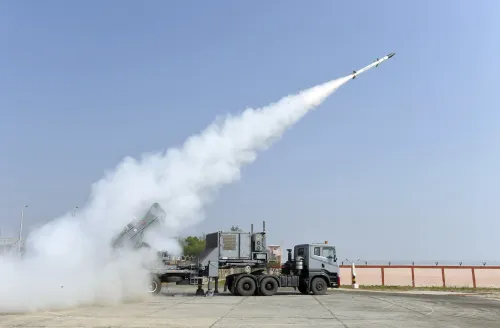
Is the Indian Army Set to Lead with Ramjet-Powered 155 mm Artillery Shells?

Synopsis
The Indian Army is on the verge of a monumental advancement by introducing ramjet-powered 155 mm artillery shells. This innovative step, developed in collaboration with IIT Madras, promises to enhance range and precision, marking a significant evolution in military capabilities. Discover how this technology could reshape warfare.
Key Takeaways
Enhanced Range: Ramjet technology could increase the range of 155 mm artillery shells by 30-50%.
Cost-Effective Solution: Reduces reliance on expensive missile systems.
Indigenous Development: Showcases India's commitment to self-reliance in defense technology.
Collaboration with Academia: Strengthens ties between the military and educational institutions.
Future Innovations: Potential for further advancements in artillery propulsion technology.
New Delhi, Jan 3 (NationPress) In a groundbreaking move towards enhancing military self-sufficiency, the Indian Army is poised to become the first military globally to utilize ramjet-powered artillery shells for its 155 mm artillery systems.
This venture is part of India’s larger Atmanirbharta (self-reliance) initiative and is being developed in partnership with the Indian Institute of Technology (IIT) Madras.
The new technology is expected to increase the range of standard artillery shells by 30 to 50 percent while preserving their destructive capabilities, representing a major advancement in battlefield effectiveness. Modernizing artillery has been a long-standing goal for the Indian Army.
Efforts have been aimed at boosting the range and precision of munitions to align with the requirements of contemporary combat. While traditional artillery shells are lethal, they fall short in range and accuracy when compared to modern missile systems.
By incorporating ramjet technology into 155 mm shells, the Army seeks to close this gap, enabling its artillery forces to engage targets at greater distances with enhanced efficiency. Although ramjet propulsion has been utilized in missiles for decades, applying this technology to artillery shells is a groundbreaking approach.
A ramjet functions as an air-breathing engine that operates without a compressor or turbine. It uses the forward velocity of the projectile to compress incoming air. As the shell reaches speeds of about Mach 2, the ramjet activates, burning fuel in the compressed air to generate thrust that prolongs and extends the shell's trajectory.
The project is led by IIT Madras in collaboration with the Army Technology Board (ATB). Ongoing developmental trials have already shown promising results at the Pokharan field firing ranges in Rajasthan.
These trials have confirmed the viability of retrofitting ramjet systems onto existing 155 mm shells, indicating that this technology can be integrated with the Army's current arsenal without necessitating the design of new munitions.
Once fully realized, this technology will be adaptable for use across various artillery systems within the Army, including the M777 ultra-light howitzer. This adaptability ensures that the innovation will enhance the overall artillery capabilities of the force rather than be limited to a specific platform.
The Indian Army operates artillery pieces with different calibers, including light artillery (up to 105 mm) for close troop support, medium artillery (106–155 mm) for bombardment, and heavy artillery (above 155 mm) for targeting strategic installations.
The ramjet-powered shell fits into the medium artillery category but offers performance that can compete with heavier systems, as a result of its extended range. This enables the Army to execute long-range strikes without deploying cumbersome heavy artillery systems.
Therefore, the rollout of ramjet-powered artillery shells significantly augments the Army’s capability for deep strikes, disrupts enemy supply lines, and neutralizes fortified positions from a safer distance.
This also mitigates dependence on costly missile systems for medium-range targets, presenting a cost-effective yet potent alternative. The advancement highlights India’s commitment to indigenous defense technologies.
Through collaboration with IIT Madras, the Army is not just advancing its own operational capabilities but also nurturing innovation within the nation’s academic and research sectors. This partnership between military and academia is a fundamental element of the Atmanirbharta initiative, aimed at diminishing reliance on foreign imports and fostering a robust domestic defense sector.
While the technology is still in the testing phase, its prospective applications are extensive. Once perfected, ramjet-assisted shells could be implemented across multiple artillery platforms, greatly enhancing India's firepower.
The modular design allows for the upgrading of existing 155 mm shells rather than requiring complete replacement, ensuring cost-effectiveness and rapid deployment. The success of this initiative could also lead to future advancements in artillery propulsion.
Concepts such as scramjet-assisted shells or hybrid propulsion systems may soon become viable, pushing the limits of artillery capabilities.
Point of View
It is essential to recognize the Indian Army's commitment to advancing its capabilities through indigenous technology. This initiative not only strengthens national defense but also fosters collaboration between the military and academic institutions, paving the way for a self-reliant defense ecosystem. Such advancements are crucial for maintaining India’s strategic edge.
NationPress
25 Oct 2026
Frequently Asked Questions
What are ramjet-powered artillery shells?
Ramjet-powered artillery shells are advanced munitions that use ramjet propulsion technology to significantly increase their range and effectiveness on the battlefield.
Who is developing this technology?
The development of ramjet-powered shells is a collaborative effort between the Indian Army and the Indian Institute of Technology (IIT) Madras.
What is the expected range increase for these shells?
The new ramjet-powered shells are expected to extend the range of conventional artillery by 30 to 50 percent.
How does ramjet technology work?
Ramjet technology uses the forward motion of the projectile to compress air, igniting fuel to create thrust that propels the shell further.
What are the implications for India's military strategy?
The introduction of ramjet-powered artillery enhances India's ability to conduct deep strikes and reduces dependence on expensive missile systems for medium-range targets.