India's 7.8% GDP growth in Q1 FY27: BJP hails Modi, Opposition cites inflation and joblessness

Synopsis
India's 7.8% GDP growth in Q1 FY27 tops every major economy — but the political battle over what that number actually means is just as significant. Opposition parties are not just questioning the figure; they are citing the RBI's own data showing household savings at a five-decade low and bank credit growth at 18%, arguing that Indians are literally borrowing to sustain a growth statistic.
Key Takeaways
India recorded 7.8 per cent GDP growth in the April–June quarter of FY27 , the highest among major economies globally.
China grew at 4.3 per cent , the US at 2.1 per cent , and most large European economies at around 1 per cent or less in the same period.
BJP and NDA leaders credited PM Modi and Finance Minister Nirmala Sitharaman 's policies for the growth milestone.
Opposition parties — including CPI , CPI(M) , Samajwadi Party , Congress , and AAP — argued that inflation, unemployment, and rising prices of essentials are not reflected in the headline figure.
AAP cited an RBI report showing household savings at their lowest in five decades and bank credit growth at 18 per cent , suggesting growth is being financed by debt.
80 crore citizens remain dependent on government food grains, according to AAP spokesperson Priyanka Kakkar .
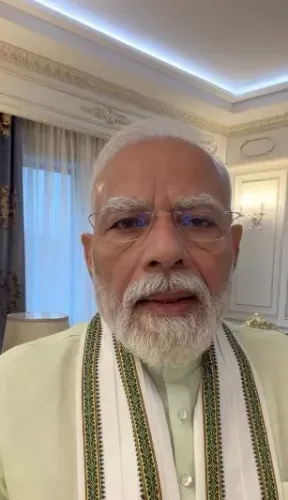
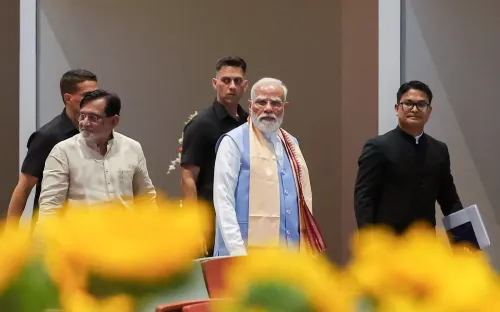
India posted a 7.8 per cent GDP growth in the April–June quarter of FY27, retaining its position as the world's fastest-growing major economy — a figure that sparked a sharp political divide on Tuesday, 1 September, with ruling Bharatiya Janata Party (BJP) and National Democratic Alliance (NDA) leaders crediting Prime Minister Narendra Modi and Finance Minister Nirmala Sitharaman, while Opposition parties argued the headline number bears little relation to the daily struggles of ordinary citizens.
How India Compares Globally
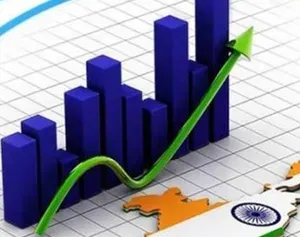
India's 7.8 per cent growth rate comfortably outpaces every other large economy tracked in the same period. Malaysia and Singapore grew at 6.0 per cent and 5.9 per cent respectively, Indonesia at 5.29 per cent, and China at 4.3 per cent. The United States recorded 2.1 per cent growth, while most large European economies expanded at around 1 per cent or less. This comparative advantage has become the centrepiece of the ruling coalition's political messaging.
What the Ruling Coalition Said
Uttar Pradesh Deputy Chief Minister Brijesh Pathak said India's economy was progressing continuously under Modi's leadership. 'Today, we are the fourth-largest economy in the world. The GDP growth has shown that under the leadership of Prime Minister Narendra Modi, we will fulfil the vision of Viksit Bharat,' he said.
Janata Dal (United) National General Secretary Shyam Rajak attributed the performance to the government's long-term economic vision. 'The determination and patience with which our Prime Minister and Finance Minister are working show that their dream is to make India a world leader by 2047,' Rajak said. JD(U) Chief Spokesperson Neeraj Kumar added that the figure demonstrated India's resilience at a time of global economic headwinds.
Union Minister Gajendra Singh Shekhawat pointed to structural policy reforms. 'We have introduced policy reforms to make India self-reliant and a manufacturing hub,' he said, adding that India had maintained its focus on manufacturing and exports despite geopolitical instability worldwide. Union Minister of State Satish Chandra Dubey and Bihar Minister Ram Kripal Yadav also credited the government's leadership, with Yadav specifically saluting both Modi and Sitharaman 'for their development-oriented policies.'
BJP leader T.R. Sriniwas directly targeted Congress leader Rahul Gandhi, saying: 'Rahul Gandhi, you have seen the GDP figures that came out yesterday. The growth rate is 7.8 per cent... please start taking economic classes, for God's sake, before you open your mouth, because the way our economy is growing and the way Western economies are growing, we are number one now.'
Opposition: Growth on Paper, Pain on the Ground
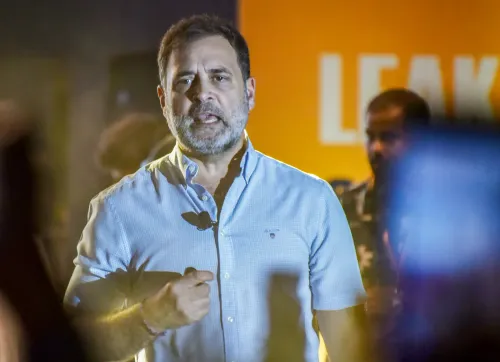
Opposition leaders across parties questioned whether the 7.8 per cent figure had translated into tangible relief for working-class and middle-class households. Communist Party of India (CPI) Rajya Sabha MP P. Santhosh Kumar said: 'The basic question is, how much is this beneficial to the common man? And to that question, the government is silent. Price rise is at its peak, unemployment, according to NITI Aayog, is also rising.'
CPI leader Annie Raja argued that GDP growth 'has nothing to do with the real life of the people of this country,' citing difficulties faced by the poor, working people, and the middle class. Communist Party of India (Marxist) Secretariat Member Ch Babu Rao called the government's framing 'completely misleading,' stating: 'Inflation, rising prices, unemployment and the devaluation of the rupee show that the economy is in crisis.' He further claimed that the benefits of growth were 'largely reaching corporates' while workers, farmers, and industry faced difficulties.
Samajwadi Party MP Awadhesh Prasad said the figures were 'very far removed from the ground reality,' and alleged that India's foreign policy and economy had become overly dependent on the United States. Punjab Indian National Congress (Congress) SC Department in-charge Sudhir Chaudhary questioned rising prices of essential commodities including onions, garlic, petrol, diesel, sugar, eggs, and milk, arguing that GDP growth must ultimately translate into relief for ordinary households.
AAP Raises RBI Data on Household Savings
Aam Aadmi Party (AAP) spokesperson Priyanka Kakkar raised a pointed question about the quality of growth, citing an RBI report. 'According to these figures, inflation in the country is low — do you see this reflected in the prices of onions, sugar, or petrol? ... When an RBI report states that household savings in our country are at their lowest in five decades, their own report reveals that to achieve this figure, it was shown that bank credit growth is at 18 per cent — meaning people are running their lives on loans,' she said. Kakkar also noted that 80 crore citizens remain dependent on government food grains, questioning whether this reality is captured in the headline GDP number.
What This Debate Signals
The divergence between a strong GDP print and Opposition narratives of inflation and unemployment is not new — similar tensions emerged after the post-pandemic growth rebound of FY23. This time, however, the Opposition's critique is anchored in specific data points: NITI Aayog unemployment figures, the RBI's household savings data, and credit growth numbers. Whether the government addresses these metrics directly — rather than defending the headline growth rate — will likely define the economic debate heading into the next electoral cycle.
Point of View
But the Opposition's counter-narrative this time is sharper than usual — because it is data-driven. Citing NITI Aayog's own unemployment figures and an RBI report on household savings hitting a fifty-year low, critics are not merely disputing the number; they are questioning the composition of growth. If credit expansion at 18 per cent is partly funding consumption that feeds into GDP, the sustainability question is legitimate. The government's response — largely celebratory rather than explanatory — leaves that question unanswered, and that gap is where the real political and economic debate will play out.
NationPress
17 Oct 2026
Frequently Asked Questions
What was India's GDP growth rate in Q1 FY27?
India recorded a GDP growth rate of 7.8 per cent in the April–June quarter of FY27, making it the fastest-growing major economy in the world during that period. This figure surpassed China (4.3%), Indonesia (5.29%), Singapore (5.9%), and Malaysia (6.0%).
Why is the Opposition criticising the 7.8% GDP growth figure?
Opposition leaders argue that the headline GDP number does not reflect the lived experience of ordinary citizens, pointing to rising inflation, unemployment data from NITI Aayog, and an RBI report showing household savings are at their lowest in five decades. They also highlight that bank credit growth stands at 18 per cent, suggesting that consumption — and thus GDP — may be partly debt-driven.
What did BJP and NDA leaders say about the GDP growth?
BJP and NDA leaders credited Prime Minister Narendra Modi and Finance Minister Nirmala Sitharaman's development-oriented policies for the growth. Leaders including UP Deputy CM Brijesh Pathak, JD(U)'s Shyam Rajak, and Union Minister Gajendra Singh Shekhawat cited long-term vision, manufacturing reforms, and export promotion as key drivers.
How does India's GDP growth compare with other major economies?
India's 7.8 per cent growth in Q1 FY27 leads all major economies. China grew at 4.3 per cent, Indonesia at 5.29 per cent, Singapore at 5.9 per cent, Malaysia at 6.0 per cent, and the United States at 2.1 per cent. Most large European economies grew at around 1 per cent or less.
What is the significance of the RBI household savings data cited by the Opposition?
AAP spokesperson Priyanka Kakkar cited an RBI report stating that household savings in India are at their lowest level in five decades. She argued this indicates that citizens are financing consumption — which contributes to GDP — through loans rather than income, raising questions about the quality and sustainability of the growth figure.