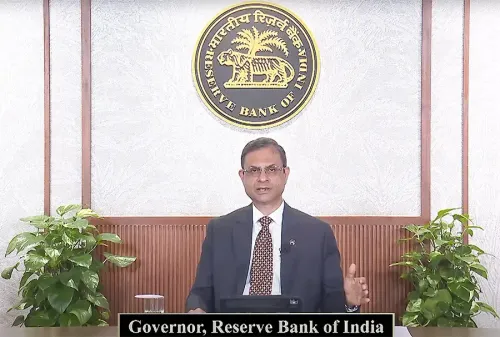
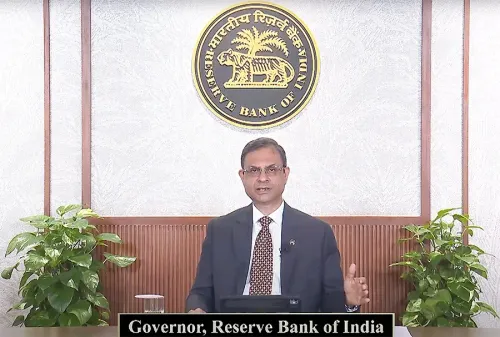
Is Inflation Staying Below RBI's Tolerance Level?

Synopsis
In the face of global challenges, India's CPI inflation remains below the RBI's desired range, offering a glimpse of economic stability. Experts predict that this trend will continue, driven by favorable supply conditions and upcoming GST reforms.
Key Takeaways
Current CPI inflation rate is 2.07% .
Inflation remains below RBI's 4% target .
Favorable supply-side conditions are aiding inflation control .
GST reforms may further reduce inflation .
Geopolitical factors influence economic stability .
New Delhi, Sep 12 (NationPress) The consumer price index (CPI) inflation remains below the Reserve Bank of India's (RBI) acceptable range of 2-6 percent in August, amidst challenging geopolitical circumstances, ensuring price stability, as per industry experts. CPI inflation registered at 2.07 percent for the month, despite adverse global conditions.
“The year-on-year CPI inflation for August remained within the RBI’s tolerance threshold, even with ongoing international policy instability,” stated Hemant Jain, President of PHDCCI.
The annual inflation rate, derived from the All-India Consumer Food Price Index (CFPI), was recorded at –0.69 percent (provisional) in August 2025 in comparison to August 2024, reinforcing the current low CPI inflation, Jain remarked.
He emphasized that the decline in prices for cereals and their products, pulses, and a moderation in costs related to clothing, housing, and fuel, compared to July 2025, have collectively contributed to keeping inflation within the RBI's acceptable limits.
Madhavi Arora, Chief Economist at Emkay Global Financial Services, noted that the persistent inflation undershoot relative to the RBI’s forecasts indicates that FY26 inflation is likely to be at least 50 basis points lower than the RBI's estimates.
Moreover, the trend of disinflation may be further reinforced by upcoming domestic GST rate reductions.
“We contend that the RBI’s focus on projected inflation for the next year seems increasingly misaligned with the changing global landscape, especially as Asia trends towards a disinflationary stance,” she added.
India’s CPI increased in August 2025 from 1.6 percent in July 2025, yet the inflation context remains benign.
“The increase was primarily food-driven, reflecting seasonal fluctuations, while inflation in housing, health, education, transport, and fuel has eased, indicating softer core pressures,” explained Mahendra Patil, Founder and Managing Partner of MP Financial Advisory Services LLP.
Arsh Mogre of PL Capital mentioned that the disinflationary momentum has been amplified by favorable supply conditions and a good monsoon season. With the GST reforms, even a 50-60 percent pass-through could reduce FY26 inflation projections by 20-30 basis points.
Data from the Ministry of Statistics indicated that CPI inflation rose slightly to 2.07 percent in August, despite a continued decrease in food prices during the month, alleviating the financial burden on consumers.
The headline inflation rate in August was marginally higher than the 1.61 percent retail inflation rate in July, marking the lowest level since June 2017.
Given that the inflation rate remains well below the 4 percent target, the RBI can continue to implement a soft monetary policy to foster growth.
Point of View
The ongoing inflation dynamics in India highlight a crucial balancing act. As the RBI navigates the pressures of a fluctuating global economy, maintaining price stability while fostering growth becomes paramount. The data suggests resilience in the face of challenges, reflecting the adaptability of India's economic framework.
NationPress
4 Oct 2026
Frequently Asked Questions
What is the current CPI inflation rate in India?
The current CPI inflation rate in India is 2.07 percent for August 2025.
How does the current inflation rate compare to RBI's target?
The inflation rate is well below the RBI's target of 4 percent.
What factors are influencing the CPI inflation rate?
Factors include favorable supply-side conditions, good monsoon seasons, and moderation in various product prices.
What is the significance of the GST reforms?
GST reforms may further decrease inflation projections by allowing better pricing structures.
How do geopolitical factors impact inflation?
Geopolitical factors can create uncertainties that influence economic stability and inflation rates.