Are India’s Energy Sourcing Decisions Driven by National Interest?
Synopsis
Foreign Secretary Vikram Misri emphasizes India's commitment to national interest in energy sourcing, focusing on diversification and competitive pricing. Amid potential reductions in Russian oil imports, India aims to secure stable energy supplies, underscoring its role in global energy markets.
Key Takeaways
India's energy policy focuses on national interest.
Emphasis on diversification and competitive pricing .
80-85% of energy needs are met through imports.
Strategic petroleum reserves can last for 74 days.
India plays a vital role in global energy markets .
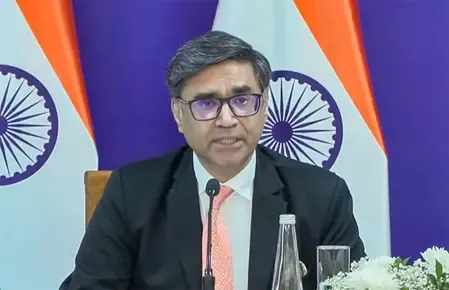
New Delhi, Feb 9 (NationPress) Foreign Secretary Vikram Misri stated on Monday that India's energy sourcing choices are influenced by the nation's interests, with a strong focus on diversification and competitive pricing. This statement came in light of reports indicating that India might scale back its Russian oil imports following a temporary trade agreement with the United States.
Addressing inquiries regarding Russian crude, the Foreign Secretary underscored that, as a developing economy and a major net importer, India must place a premium on stable and affordable energy supplies.
He asserted that safeguarding Indian consumers is “the government’s primary commitment,” revealing that India depends on imports for 80 to 85 percent of its energy requirements, a reliance that could lead to inflationary pressures.
Misri elaborated that the government aims to guarantee that “consumers obtain sufficient energy at the appropriate price and through dependable and secure supplies.”
He further clarified that the energy import policy is completely driven by these objectives.
Misri pointed out the global uncertainties affecting energy markets and highlighted India’s role in fostering price stability, noting, “India is not only one of the largest energy consumers but also serves as a crucial stabilizing entity within global energy markets.”
The Foreign Secretary stated, “The principal factors guiding our energy policy are ensuring adequate availability, fair pricing, and the reliability of supply.”
He also noted that energy sourcing is managed by both public and private sector oil companies, which make decisions based on current market conditions.
Misri confidently remarked, “Whether it is the government or our businesses, our choices will always be informed by national interests.”
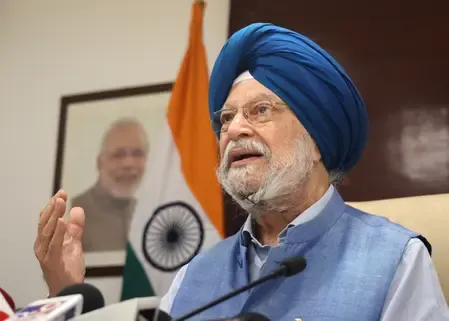
Minister of Petroleum and Natural Gas Hardeep Singh Puri informed the Rajya Sabha that India’s strategic petroleum reserves can sustain consumption for 74 days in case of global supply disruptions. The Indian Strategic Petroleum Reserves Limited (ISPRL) currently holds around 4.094 million metric tonnes of crude, equating to about 77 percent of total storage capacity.
Puri also highlighted that India ranks as the third-largest crude oil consumer and the fourth-largest refiner, with refining capacity expanding from 260 to 320 million metric tonnes annually.
Point of View
It is crucial to highlight that India's energy sourcing decisions are strategically aligned with national interests. The focus on diversification and competitive pricing is essential for ensuring stable energy supplies, especially in a fluctuating global market. This approach not only protects consumers but also reinforces India's position as a stabilizing force in international energy dynamics.
NationPress
21 Sept 2026
Frequently Asked Questions
What drives India's energy sourcing decisions?
India's energy sourcing decisions are primarily driven by national interests, focusing on diversification and competitive pricing.
How much of India's energy needs are met through imports?
India relies on imports for approximately 80 to 85 percent of its energy requirements.
What is the role of public and private sectors in energy sourcing?
Energy sourcing in India is managed by both public and private sector oil companies, which make decisions based on market conditions.
How long can India's strategic petroleum reserves last?
India's strategic petroleum reserves can sustain consumption for up to 74 days in the event of global supply disruptions.
What is India's position in global energy consumption?
India is the third-largest consumer of crude oil and the fourth-largest refiner in the world.