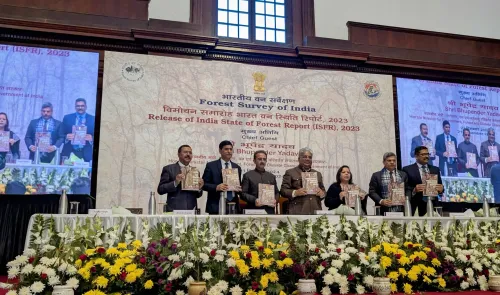
India's forest and tree cover stands at 25.17% of total area: ISFR 2023

Synopsis
India's forests and tree cover now span 8.27 lakh sq km — 25.17% of the country's land — and have grown by over 1,445 sq km since the last count. With 1,134 protected areas, 58 Tiger Reserves, and 150 elephant corridors now mapped, the data offers a rare moment of measurable conservation progress, even as infrastructure and mining pressures on forest land continue to mount.
Key Takeaways
India's forest and tree cover is 8.27 lakh sq km , equal to 25.17% of the country's total geographical area, per ISFR 2023 .
Cover increased by 1,445.81 sq km compared to the ISFR 2021 assessment.
Forest land diversion for infrastructure and non-forestry uses is regulated under the Van (Sanrakshan Evam Samvardhan) Adhiniyam, 1980 .
India now has 1,134 Protected Areas , 58 Tiger Reserves , and 33 Elephant Reserves .
32 tiger corridors and 150 elephant corridors have been identified to maintain ecological connectivity.
India's combined forest and tree cover stands at 8.27 lakh sq km, accounting for 25.17 per cent of the country's total geographical area, according to the India State of Forest Report (ISFR) 2023. The figure was disclosed in the Lok Sabha on 3 August by Minister of State for Environment, Forest and Climate Change Kirti Vardhan Singh in a written reply.
Key Findings from ISFR 2023
The ISFR 2023 data shows that India's forest and tree cover has grown by 1,445.81 sq km compared to the previous assessment under ISFR 2021. While the increase is incremental, it signals a continued upward trend in green cover across the country over successive biennial assessments.
How Forest Diversion Is Regulated
Singh told the House that diversion of forest land for non-forestry purposes — including infrastructure projects — is governed by the provisions of the Van (Sanrakshan Evam Samvardhan) Adhiniyam, 1980, along with rules and guidelines issued under it. Each proposal is evaluated on a case-to-case basis, with emphasis on minimising the requirement of forest land and avoiding or reducing forest fragmentation.
Mining in Forest Areas: The Appraisal Process
On the question of mining in forest areas, the Minister of State said proposals are assessed through statutory appraisal processes under the Van (Sanrakshan Evam Samvardhan) Adhiniyam, 1980, the Environment (Protection) Act, 1986, and the Wild Life (Protection) Act, 1972. Site-specific ecological features, likely impacts on wildlife and habitats, and proposed mitigation measures are all taken into account before any clearance is granted.
Protected Areas, Tiger and Elephant Reserves
Singh informed the Lok Sabha that the network of protected areas — comprising National Parks, Sanctuaries, Conservation Reserves, and Community Reserves — has expanded to 1,134 across the country. India currently has 58 Tiger Reserves and 33 Elephant Reserves. To maintain ecological connectivity, 32 tiger corridors and 150 elephant corridors have been identified, he added.
The government's approach, as outlined by the Minister, reflects a dual mandate: facilitating development while upholding statutory environmental safeguards. How effectively that balance holds as infrastructure demands intensify will remain a key question for policymakers and conservationists alike.
Point of View
445 sq km sounds encouraging until measured against the scale of forest land regularly diverted for roads, mines, and power lines. The case-by-case appraisal system the government cites has long been criticised for approvals that outpace rejections. The expansion of protected areas to 1,134 is a genuine milestone, but corridor identification alone does not guarantee connectivity if linear infrastructure bisects those very corridors. The ISFR methodology — which counts tree cover outside forests — also tends to flatter the headline number; the quality and density of that cover matters as much as the quantum.
NationPress
18 Sept 2026
Frequently Asked Questions
What does India's ISFR 2023 report say about forest cover?
The India State of Forest Report 2023 states that India's total forest and tree cover is 8.27 lakh sq km, representing 25.17% of the country's geographical area. This is an increase of 1,445.81 sq km over the ISFR 2021 assessment.
By how much has India's forest cover increased since the last report?
India's forest and tree cover increased by 1,445.81 sq km between the ISFR 2021 and ISFR 2023 assessments, according to Minister of State Kirti Vardhan Singh's statement in the Lok Sabha on 3 August.
How does India regulate diversion of forest land for infrastructure projects?
Forest land diversion is regulated under the Van (Sanrakshan Evam Samvardhan) Adhiniyam, 1980, and associated rules. Each proposal is evaluated individually, with emphasis on minimising forest land use and reducing fragmentation.
How many Tiger Reserves and Protected Areas does India have?
India currently has 1,134 Protected Areas, 58 Tiger Reserves, and 33 Elephant Reserves. Additionally, 32 tiger corridors and 150 elephant corridors have been identified to sustain ecological connectivity.
What laws govern mining proposals in forest areas in India?
Mining proposals in forest areas are assessed under the Van (Sanrakshan Evam Samvardhan) Adhiniyam, 1980, the Environment (Protection) Act, 1986, and the Wild Life (Protection) Act, 1972. Site-specific ecological impacts and mitigation measures are considered before any clearance is granted.