India's Inflation Rate Rises to 3.4% in March 2024: Key Insights
Synopsis
India's inflation rate has risen to 3.4% in March 2024, driven by steep increases in silver and gold jewellery prices. While food inflation shows mixed trends, the Reserve Bank of India projects a 4.6% inflation rate for 2026-27 amidst ongoing global challenges.
Key Takeaways
Inflation Rate: India's inflation reached 3.4% in March 2024.
Jewellery Prices: Silver jewellery prices soared by 148.61%.
Food Inflation: Overall food inflation was recorded at 3.87%.
RBI Projections: CPI inflation projected at 4.6% for 2026-27.
Core Inflation: Core inflation estimated at 4.4% for the same period.
New Delhi, April 13 (NationPress) The inflation rate in India, as per the latest Consumer Price Index (CPI) series with a base year of 2024, has increased to 3.4 per cent in March compared to the same month last year, according to information released by the Ministry of Statistics on Monday.
Among the commodities that experienced the most significant inflation this month were silver jewellery, which saw an astonishing 148.61 per cent rise in prices, while gold jewellery recorded a 45.92 per cent increase.
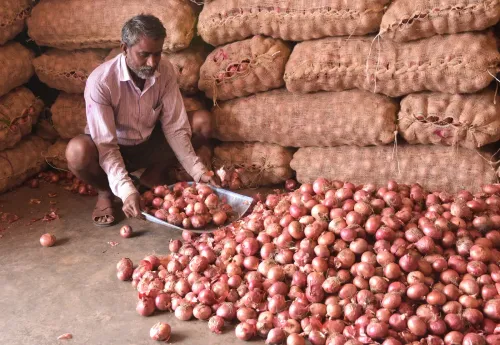
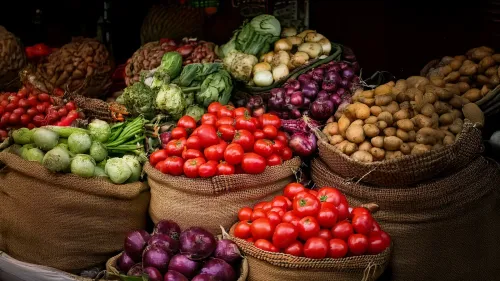
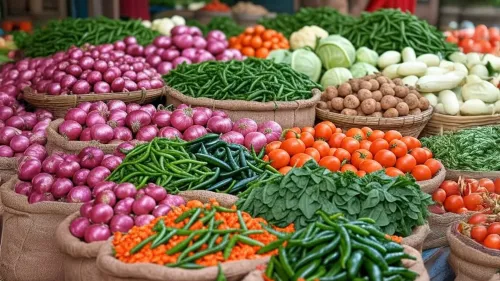
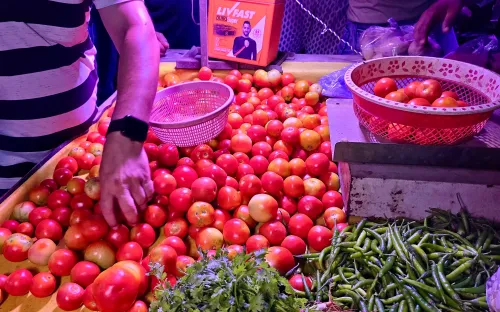
Food inflation for March was recorded at 3.87 per cent, primarily due to rising prices of vegetables like tomato and cauliflower. Conversely, the prices of onion, potato, and garlic saw a double-digit decrease compared to the previous year, along with a reduction in pulses. Specifically, the prices of arhar and tur daal fell by 9.56 per cent, while chickpea prices dropped by 7.87 per cent.
On a month-on-month basis, the inflation in March was slightly higher than the 3.21 per cent recorded in February, and the revised figure of 2.74 per cent for January, the month the new series was initiated.
Recently, the Reserve Bank of India (RBI) projected the country's inflation rate based on the CPI for the fiscal year 2026-27 to be 4.6 per cent. This projection is supported by improved near-term food supply prospects due to a strong rabi crop, even amidst increasing oil prices on the global stage due to the ongoing conflict in Iran.
RBI Governor Sanjay Malhotra commented: "The higher global energy prices have led to price hikes in certain fuels, such as premium petrol, LPG, and diesel for industrial purposes. However, the robust rabi crop enhances our near-term food supply outlook, offering some relief."
Considering these factors, the RBI projects CPI inflation for 2026-27 to be 4.6 per cent, with Q1 at 4.0 per cent, Q2 at 4.4 per cent, Q3 at 5.2 per cent, and Q4 at 4.7 per cent.
However, ongoing high energy prices due to the West Asia conflict and potential El Nino conditions, which could negatively affect the southwest monsoon, present upside risks to inflation, he noted.
Malhotra also stated that India’s core inflation, which excludes food and fuel prices, is expected to be 4.4 per cent for 2026-27. Excluding precious metals, it is even lower, indicating that the underlying inflation pressures are likely to remain contained.
Point of View
The recent rise in India's inflation rate to 3.4% is a crucial indicator of economic conditions. While some sectors face price hikes, particularly in jewellery, the mixed data on food inflation suggests a complex landscape for consumers and policymakers alike. The RBI's projections for the coming years highlight the balancing act needed to manage inflation amid global uncertainties.
NationPress
25 Sept 2026
Frequently Asked Questions
What is the current inflation rate in India as of March 2024?
As of March 2024, India's inflation rate stands at 3.4% based on the new Consumer Price Index.
Which commodities experienced the highest inflation in March 2024?
Silver jewellery saw the highest inflation at 148.61%, followed by gold jewellery at 45.92%.
What is the food inflation rate for March 2024?
The overall food inflation rate for March 2024 is 3.87%.
What does the RBI project for India's inflation rate for the fiscal year 2026-27?
The RBI projects India's inflation rate for 2026-27 to be 4.6%.
What factors are affecting inflation in India currently?
Current inflation is influenced by high global energy prices, local vegetable price fluctuations, and the robust rabi crop.