Is India Morally Responsible for Instilling Righteousness and Ethical Values?
Synopsis
In a thought-provoking address, Mohan Bhagwat, the Chief of RSS, emphasizes India's unique moral obligation to foster righteousness and ethical values worldwide. This compelling message resonates with the pressing need for a moral framework in today's society, urging individuals to lead by example rather than mere words. Explore the profound insights shared at the Festival of Righteousness.
Key Takeaways
India's moral responsibility is to promote righteousness globally.
Exemplary conduct is essential for instilling values, not just words.
The importance of coexistence and balance with nature.
Key pillars of Indian tradition include truth and non-violence .
Societal change requires universal moral principles beyond legal frameworks.
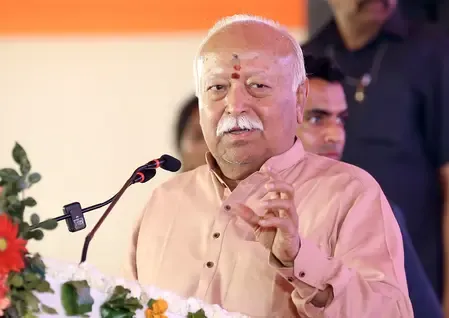
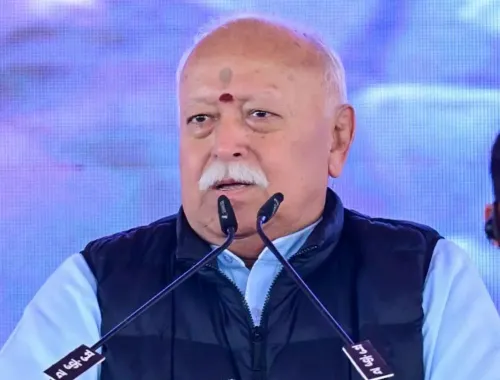
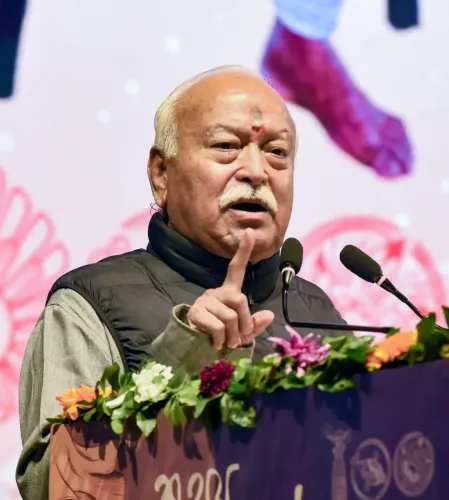
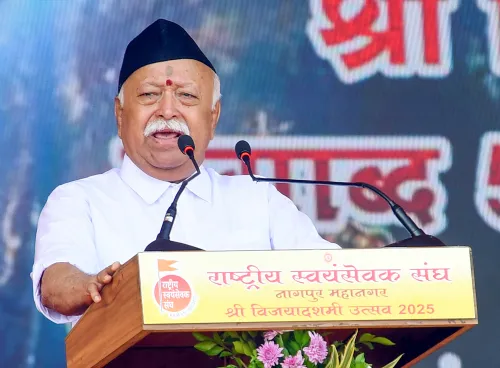
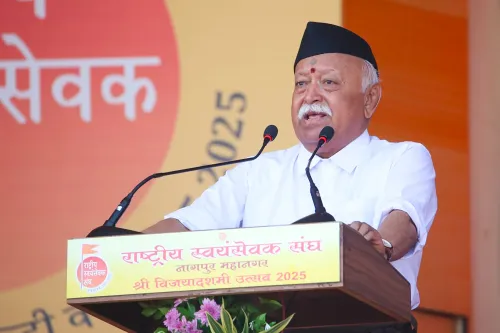
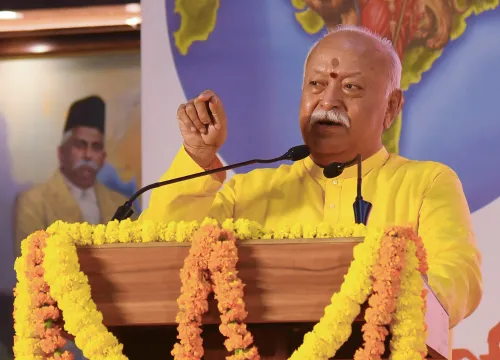
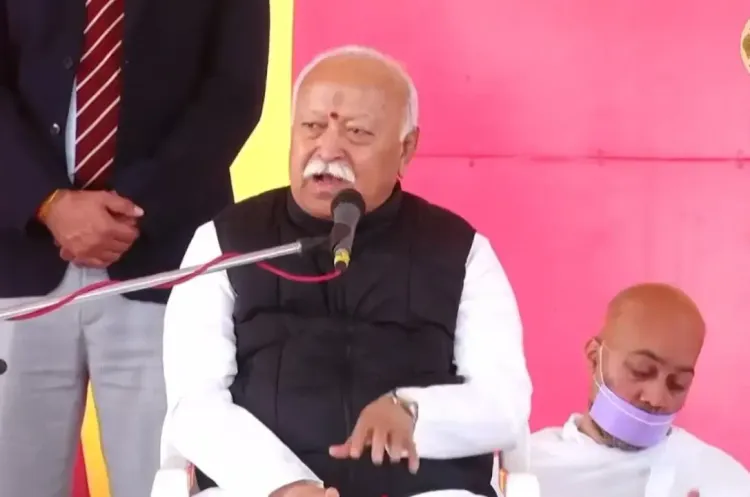
Jaipur, Jan 22 (NationPress) The Chief of Rashtriya Swayamsevak Sangh (RSS), Mohan Bhagwat, stated on Thursday that India holds a profound and historic obligation to promote righteousness and ethical values globally. This mission cannot be accomplished solely through speeches or literature; it necessitates an exemplary way of living.
Bhagwat made these remarks at the 162nd 'Maryada Mahotsav' (Festival of Righteousness) in Chhotikhatu, situated in Rajasthan's Didwana-Kuchaman district.
The event was attended by Acharya Mahashraman, the 11th Acharya of the Jain Shwetambar Terapanth sect, attracting a significant gathering of devotees from across the nation.
He emphasized that in India's civilizational legacy, truth and righteousness are not mere concepts but integral elements of life, rendering the Indian ethos uniquely significant on a global scale.
According to him, the current global conflicts and social discord cannot be resolved solely through technology, capital, or military might.
"What the world requires is a moral compass to navigate human behavior within the constraints of righteousness. India embodies this vision," Bhagwat remarked.
The RSS Chief noted that while eternal truths are timeless, their application must adapt to changing circumstances.
He pointed out that the relevance of any ideology is validated when the most exemplary individuals in society embody it.
"People are inspired not by sermons but by actions. Hence, those leading disciplined, moral, and spiritual lives are revered as role models in Indian society," he asserted.
Discussing development and environmental issues, Bhagwat remarked that imbalance is the root cause of today's global crises.
The unbridled quest for development has strained humanity's connection with nature, he added.
"Indian tradition advocates for coexistence and equilibrium. Instead of conflict with nature, harmony provides a sustainable solution — a notion that is more pertinent now than ever," he stated.
While acknowledging the necessity of material progress, he argued that it is not the ultimate objective of life.
"In Indian philosophy, wealth serves as a means, not an end, which clarifies the persistent spirit of charity, service, and philanthropy within Indian society," Bhagwat highlighted.
He articulated that the core belief of Indian philosophy is the oneness underlying visible diversity.
"This understanding cultivates restraint, compassion, and self-control. Recognizing that all creation stems from a single source naturally leads to balanced and humane behavior," he added.
He outlined truth, non-violence, non-stealing, non-possessiveness, celibacy, and self-discipline as fundamental tenets of Indian tradition, describing them as not only moral values but also the bedrock of social and environmental harmony.
Bhagwat pointed out that legal frameworks have their limitations and cannot address every facet of life.
"Beyond a certain limit, society requires the guidance of Dharma — universal moral principles beneficial to all, regardless of religion or belief," he explained.
He stressed that India has never attempted to impose its values on the world through coercion or military force.
"Instead, India has always sought to lead by example," Bhagwat concluded.
"When a society exemplifies through its actions that its values are advantageous for humanity, others will naturally follow suit," he remarked.
In closing, Bhagwat reiterated that for any idea to make a global impact, it must first be authentically lived.
"Only that which shines from within can illuminate others. Falsehood may yield temporary benefits, but only truth-guided actions ensure enduring well-being," he added.
Point of View
It is crucial to recognize the significance of this perspective in shaping societal values and fostering a more harmonious world.
NationPress
7 Oct 2026
Frequently Asked Questions
What did Mohan Bhagwat say about India's responsibility?
Mohan Bhagwat emphasized that India has a profound moral obligation to instill righteousness and ethical values globally, which can only be achieved through exemplary conduct.
What is the Festival of Righteousness?
The Festival of Righteousness, or 'Maryada Mahotsav,' is an event promoting ethical values, held annually, where significant individuals share insights on morality and righteousness.
Why does Bhagwat believe actions are more influential than words?
Bhagwat asserts that people are inspired by conduct rather than sermons, making it crucial for individuals to embody moral principles in their lives.
How does Bhagwat connect environmental issues to development?
He argues that the unrestrained pursuit of development has led to an imbalance in humanity's relationship with nature, advocating for a harmonious coexistence instead.
What are the core pillars of Indian tradition according to Bhagwat?
Bhagwat identifies truth, non-violence, non-stealing, non-possession, celibacy, and self-discipline as the foundational pillars of Indian tradition.