How Must We Understand Violence and Non-Violence in Context of Dharma?
Synopsis
Explore the profound insights shared by Mohan Bhagwat during the 162nd Maryada Mahotsav in Rajasthan, focusing on the relevance of Dharma in understanding violence and non-violence. Discover how the teachings of saints have shaped Indian values and societal conduct.
Key Takeaways
Dharma is vital in guiding principles of conduct.
Charity and service are integral to Indian culture.
Values such as truth and non-violence are deeply rooted in society.
India aims for global concern over self-interest.
Discipline is essential in both monarchy and democracy.
Jaipur, Jan 22 (NationPress) A significant and respectful event took place on the eve of the 162nd Maryada Mahotsav (Festival of Decorum) at Chhoti Khatu in the Nagaur district of Rajasthan on Thursday.
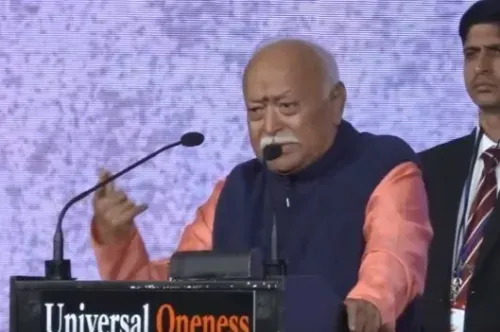
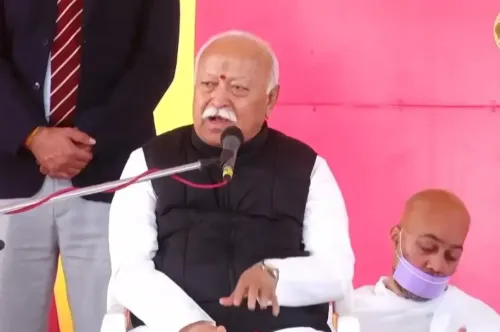
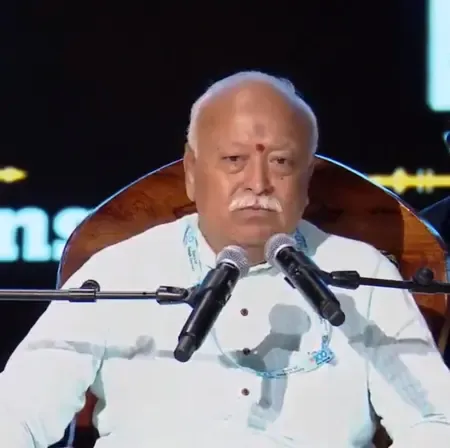
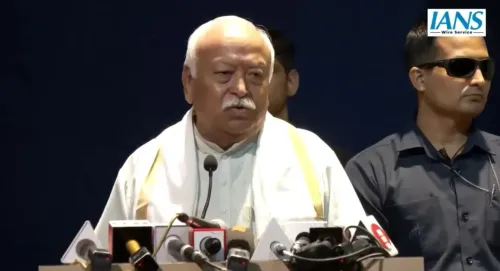
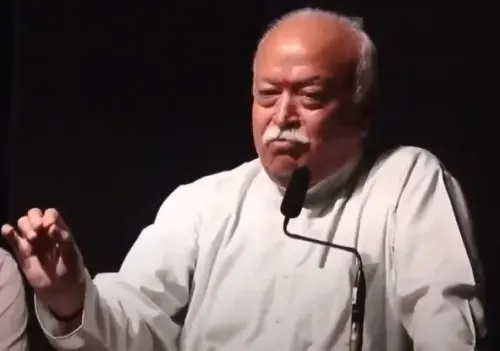
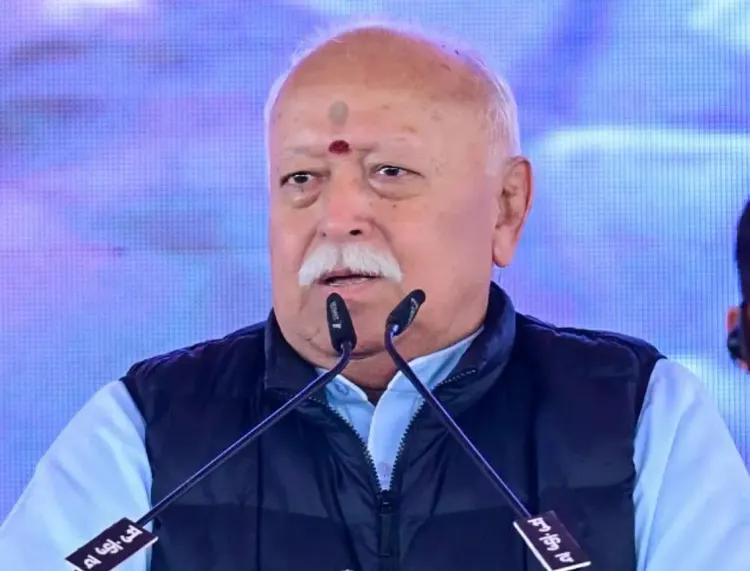
The gathering was honored by the presence of Acharya Mahashraman, with Rashtriya Swayamsevak Sangh (RSS) Sarsanghchalak Mohan Bhagwat delivering an insightful address.
In his speech, Bhagwat emphasized that India has historically led the world through the practice of decorum and righteous conduct. He remarked that throughout history, individuals have sought guidance from saints regarding values and discipline.
“While we learn to wield the stick in Sangh shakhas, we turn to saints for guidance on its purpose, the appropriate times for its use, and the limitations that should be adhered to,” he stated, underscoring that actions, not just words, inspire societal change.
He noted that the most exemplary individuals in Indian society have consistently lived by these values, serving as inspirational figures for others.
Bhagwat remarked that the mere pursuit of wealth does not align with India’s traditions; even those who are financially successful are encouraged to give back and contribute to society.
Charity and service are fundamental aspects of Indian culture, he added.
Highlighting the importance of truth, Bhagwat asserted that while truth is boundless, modern society often restricts itself to material and sensory experiences.
He pointed out that although people may seem diverse, they share a common essence, and embracing the idea that “everyone is our own” fosters discipline and compassion.
Bhagwat explained that values such as truth, non-violence, celibacy, non-stealing, and non-possession have been profoundly understood and practiced in India.
Dharma, he added, is the guiding principle that maintains righteousness and balance, noting that not all of life’s challenges can be resolved solely through legal means; many require the wisdom of Dharma.
Discussing the global context, Bhagwat stated that numerous nations operate based on self-interest, whereas India consistently follows a path of universal concern.
He cited India’s humanitarian efforts during global crises as a prime example of Dharma in practice. On the subject of environmental balance, he contrasted Western agricultural methods aimed at pest elimination with India's approach of maintaining ecological balance through controlled pest management.
This, he said, illustrates India’s broader philosophy of harmony rather than excess. Addressing the audience, Acharya Mahashraman, quoting a Sanskrit verse, remarked that wise words are invaluable like gems, often unrecognized by the ignorant.
A true guru, he stated, bestows words of welfare and genuine knowledge, steering society in the right direction. In India, he added, scriptures, sacred texts, and saintly teachings have always enriched human understanding and provided life guidance.
He elaborated that the tradition of Maryada Mahotsav dates back to Magha Shukla Saptami, initiated by the first Guru, while the festival was formally established by the fourth Guru, Dayacharya Ji. He stressed that discipline and decorum are vital in both monarchies and democracies.
Acharya Mahashraman stated that peace is humanity's ultimate goal. However, when the message of peace is not comprehended, firmness may become necessary. Non-violence should remain the nation's core principle, and aggression should never be instigated. Nevertheless, if national security is jeopardized, the armed forces must act decisively to safeguard citizens.
“For saints, absolute non-violence is crucial, but for householders and the state, the use of force may be essential for national protection,” he remarked, adding that strictness may sometimes be necessary for the greater good and enduring peace.
Earlier, Mansukh Bhai Sethia, the chairman of the organizing committee, welcomed guests and devotees, outlining the significance of the program.
Senior RSS officials, including Nandlal Babaji, Rajasthan regional secretary Jaswant Khatri, regional organizer Nimbaram, Jodhpur provincial head Hardayal, Didwana district head Ram Avtar Sarraf, and Nagaur district head Mukesh Bhati, attended alongside representatives from various social organizations and a large number of devotees and women.
Special focus was placed on ensuring no food was wasted during the event, a discipline diligently observed by devotees, including those who journeyed from outside Rajasthan.
Point of View
The teachings shared by Mohan Bhagwat resonate with the enduring principles of Dharma that have shaped Indian society. His emphasis on the balance between violence and non-violence highlights a critical understanding necessary for both individuals and the state. The call for compassion and discipline serves as a reminder of India's role as a moral compass in a world often swayed by self-interest.
NationPress
7 Oct 2026
Frequently Asked Questions
What is the significance of Maryada Mahotsav?
The Maryada Mahotsav, or Festival of Decorum, emphasizes the values of discipline and decorum in society, rooted in the teachings of Indian saints and culture.
Who is Mohan Bhagwat?
Mohan Bhagwat is the Sarsanghchalak (Chief) of the Rashtriya Swayamsevak Sangh (RSS), an influential cultural and social organization in India.
How does Bhagwat define Dharma?
Dharma is defined as the principle that maintains righteousness and balance, guiding individuals and society beyond mere legal frameworks.
What role do saints play in Indian culture according to Bhagwat?
Saints are seen as guiding figures for values and discipline, providing wisdom that shapes the moral fabric of society.
What insights did Bhagwat share about violence and non-violence?
Bhagwat explained that while non-violence is essential, there are circumstances where the use of force may be necessary for national security.