CM Yogi Shares Ancient Shloka on Dharma and Non-Violence
Synopsis
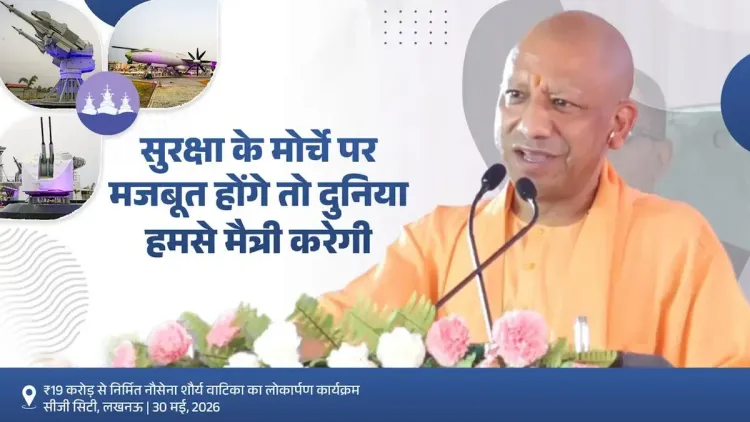
The Chief Minister's Office of Uttar Pradesh shared a Sanskrit shloka from the Mahabharata on 30 May 2026, with CM Yogi Adityanath invoking India's Rishi tradition to highlight both non-violence and righteous force as pillars of Dharma — continuing a pattern of civilizational messaging from the BJP-led state government.
Key Takeaways
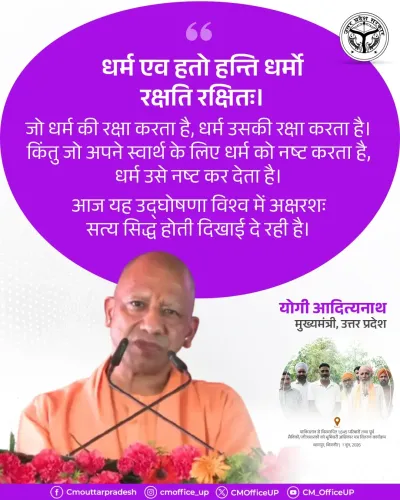
The CMOfficeUP account posted a Sanskrit shloka on 30 May 2026 attributed to CM Yogi Adityanath .
The verse — 'Ahimsa paramo dharmah, dharma himsa tathaiva cha' — is drawn from the Mahabharata .
It translates as: 'Non-violence is the highest Dharma; so too is violence in service of Dharma.' CM Yogi Adityanath has regularly used scriptural references in public messaging since taking office in 2017 .
No specific event or occasion was cited as the trigger for the post.
The post continues a broader BJP pattern of linking India's civilizational heritage to contemporary governance communications.
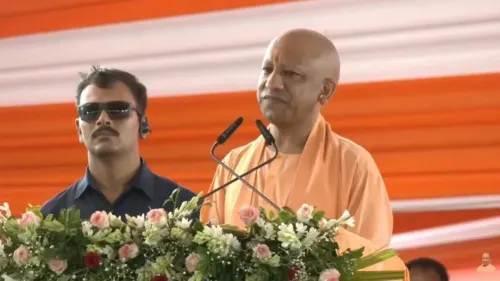
The Chief Minister's Office of Uttar Pradesh, on behalf of Chief Minister Yogi Adityanath, shared a Sanskrit shloka from India's ancient Rishi tradition on Saturday, 30 May 2026, emphasising the dual principle of non-violence and righteous force as core tenets of Dharma.
The post quoted the verse: 'Ahimsa paramo dharmah, dharma himsa tathaiva cha' — meaning 'Non-violence is the highest Dharma; so too is violence in service of Dharma.' The verse is drawn from the Mahabharata and is widely cited in Hindu philosophical discourse to articulate that while non-violence is a supreme value, the use of force in defence of righteousness is equally sanctioned by Dharmic tradition.
Context
The shloka attributed to India's Rishi tradition carries layered meaning. Its first half — 'Ahimsa paramo dharmah' — is among the most recognised phrases in Indian ethical thought, associated with figures from Mahatma Gandhi to ancient sages. The second half, often left unquoted in popular usage, asserts that dharma himsa — violence in the service of Dharma — is equally valid, providing a philosophical basis for just force.
The Chief Minister's Office shared the verse as a standalone reflection attributed directly to CM Yogi Adityanath, without specifying an immediate occasion or event as the trigger for the post.
Policy Backdrop
Since 2017, CM Yogi Adityanath — head of the Gorakhnath Math and a prominent BJP leader — has consistently woven references to Hindu scripture, philosophy, and civilizational heritage into his public communications and governance messaging. Posts invoking Sanskrit shlokas and ancient texts have been a recurring feature of the CMOfficeUP social media presence.
This pattern reflects a broader approach by BJP-governed states to position India's classical philosophical tradition as directly relevant to contemporary governance and public life. The Mahabharata verse in particular has appeared in political discourse across the ideological spectrum when addressing questions of law, order, and the state's legitimate use of authority.
Stakeholders and Impact
The post is addressed to the citizens of Uttar Pradesh and the wider Indian public. For the state's large population, such messaging reinforces the Chief Minister's identity as a religious and cultural figure alongside his role as an administrator.
The verse's dual emphasis — on non-violence and on righteous force — resonates with multiple audiences: those who prioritise peaceful coexistence and those who support firm state action against crime and disorder, both of which have been central themes of the Yogi Adityanath government's public positioning since 2017.
What's Next
Observers will watch whether this philosophical messaging precedes any state-level announcement on cultural programming, law-and-order policy, or public events in Uttar Pradesh that invoke traditional Dharmic values. The CMOfficeUP account has previously used such posts as thematic framing ahead of larger policy or ceremonial communications.
Point of View
The messaging appeals across a wide spectrum without committing to a specific policy action. This form of ambient cultural signalling has become a consistent tool in BJP-governed states to reinforce civilizational branding between hard news cycles. Whether it precedes a concrete policy or ceremonial announcement in Uttar Pradesh remains to be seen.
NationPress
19 Sept 2026
Frequently Asked Questions
What does 'Ahimsa paramo dharmah dharma himsa tathaiva cha' mean?
It is a Sanskrit verse from the Mahabharata meaning 'Non-violence is the highest Dharma; so too is violence in service of Dharma.' It acknowledges non-violence as a supreme value while also sanctioning the use of force when it serves righteous ends.
Why did CM Yogi Adityanath post this shloka?
The Chief Minister's Office of Uttar Pradesh shared the verse on 30 May 2026 as a reflection attributed to CM Yogi Adityanath, invoking India's Rishi tradition. No specific occasion was cited in the post.
Where is this shloka from?
The verse 'Ahimsa paramo dharmah, dharma himsa tathaiva cha' is widely attributed to the Mahabharata and is one of the most cited shlokas in Hindu philosophical and ethical discourse.
Does CM Yogi Adityanath often post Sanskrit shlokas?
Yes. Since becoming Chief Minister of Uttar Pradesh in 2017, Yogi Adityanath and his office have regularly shared Sanskrit verses and references to Hindu scripture as part of their cultural governance messaging on social media.
What is the significance of this verse in Indian politics?
The verse is significant because its dual meaning — endorsing both non-violence and righteous force — has been invoked across India's political spectrum when discussing law, order, and the state's authority, making it a philosophically versatile reference point.