Is India's 5th-century ‘stitched’ vessel reviving ancient maritime ties with Oman?
Click to start listening
Synopsis
Witness the remarkable maiden voyage of India's INSV Kaundinya, a stitched sail vessel inspired by ancient maritime traditions, as it embarks on a historic journey to Oman. This endeavor not only revives India's rich cultural heritage but also strengthens ties with Oman, showcasing centuries of shared history and diplomacy.
Key Takeaways
- INSV Kaundinya completed a successful maiden voyage to Oman.
- This voyage symbolizes 5,000 years of maritime ties between India and Oman.
- Constructed using ancient techniques, the vessel highlights India's craftsmanship.
- The project aims to reconnect India with its maritime past.
- The warm reception in Oman underscores the importance of cultural diplomacy.
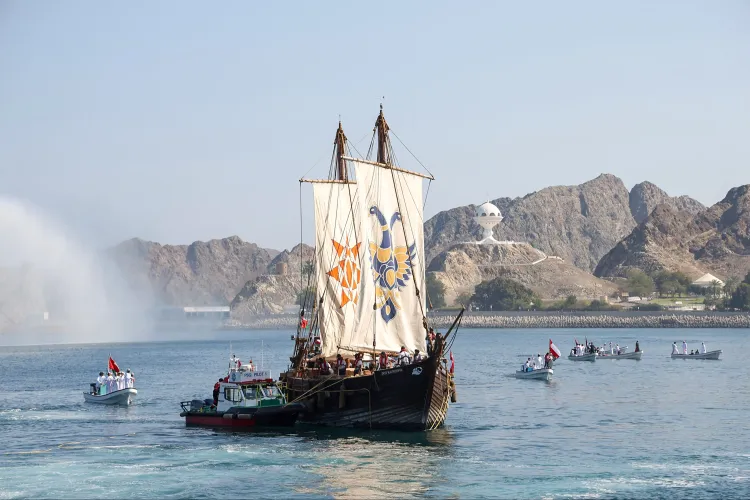
New Delhi, Jan 14 (NationPress) The Indian Naval Sailing Vessel (INSV) Kaundinya has triumphantly concluded its inaugural journey from Porbandar, Gujarat, to Muscat, Oman, marking a significant achievement in India’s maritime diplomacy and the revival of its cultural heritage. This stitched sail vessel, envisioned by Prime Minister Narendra Modi and inspired by a fifth-century ship depicted in the Ajanta cave paintings, reached Muscat after a remarkable 17-day expedition across the Arabian Sea.
Randhir Jaiswal, spokesperson for the Ministry of External Affairs, announced the arrival of INSV Kaundinya in Muscat via a post on his X handle. He stated, “A Voyage Across Time: Seas That Connect, Histories That Endure,” and added, “The Indian Naval Sailing Vessel (INSV) Kaundinya has successfully completed its maiden voyage from Porbandar and has arrived in Muscat today.”
He further elaborated, “Envisioned by PM @narendramodi, this traditionally constructed stitched sail vessel stands as a powerful symbol of 5,000 years of maritime, cultural, and civilizational connections between India and Oman.” The vessel received a warm welcome from Minister of Ports, Shipping, and Waterways, Shri @sarbanandsonwal, along with other dignitaries from Oman.
Jaiswal also provided intriguing details about INSV Kaundinya. This is no ordinary ship; it was built using ancient techniques that eschew nails or metal fastenings, with wooden planks stitched together using coir rope, coconut fiber, and natural resin. This method, once prevalent in Indian Ocean shipbuilding, exemplifies India’s indigenous craftsmanship and sustainable practices.
The sails of INSV Kaundinya showcase motifs of the Gandabherunda and the Sun, while its bow features a sculpted Simha Yali. Additionally, a Harappan-style stone anchor embellishes the deck, with each component reflecting India’s rich maritime heritage. The vessel is named after the legendary Indian mariner Kaundinya, known for sailing across the Indian Ocean to Southeast Asia centuries ago. Thus, the vessel encapsulates India’s long-standing tradition of maritime exploration and cultural exchange. This voyage was more than just a naval exercise; it was a cultural mission.
The project commenced in 2023 through a tripartite agreement among the Ministry of Culture, the Indian Navy, and Hodi Innovations, with artisans from Kerala leading the construction. Prime Minister Modi envisioned this initiative as a means to reconnect India with its maritime past and fortify ties with Oman, a nation historically linked to India through the trade of spices, textiles, and precious stones.
The 17-day journey from Porbandar to Muscat retraced ancient trade routes once traversed by Indian merchants and sailors. Sailing without modern propulsion, the vessel relied solely on wind and traditional rigging, testing both the crew's endurance and the seaworthiness of the stitched design.
The Indian Navy oversaw the voyage, ensuring safety while maintaining authenticity. Earlier hydrodynamic model testing at IIT Madras validated the design, proving that ancient techniques can endure modern maritime conditions.
India and Oman are bound by centuries-old maritime connections. Archaeological evidence suggests Indo-Omani trade dates back to the Bronze Age, with Harappan artifacts discovered in Omani sites. The warm reception of the vessel in Oman underscored the importance of cultural diplomacy in strengthening bilateral relations.
The voyage coincided with the strengthening of strategic cooperation between the two countries in energy, defense, and trade. Future voyages are anticipated to trace other ancient trade routes across the Indian Ocean, linking India with Southeast Asia and Africa.
Point of View
I believe that the successful voyage of INSV Kaundinya exemplifies India's commitment to cultural diplomacy and maritime heritage. This initiative reinforces our historical connections with Oman and showcases our ability to blend tradition with modernity. It is a testament to our enduring maritime spirit and the importance of fostering international relationships through cultural exchanges.
NationPress
14/01/2026
Frequently Asked Questions
What is INSV Kaundinya?
INSV Kaundinya is an Indian Naval Sailing Vessel that recently completed its maiden voyage from Porbandar to Muscat, inspired by ancient shipbuilding techniques.
Who commissioned the construction of INSV Kaundinya?
The project was initiated in 2023 through a tripartite agreement between the Ministry of Culture, the Indian Navy, and Hodi Innovations.
What ancient techniques were used in building the vessel?
The vessel was constructed using traditional techniques, stitching wooden planks together with coir rope, without the use of nails or metal fastenings.
What historical significance does the voyage hold?
The voyage retraced ancient trade routes used by Indian merchants and sailors, highlighting the long-standing maritime connections between India and Oman.
What are the future plans for similar voyages?
Future voyages are expected to trace other ancient trade routes across the Indian Ocean, enhancing cultural ties with Southeast Asia and Africa.