India's draft steel policy targets 604 MT capacity, net-zero path by 2047
Synopsis
India's draft National Steel Policy 2047 doesn't just set a capacity target — it reframes the entire sector as a climate, trade, and technology challenge. With crude steel output targeted at 604 MT by 2047 and carbon intensity to be cut by 39%, the policy demands a simultaneous industrial scale-up and decarbonisation, while tackling a near-total coking coal import dependence that has long been a structural weak point.
Key Takeaways
India's draft National Steel Policy 2047 targets crude steel capacity of 604 MT by 2047 — up from 220 MT currently, a near threefold increase.
Finished steel demand is projected at 505 MT by 2047; per capita consumption expected to reach 302 kg .
Carbon-emission intensity target: 1.54 tonnes of CO₂ per tonne of crude steel by 2047, down from 2.54 tonnes currently.
India imports roughly 92% of its coking coal; the draft proposes domestic mining expansion, washeries, AI-optimised blending, and long-term supply deals to reduce this dependence.
Iron ore demand projected to rise from 299 MT in 2025 to 772 MT by 2047, with overseas asset acquisition and slurry pipeline expansion proposed.
Steel exports are expected to rise by 45 MT ; policy also prioritises speciality steel , Industry 4.0 , and international technology cooperation.
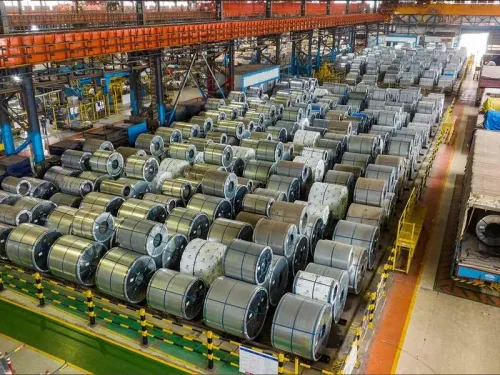
India's National Steel Policy 2047 draft, unveiled by the government on 11 October 2026, sets an ambitious target of raising the country's crude steel capacity nearly threefold — from the current 220 million tonnes (MT) to 604 MT by 2047. The policy lays out a comprehensive roadmap covering raw material security, decarbonisation, digital transformation, and value-added steel production.
Capacity and Demand Projections
According to the draft policy, finished steel demand is projected to climb to 505 MT by 2047, with per capita steel consumption expected to reach 302 kg — up sharply from current levels. Steel exports are also forecast to rise by 45 MT, underscoring the sector's potential as a global supply player. India is already the world's second-largest producer and consumer of steel, and the new targets signal ambitions to cement that position through 2047, the centenary of independence.
Raw Material Security: Iron Ore and Coking Coal
Raw materials — primarily iron ore and coking coal — account for over 65–70% of the cost of steel production, making their supply a strategic priority. While India is largely self-sufficient in iron ore, it currently imports roughly 92% of its coking coal requirement — a significant vulnerability the draft policy directly addresses.
Iron ore demand is projected to surge to 772 MT by 2047 from 299 MT in 2025. To secure supply, the policy proposes acquiring overseas iron ore assets, forming joint ventures, and expanding slurry pipeline infrastructure to reduce dependence on road and rail logistics. On the coking coal side, demand is expected to nearly triple to 236 MT. The draft outlines plans to scale up domestic mining, expand coal washeries, pursue long-term supply agreements, and deploy artificial intelligence to optimise coal blending — steps that could partially reduce import exposure over the policy horizon. Other inputs such as manganese and limestone are also flagged for sustained policy attention.
Decarbonisation and Emissions Targets
The draft commits to cutting average carbon-emission intensity in the steel sector from the current 2.54 tonnes of CO₂ per tonne of crude steel to 1.54 tonnes by 2047 — a reduction of roughly 39%. This is framed as consistent with India's broader net-zero emissions goal for 2070.
The decarbonisation roadmap includes improving energy efficiency, increasing renewable electricity use in steelmaking, promoting scrap-based electric arc furnace production, and piloting hydrogen-based steelmaking and carbon capture and storage technologies. These low-carbon pathways will need to scale in parallel with capacity expansion, and the draft acknowledges this as a significant structural challenge for the industry.
Value-Added Steel and Digital Push
The policy places emphasis on expanding production of speciality steel and stainless steel to reduce dependence on imports of both raw materials and technology. Steel quality standards are to be reinforced through revised Indian Standards and strengthened conformity assessment mechanisms.
Digital transformation is identified as an emerging priority, with the draft calling for investment in digital infrastructure, common data standards, and Industry 4.0 adoption — powered by trusted AI systems and autonomous production technologies. International cooperation in raw material diversification, trade, and technology is also outlined as a growing priority area in the years ahead.
What Happens Next
The draft National Steel Policy 2047 is open for stakeholder consultation before finalisation. Industry bodies, steel producers, and environmental groups are expected to weigh in on the feasibility of the emissions targets and the pace of raw material transition. If adopted, the policy would represent the most sweeping overhaul of India's steel sector strategy in decades, with implications for infrastructure, manufacturing, employment, and the country's climate commitments.
Point of View
And no policy commitment has meaningfully dented that dependence in years. The draft's AI-driven blending and washery expansion proposals are directionally sound but require execution capacity the sector has historically lacked. More critically, scaling capacity threefold while simultaneously cutting carbon intensity by 39% is a dual mandate that very few steel economies have managed — the policy's credibility will hinge on whether the decarbonisation roadmap has binding milestones or remains aspirational. Stakeholder consultation will reveal whether the industry sees the net-zero trajectory as achievable, or as a target that will be quietly revised as 2047 approaches.
NationPress
11 Oct 2026
Frequently Asked Questions
What is India's draft National Steel Policy 2047?
It is a government-released draft policy that targets raising India's crude steel capacity from around 220 million tonnes to 604 million tonnes by 2047, while cutting carbon-emission intensity and securing raw material supply. The policy covers decarbonisation, digital transformation, value-added steel, and international cooperation.
Why is coking coal a concern in the steel policy?
India currently imports approximately 92% of its coking coal requirement, making it a major cost and supply risk for the steel sector. The draft proposes domestic mining expansion, coal washeries, long-term supply agreements, and AI-based coal blending to reduce this import dependence over the policy horizon.
What are the emissions targets under the new steel policy?
The policy targets a reduction in average carbon-emission intensity from 2.54 tonnes of CO₂ per tonne of crude steel today to 1.54 tonnes by 2047 — a roughly 39% cut — aligned with India's net-zero emissions goal for 2070. Measures include renewable energy adoption, scrap-based steelmaking, hydrogen technologies, and carbon capture.
How much will steel demand and exports grow by 2047?
Finished steel demand is projected to reach 505 million tonnes by 2047, with per capita consumption rising to 302 kg. Steel exports are expected to grow by 45 million tonnes, reflecting India's ambition to expand its role as a global steel supplier.
What is the current status of the draft policy?
The National Steel Policy 2047 is in draft form and is subject to stakeholder consultation before it is finalised. Industry bodies, producers, and environmental groups are expected to submit their views on the feasibility of the capacity and emissions targets.