INS Dunagiri commissioned: India's Project 17A stealth frigate vs 1977 original
Synopsis
The new INS Dunagiri is not a refit — it is a reinvention. At 6,670 tonnes, armed with BrahMos missiles and built with 75 per cent indigenous content, it outclasses its 1977 Leander-class namesake in every dimension. Its commissioning by PM Modi in Kolkata marks a defining moment in India's drive to build blue-water naval power at home.
Key Takeaways
PM Narendra Modi will commission INS Dunagiri in Kolkata on 22 June 2025 , alongside INS Sanshodhak and INS Agray .
The new frigate is a Nilgiri-class, Project 17A stealth warship built by GRSE , displacing 6,670 tonnes — more than double the 2,692 tonnes of the 1977 original.
It carries BrahMos supersonic cruise missiles , MRSAM VLS cells , and a 127 mm main gun, replacing the older vessel's 115 mm Vickers guns and zero anti-ship missiles.
Indigenous content stands at nearly 75 per cent , including DMR 249A steel hull, HUMSA-NG sonar, Shakti EW Suite , and CODOG propulsion management.
The vessel can operate two multi-role helicopters (MH-60R Seahawk or ALH Dhruv Mk-III), compared to the single helicopter capacity of the F36 .
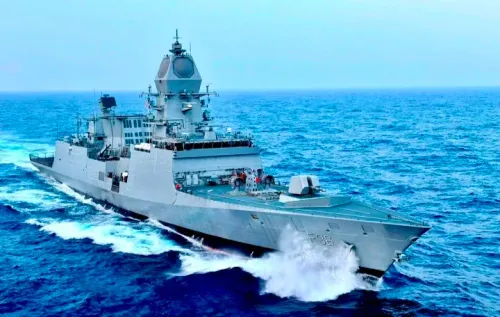
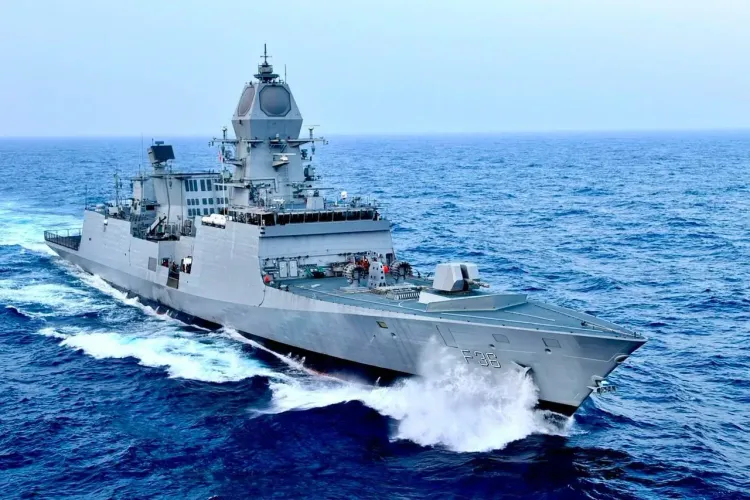
Prime Minister Narendra Modi is set to commission the stealth frigate INS Dunagiri into the Indian Navy in Kolkata on Sunday, 22 June 2025, marking the rebirth of a warship name first carried by a vessel commissioned 49 years ago. The new Nilgiri-class guided-missile frigate, built under the Navy's Project 17A, is a radar-evading, digitally integrated warship that shares little beyond its name with its steam-powered predecessor.
A Name, Two Eras
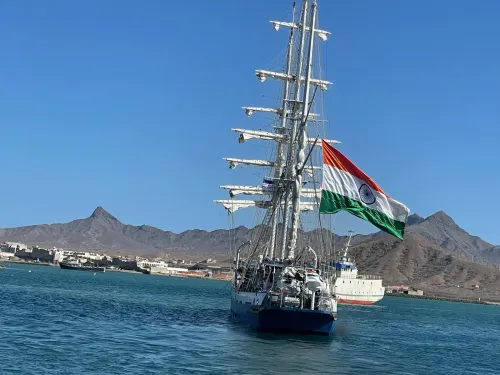
The original INS Dunagiri (F36) was a Leander-class frigate built by Mazagon Docks in 1977 under a foreign design licence. It measured 113.38 metres in length and displaced 2,692 tonnes. The new warship, constructed by Garden Reach Shipbuilders and Engineers (GRSE) Ltd in Kolkata, stretches 149 metres and displaces 6,670 tonnes — more than double its predecessor's bulk. GRSE delivered the vessel on 30 March 2025 alongside two other warships, INS Sanshodhak and INS Agray, which will also be commissioned by the Prime Minister at the same ceremony.
Stealth vs Steel: What Changed in 49 Years
The contrast in survivability is stark. According to an official, the old ship had 'a traditional steel superstructure that lit up brightly on enemy radar screens,' while the new frigate features 'complex stealth geometry and is built with radar-absorbent materials to significantly reduce its radar cross-section — made to act like a ghost on the water.'
In firepower, the leap is equally dramatic. The F36 relied on twin 115 mm Vickers guns and lacked advanced anti-ship missiles entirely. The new INS Dunagiri carries a rapid-firing 127 mm main gun, BrahMos supersonic cruise missiles for long-range surface strikes, and Vertical Launch System (VLS) cells loaded with Medium Range Surface to Air Missiles (MRSAMs). The older frigate could embark only a single Sea King or Chetak helicopter; the Nilgiri-class vessel has a larger deck capable of operating and servicing two multi-role helicopters, including the MH-60R Seahawk or ALH Dhruv Mark-III.
The Indigenous Content Story
With nearly 75 per cent indigenous content, the new INS Dunagiri is a flagship demonstration of India's Aatmanirbhar Bharat defence push. Its structural hull was fabricated using domestically produced DMR 249A shipbuilding steel. The ship's Integrated Platform Management System (IPMS) — developed indigenously — manages and automates the vessel's Combined Diesel or Gas (CODOG) propulsion system, auxiliary systems, and power generation through a unified digital interface.
The Controllable Pitch Propellers (CPP) were manufactured and integrated locally, with blades that dynamically adjust pitch for fuel efficiency during quiet cruising or high-speed tactical manoeuvres. Onboard systems include the indigenous HUMSA-NG Sonar Suite, the Shakti Electronic Warfare (EW) Suite, a 76 mm Super Rapid Gun Mount (SRGM), and twin 12.7 mm Stabilised Remote-Controlled Guns (SRCG). The flight deck and telescopic hangar were indigenously re-engineered to support the Advanced Light Helicopter Dhruv Mk-III, significantly expanding over-the-horizon surveillance and anti-submarine warfare capabilities.
What This Signals for India's Naval Ambitions
The commissioning of INS Dunagiri is part of a broader push to modernise the Indian Navy with domestically built platforms. Project 17A covers a class of seven frigates — four being built by Mazagon Docks in Mumbai and three by GRSE in Kolkata. The programme represents one of the most ambitious indigenous warship construction efforts in India's post-independence history. With the induction of the new INS Dunagiri, the Navy adds a potent, multi-domain combatant to its order of battle at a time of heightened maritime competition in the Indo-Pacific.
Point of View
It would represent a genuine structural shift in how India builds warships, not just buys them. The comparison with the 1977 Leander-class frigate flatters the new vessel, but the real benchmark is not the past — it is whether India can sustain this production tempo and close the gap with China's naval build rate, which outpaces India's by a wide margin.
NationPress
19 Sept 2026
Frequently Asked Questions
What is INS Dunagiri and when will it be commissioned?
INS Dunagiri is a Nilgiri-class, guided-missile stealth frigate built under the Indian Navy's Project 17A by Garden Reach Shipbuilders and Engineers (GRSE) in Kolkata. It is scheduled to be commissioned by Prime Minister Narendra Modi in Kolkata on 22 June 2025, along with INS Sanshodhak and INS Agray.
How does the new INS Dunagiri differ from the original 1977 warship?
The original INS Dunagiri (F36) was a Leander-class, steam-powered frigate displacing 2,692 tonnes and measuring 113.38 metres, built under a foreign design licence. The new vessel displaces 6,670 tonnes, stretches 149 metres, features stealth geometry, radar-absorbent materials, BrahMos missiles, and carries nearly 75 per cent indigenous content — a fundamental transformation in every dimension.
What weapons does the new INS Dunagiri carry?
The new INS Dunagiri is armed with BrahMos supersonic cruise missiles for long-range surface strikes, Vertical Launch System (VLS) cells for Medium Range Surface to Air Missiles (MRSAMs), a rapid-firing 127 mm main gun, a 76 mm Super Rapid Gun Mount (SRGM), and twin 12.7 mm Stabilised Remote-Controlled Guns (SRCG).
What indigenous systems are on board the new INS Dunagiri?
The frigate features approximately 75 per cent indigenous content, including a hull built from DMR 249A shipbuilding steel, an Integrated Platform Management System (IPMS), Controllable Pitch Propellers (CPP), the HUMSA-NG Sonar Suite, the Shakti Electronic Warfare Suite, and a re-engineered flight deck and telescopic hangar for the ALH Dhruv Mk-III helicopter.
What is Project 17A and how many frigates does it cover?
Project 17A is an Indian Navy programme to build seven advanced stealth frigates indigenously — four at Mazagon Docks in Mumbai and three at GRSE in Kolkata. INS Dunagiri is one of the GRSE-built vessels and represents one of the most ambitious indigenous warship construction programmes in India's post-independence history.