Smriti Irani highlights Adivasi village in Hooghly lit up for Diwali
Synopsis
BJP leader Smriti Irani highlights that Adivasi families in Chakdah village, Hooghly, West Bengal, received electricity for the first time this Diwali — 75 years after Independence — and uses it to indict successive state governments for failing the most basic development benchmarks.
Key Takeaways
Adivasi families in Chakdah village, Hooghly district, West Bengal , reportedly received electricity for the first time, celebrating Diwali 2026 with electric light in their homes.
BJP leader Smriti Irani posted on 6 November 2026 , framing the development as an indictment of decades of governance failure by successive state governments.
The Saubhagya scheme , launched in 2017 for last-mile rural electrification, was the central government's flagship effort to close such coverage gaps nationwide.
West Bengal has been under Trinamool Congress rule since 2011 and Left Front rule before that — both implicitly targeted by Irani's '75 years' framing.
Irani argued that development must be measured by 'the dignity and opportunities it brings to the last citizen', positioning Adivasi welfare as a BJP political benchmark.
The West Bengal state government had not officially responded to the Chakdah electrification claim at the time of publication.
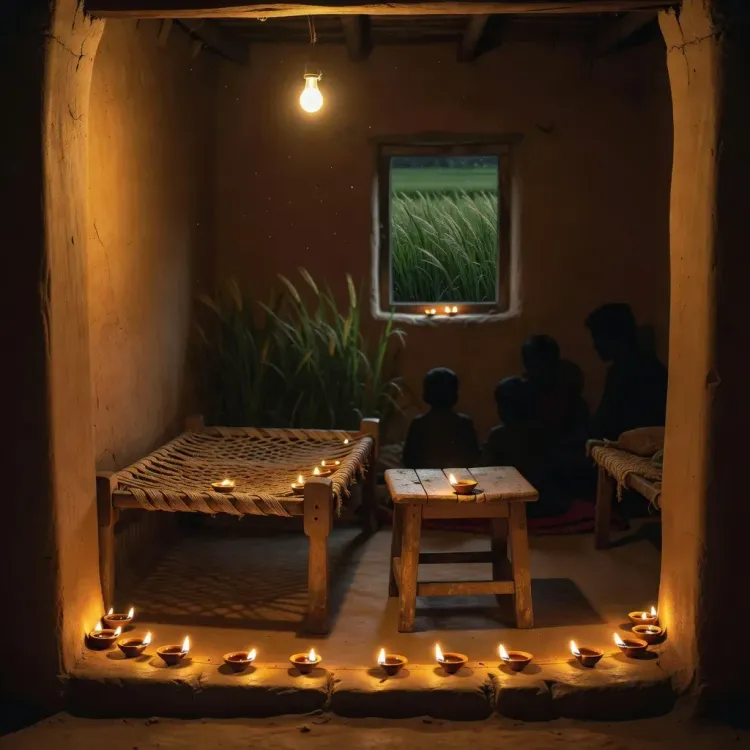
Seventy-five years after Independence, Adivasi families in Chakdah village, Hooghly district, West Bengal, are celebrating Diwali 2026 with electric light in their homes for the first time — a fact BJP leader Smriti Irani has placed at the centre of a sharp political indictment of the state's governance record.
Irani's post draws a pointed contrast: a nation that declared universal electrification a national mission years ago still had homes in darkness in West Bengal. 'How could successive governments speak of development while families continued to be deprived of such a basic necessity?' she asked, framing the story not as a celebration alone, but as a reckoning.
Chakdah's long wait and the Saubhagya promise
The Saubhagya scheme, launched in 2017, was designed precisely for such last-mile gaps — bringing electricity to unconnected rural households across India. National-level figures from that drive reported near-complete village coverage, yet Irani's post signals that pockets of exclusion persisted in West Bengal long after those headline numbers were declared. For the Adivasi residents of Chakdah, the festival of lights carries a meaning this year that it simply could not before.
West Bengal has been governed by the Trinamool Congress since 2011, and before that by the Left Front for over three decades. BJP has, since at least 2014, made the state's rural infrastructure deficit a recurring campaign argument — and Irani's post follows that established playbook with precision, naming neither the TMC nor the Left by name but letting the arithmetic of 75 years do the work.
The 'dignity of the last citizen' as a political yardstick
The rhetorical heart of Irani's post is a reframing of what 'development' means: not slogans or political patronage, but measurable delivery to the most marginalised. 'The BJP believes that development must be measured not by political slogans, but by the dignity and opportunities it brings to the last citizen,' she wrote. It is a line calibrated for the Adivasi vote — a community that has been a contested constituency between the BJP and regional parties across eastern India.
The claim lands against the backdrop of a central government that has consistently pointed to electrification, road connectivity, and direct-benefit transfers as its development report card. By anchoring the narrative in a single village, a single community, and a single festival night, Irani converts a macro-policy achievement — or failure — into something viscerally human.
What the West Bengal government says — and hasn't
As of publication, no official response from the West Bengal state government has addressed the specific claim about Chakdah village. The state's position on electrification coverage and any pending work under central schemes remains unaddressed. That silence, in the charged atmosphere of Bengal politics, is itself part of the story.
With West Bengal assembly elections perpetually on the horizon as a defining political contest for the BJP, the party's strategy of spotlighting individual villages — real, named, located — represents a deliberate move away from abstraction. One village. One Diwali. One question that 75 years could not answer. That is a harder image to argue with than any statistic.
Point of View
Human story that is difficult to rebut without appearing to defend neglect. By anchoring the critique in a named Adivasi village on Diwali, she maximises symbolic resonance while targeting a community that both the BJP and TMC actively court in West Bengal. The 75-year framing is deliberately broad enough to indict both the Left Front and the Trinamool Congress without naming either, keeping the moral weight on governance failure rather than partisan attack. With West Bengal remaining the BJP's most contested large-state target, this kind of village-level narrative — verifiable or not — is likely to intensify as the party builds its grassroots development record in the state.
NationPress
6 Nov 2026
Frequently Asked Questions
Which village in West Bengal got electricity for the first time this Diwali according to Smriti Irani?
Smriti Irani's post refers to Chakdah village in Hooghly district, West Bengal , where Adivasi families reportedly received electricity for the first time in Diwali 2026 , 75 years after Independence.
What is the Saubhagya scheme and how does it relate to this story?
The Saubhagya scheme was launched by the central government in 2017 to provide last-mile electricity connections to unelectrified rural households across India. It is relevant because it was designed to reach precisely the kind of excluded village Irani highlights in her post.
Is West Bengal governed by BJP or TMC?
West Bengal is governed by the Trinamool Congress (TMC) , which has been in power since 2011 . Before that, the Left Front ruled the state for over three decades. The BJP is the principal opposition at the state level.
Why is Smriti Irani focusing on Adivasi families in West Bengal?
Adivasi communities are a politically significant constituency in West Bengal, actively contested by the BJP and regional parties. Irani's focus on Adivasi welfare in Hooghly fits into the BJP's broader strategy of highlighting development delivery to marginalised groups as evidence of its governance record.
Has the West Bengal government responded to Smriti Irani's claim about Chakdah village?
As of 6 November 2026 , no official response from the West Bengal state government had been issued addressing the specific electrification claim about Chakdah village .