Smriti Irani calls for unity against divisive forces, Atmanirbhar awareness
Synopsis
BJP leader Smriti Irani on 23 October 2026 called for societal unity against divisive forces and renewed public awareness of self-reliance, echoing the Atmanirbhar Bharat Abhiyan first launched in May 2020.
Key Takeaways
Smriti Irani posted on 23 October 2026 urging Indians to unite against divisive forces and champion self-reliance.
Her Hindi message directly invokes the spirit of the Atmanirbhar Bharat Abhiyan , launched in May 2020 .
The twin themes — social cohesion and economic indigenisation — are a consistent pillar of BJP 's post- 2014 public messaging.
Irani serves as a Senior BJP leader and former Union Minister of Women & Child Development and Minority Affairs.
Analysts watch whether such messaging precedes new state-level campaigns or domestic manufacturing policy packages.
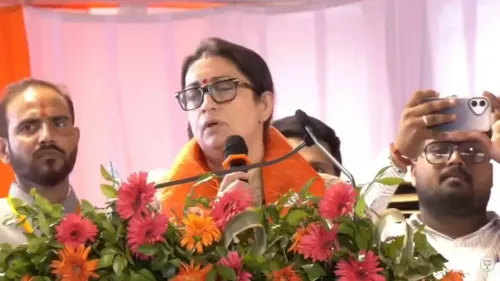
Two urgent imperatives in a single sentence — BJP leader Smriti Irani on Friday, 23 October 2026, called on Indian society to close ranks against forces she described as divisive, while simultaneously urging citizens to embrace the spirit of self-reliance that has defined national policy since 2020.
Posting in Hindi on X, Irani stated: 'Aaj hamein baantne wali taakton ke khilaf samaaj ko ekjut karna hai tatha atmanirbharta ke liye deshwasiyon ko jagruk karna hai.' — 'Today we must unite society against forces that divide us, and we must awaken citizens towards self-reliance.' The pairing is deliberate: social cohesion and economic indigenisation presented not as separate goals, but as two sides of the same national resolve.
The Atmanirbhar Bharat thread running through this call
The self-reliance strand of Irani's message connects directly to the Atmanirbhar Bharat Abhiyan, the flagship national campaign announced in May 2020 alongside a special economic package at the height of the COVID-19 pandemic. Its core ambition: drive domestic production, cut import dependence, and build economic resilience across sectors from defence to electronics to agriculture.
Six years on, 'atmanirbharta' has evolved from a crisis-era catchphrase into an enduring pillar of BJP's public messaging. Irani's post reinforces that the concept is being actively kept in public consciousness — not left to gather dust in policy documents.
Unity as the other half of the message
The first half of her statement — the call to stand together against 'divisive forces' — follows a pattern that senior BJP figures have employed consistently in the post-2014 era. The framing positions social cohesion as a prerequisite for economic ambition: a fractured society, the argument runs, cannot sustain a self-reliant economy. It is a rhetorical bridge the party has used to link cultural and developmental agendas.
Such messaging typically surfaces in broad public outreach rather than being pinned to a single bill or budget line. What to watch: whether statements like this align with forthcoming state-level campaigns or a new economic package centred on domestic manufacturing.
A unified citizenry committed to homegrown enterprise — that is the compact Irani is publicly renewing today. Whether that compact finds its next concrete expression in policy or on the campaign trail, the signal is clear: the Atmanirbhar conversation is far from over.
Point of View
She signals that the self-reliance agenda needs periodic public re-energising — not just institutional momentum. The linkage of unity and self-reliance is not accidental; it frames divisiveness as an economic threat, not merely a social one. Watch for this framing to intensify ahead of state elections or major manufacturing-policy announcements.
NationPress
23 Oct 2026
Frequently Asked Questions
What did Smriti Irani say in her October 2026 post?
Irani called on Indians to unite against forces she described as divisive and to raise awareness about self-reliance, referencing the Atmanirbhar Bharat spirit in a Hindi post on X on 23 October 2026.
What is Atmanirbhar Bharat Abhiyan?
Atmanirbhar Bharat Abhiyan is a national campaign launched in May 2020 to promote domestic production, reduce India's import dependence, and build economic resilience across key sectors.
Why do BJP leaders repeatedly invoke unity against divisive forces?
Senior BJP leaders have consistently paired social cohesion messaging with economic nationalism since 2014, framing divisiveness as an obstacle to national development and self-reliance goals.
Who is Smriti Irani?
Smriti Irani is a senior BJP leader and former Union Minister who held the portfolios of Women & Child Development and Minority Affairs in the Union Cabinet.
What should citizens watch for after Irani's self-reliance message?
Analysts suggest watching for alignment of similar messaging with state-level campaigns or new economic packages focused on domestic manufacturing and indigenisation.