CM Dhami Hails UCC as Pillar of Women's Rights in Uttarakhand
Synopsis
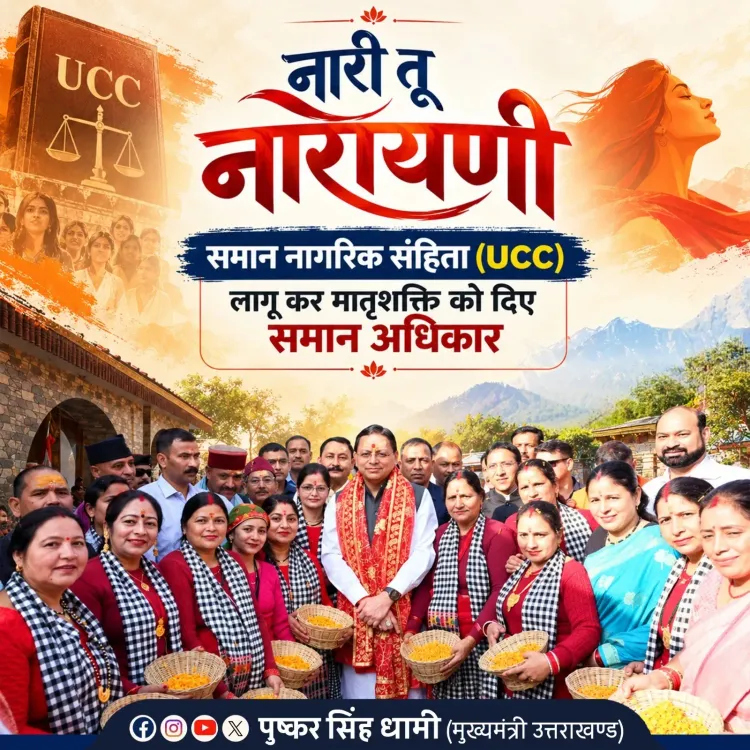
Uttarakhand CM Pushkar Singh Dhami invoked 'mātṛśakti' to reaffirm that the state's Uniform Civil Code — India's first post-independence, passed in February 2024 — guarantees equal civil rights for all citizens, with women's dignity and self-reliance at its core.
Key Takeaways
Uttarakhand became the first Indian state to enact a Uniform Civil Code after independence, with the bill passed in February 2024 .
CM Pushkar Singh Dhami framed the UCC centrally as a women's-rights instrument, using the term mātṛśakti to place women at the heart of the state's progress.
The UCC establishes common laws on marriage, divorce, inheritance, and adoption for all citizens regardless of religion, replacing personal law variations.
The code draws on Article 44 of the Indian Constitution — a long-standing Directive Principle of State Policy.
Uttarakhand's model is being watched by other BJP-governed states as a potential template for similar legislation.
Future legal challenges at the High Court or Supreme Court level could determine the code's national precedent value.
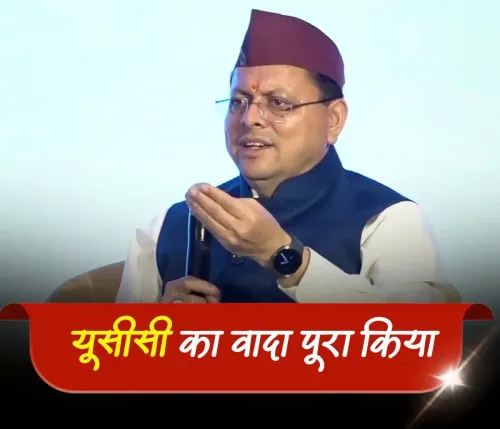
Women's empowerment and equal justice sit at the heart of a landmark legal reform — and Uttarakhand Chief Minister Pushkar Singh Dhami is making sure the message lands. On Friday, October 23, 2026, Dhami took to X to reaffirm his government's commitment to the Uniform Civil Code (UCC), calling women 'mātṛśakti' — 'the strength of the mother' — and positioning the UCC as the structural guarantee behind that promise.
In his post, Dhami wrote: 'Mātṛśakti hamārā gaurav, hamārā sammān aur pradeś kī pragati kā mazbūt ādhār hai' — 'Women are our pride, our honour, and the strong foundation of the state's progress.' He linked that sentiment directly to the UCC, framing it as a pledge to protect women's rights, dignity, and self-respect by ensuring every citizen — regardless of religion — operates under the same civil law.
How Uttarakhand Became India's First UCC State
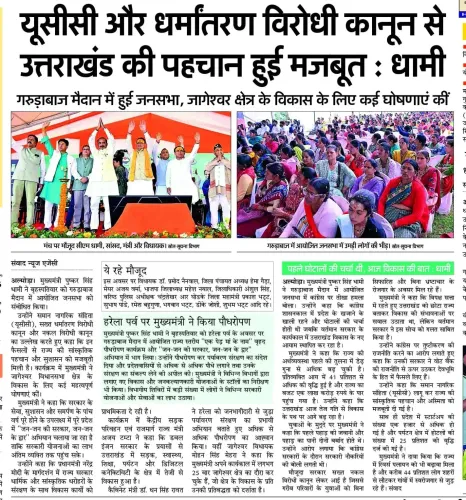
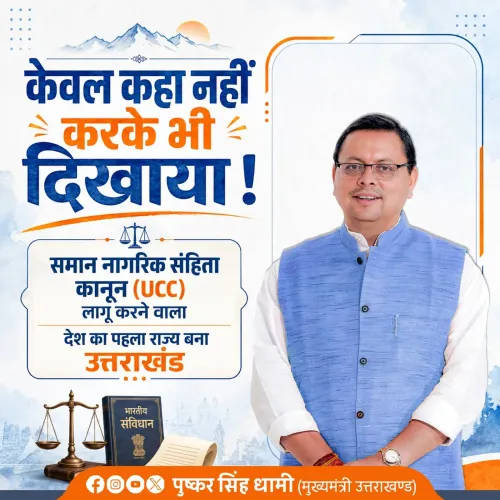
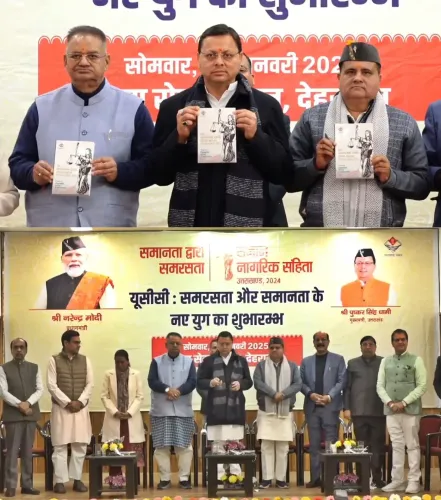
The backstory matters. In February 2024, the Uttarakhand Legislative Assembly passed the Uniform Civil Code Bill under Dhami's government — making Uttarakhand the first Indian state to enact such legislation after independence. The code brings common rules on marriage, divorce, inheritance, and adoption to all citizens, replacing the patchwork of religion-specific personal laws that had governed these domains for decades.
The constitutional anchor is Article 44 of the Indian Constitution, a Directive Principle of State Policy that had long called for a Uniform Civil Code but remained unimplemented at the national level. Uttarakhand's move transformed that aspirational clause into enforceable law — at least within state boundaries.
Women as the Central Argument for UCC
Dhami's framing is deliberate and politically significant. By centering mātṛśakti rather than religious uniformity, his post casts the UCC primarily as a women's-rights instrument: a guarantee of equal opportunity, security, and dignity that enables women to become ātmanirbhar — self-reliant — and drive the building of a 'new Uttarakhand.'
That framing speaks to real structural inequalities. Under religion-based personal laws, women from different communities have historically faced divergent rights in divorce settlements, inheritance shares, and custody arrangements. A uniform code, in principle, levels that playing field across the board.
The BJP's Broader Template — and What Comes Next
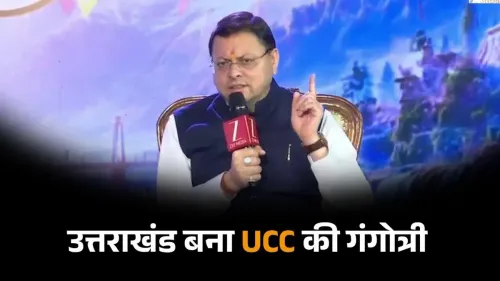
Uttarakhand's UCC is not an isolated experiment. The BJP has carried the Uniform Civil Code as a manifesto commitment for decades, and Dhami's state has now handed the party a working proof-of-concept. Other BJP-governed states are watching closely, and the rollout of specific UCC implementation rules in Uttarakhand will serve as a stress-test for the model's portability.
Legal scrutiny is also on the horizon. Any High Court or Supreme Court challenge to the state UCC's scope or application could set precedents that shape whether, and how, other states follow suit. The policy's durability will ultimately be judged not by the legislation itself but by how effectively its protections reach ordinary women in villages and towns across the state.
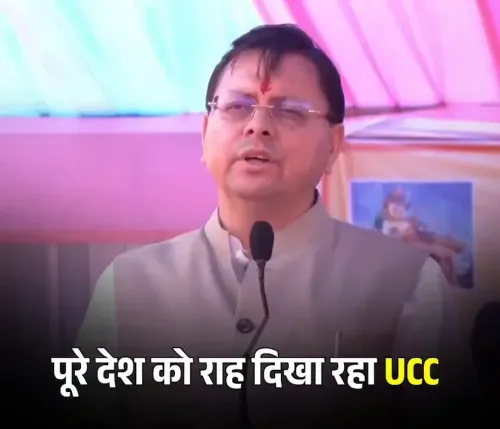
For now, Dhami is planting the flag — and the argument that equal law is the most powerful form of women's empowerment is one that will reverberate well beyond Dehradun.
Point of View
His government attempts to insulate the reform from communal-politics criticism and broaden its appeal. Uttarakhand's role as the national UCC pioneer gives the BJP a live exhibit to showcase ahead of any future push for central legislation. However, the real test of the policy's narrative will come when implementation details — registration processes, dispute resolution, legal literacy among rural women — are stress-tested in practice. How the state handles early UCC-related litigation will be as consequential for the reform's legacy as the legislation itself.
NationPress
23 Oct 2026
Frequently Asked Questions
What is the Uniform Civil Code in Uttarakhand?
The Uniform Civil Code (UCC) in Uttarakhand is a state law, passed in February 2024, that establishes common rules on marriage, divorce, inheritance, and adoption for all citizens regardless of their religion, replacing the earlier system of separate personal laws for different communities.
Is Uttarakhand the first state to implement UCC in India?
Yes. Uttarakhand became the first Indian state to pass and implement a Uniform Civil Code after independence when its Legislative Assembly passed the UCC Bill in February 2024 under Chief Minister Pushkar Singh Dhami.
What did CM Dhami say about women and the UCC?
CM Dhami called women 'mātṛśakti' — the strength and pride of the state — and stated that the UCC was enacted specifically to protect women's rights, dignity, and self-respect by guaranteeing equal civil rights for every citizen.
Which article of the Constitution supports the Uniform Civil Code?
Article 44 of the Indian Constitution, a Directive Principle of State Policy, calls for a Uniform Civil Code for all citizens. Uttarakhand's UCC is the first state-level law to operationalise this principle after independence.
Will other states follow Uttarakhand's UCC model?
Several BJP-governed states are watching Uttarakhand's implementation closely as a potential template. However, any High Court or Supreme Court challenges to Uttarakhand's UCC and the rollout of detailed implementation rules will heavily influence whether and how other states proceed.