Is Islamabad Facing a New Threat from ISKP Amidst Security Struggles?

Synopsis
The recent bombing in Islamabad highlights a troubling resurgence of the ISKP, exploiting Pakistan's security weaknesses. As analysts assess the implications, the question arises: how will this impact Pakistan's stability and its relationship with the US?
Key Takeaways
ISKP has exploited security weaknesses in Pakistan.
The group aims to destabilize Pakistan and challenge the Taliban.
Recent attacks indicate a shift in operational patterns.
Pakistan’s strategies to manage ISKP have backfired.
Heightened vigilance and strategic responses are critical.
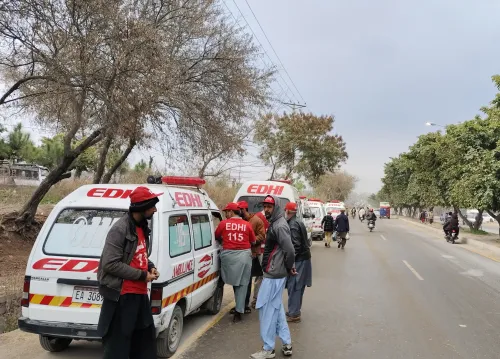
New Delhi, Feb 11 (NationPress) The recent attack on a mosque in Islamabad by the Islamic State Khorasan Province (ISKP) starkly illustrates how the terrorist organization has taken advantage of Pakistan's deteriorating security framework.
For nearly a year, the ISKP had been largely inactive in terms of operations within Pakistan.
The last incident for which the ISKP claimed responsibility occurred in Balochistan's Mastung on April 15, 2025, targeting a bus filled with Pakistani security personnel, resulting in three fatalities.
Security experts indicate that the ISKP has been active in Pakistan since 2015. However, up until 2022, the frequency of their attacks was relatively low, with some years witnessing only a single incident claimed by the group.
Post-2022, there has been a significant uptick in attacks, with the ISKP claiming a total of 90 incidents of varying severity since then.
During 2021, the ISKP began shifting its major operations from Afghanistan, establishing a base in Pakistan, which they openly label as an 'enemy nation' and an 'un-Islamic state.'
The ISKP aims to establish an Islamic state in Pakistan, thus seeking the removal of the current government.
The Islamabad mosque incident, which occurred last week, coincided with the Balochistan Liberation Army (BLA) initiating 'Operation Herof 2.0' against Pakistani security forces.
The ISKP capitalized on the security vacuum as the focus was diverted toward Balochistan, choosing this precise moment to strike in Islamabad when security measures were weakened, officials report.
An Intelligence Bureau official noted that beyond the timing of the assault, the ISKP sought to convey a strong message to the United States.
With Pakistan boasting about its revived relationship with the US, the ISKP has reacted negatively.
In January, the US commenced airstrikes against the Islamic State in Syria and Africa, leading to substantial losses for the Islamic State in Africa. The bombings in Islamabad served as a mechanism for the ISKP to reassert its influence, according to the official.
Officials have also observed a shift in the attack patterns. Previously, the ISKP primarily targeted regions in and around Balochistan. Now, they have extended their reach to the mainland, including attacks in Islamabad and Karachi.
The recent assaults have been highly impactful, showcasing the operational style of the Islamic State.
Essentially, the ISKP is fully exploiting the security breakdown in Pakistan, driven by the emergence of Baloch groups and the collapse of the ceasefire with the Tehreek-e-Taliban Pakistan (TTP). Their broader strategy involves strengthening their position to confront the Taliban in Afghanistan while simultaneously destabilizing Pakistan enough to assert control over the nation.
Currently, the ISKP is working to solidify its presence in Pakistan while building an organization capable of challenging the Taliban in Afghanistan. Officials assert that the manner in which the ISKP has executed its activities in Pakistan indicates that the country’s strategy has backfired significantly.
The ISI had previously made a 2017 agreement with the ISKP to avoid attacks within Pakistan, confining their actions to Afghanistan. However, the ISKP has failed to uphold this agreement.
In the aftermath of 'Operation Sindoor,' the ISI again sought the ISKP's assistance in rejuvenating terrorist factions, coinciding with deteriorating relations between Pakistan and the Taliban.
Pakistan now faces substantial challenges from both the BLA and the TTP. The ISI attempted to recruit the ISKP to fight alongside Lashkar-e-Taiba against the TTP, BLA, and the Afghan Taliban.
The attack on the mosque in Islamabad underscores that the ISKP has no intention of negotiating with Islamabad and is committed to undermining the Pakistani establishment, another official emphasized.
Point of View
It's crucial to remain vigilant about the growing threats posed by groups like ISKP. Their ability to exploit Pakistan's security challenges signals an urgent need for comprehensive strategies to counter terrorism and ensure the safety of citizens. It’s imperative that we maintain a balanced narrative, focusing on facts and fostering a dialogue on solutions.
NationPress
6 Oct 2026
Frequently Asked Questions
Why did ISKP attack a mosque in Islamabad?
The attack aimed to exploit the security vulnerabilities in Pakistan and send a message amid the country's shifting alliances, particularly with the United States.
How has ISKP's activity changed in recent years?
ISKP's operations have increased significantly since 2022, with a total of 90 attacks claimed in Pakistan, expanding from primarily Balochistan to major cities.
What are the implications of ISKP's resurgence?
The resurgence of ISKP poses a significant threat to Pakistan's stability and security, complicating its geopolitical dynamics, especially concerning its relationship with the US.
What can be done to counter ISKP's influence?
Addressing ISKP's influence requires a multifaceted approach, including improved intelligence sharing, community engagement, and comprehensive counter-terrorism strategies.