How Did ISRO’s Chandrayaan-2 Detect Solar Impact on the Moon’s Atmosphere?
Synopsis
In a groundbreaking discovery, ISRO's Chandrayaan-2 has observed the first solar impacts on the Moon's atmosphere. This significant finding enhances our understanding of lunar space weather, paving the way for future missions and habitats on the Moon. Dive into how this remarkable achievement could change lunar exploration forever.
Key Takeaways
Chandrayaan-2 has made the first direct observation of solar impacts on the Moon.
The study confirms theoretical predictions regarding lunar exosphere.
CMEs significantly alter the pressure in the Moon's exosphere.
Findings have implications for lunar mission planning.
Lunar exosphere is sensitive to solar activity.
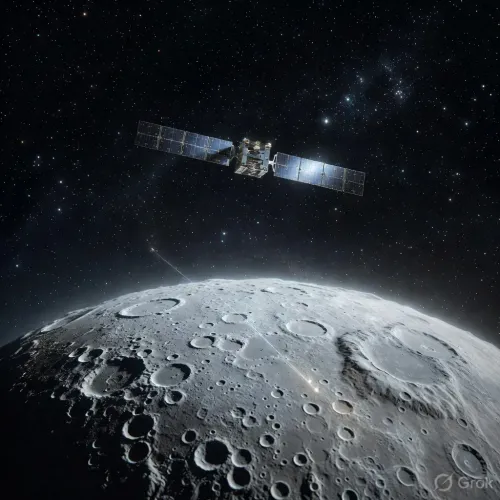
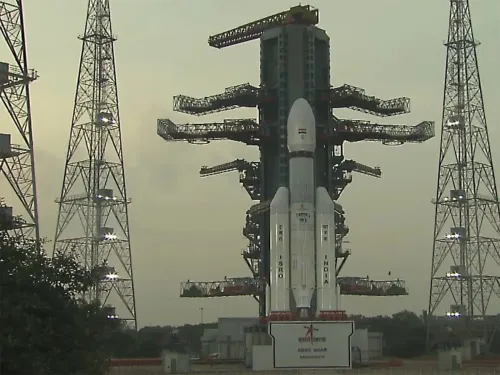
Bengaluru, Oct 18 (NationPress) In a remarkable scientific achievement, the Indian Space Research Organisation (ISRO) has revealed that its lunar orbiter Chandrayaan-2 has recorded the first observation of the impact of Coronal Mass Ejections (CMEs) from the Sun on the Moon’s exosphere.
This groundbreaking observation utilized the Chandra’s Atmospheric Composition Explorer-2 (CHACE-2) instrument aboard the orbiter.
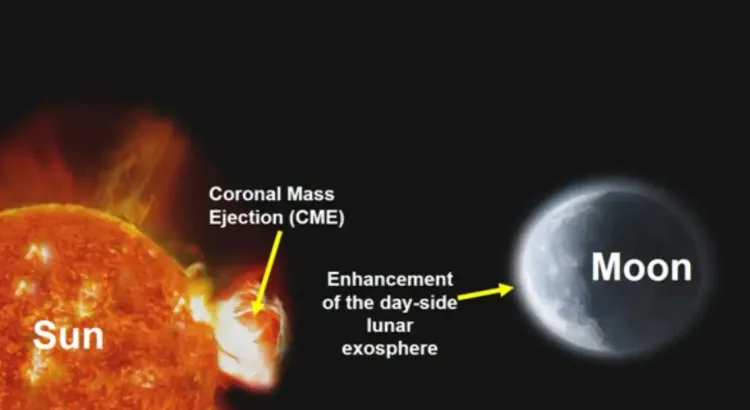
During a rare solar phenomenon on May 10, 2024, a series of CMEs struck the Moon, resulting in a significant rise in the total pressure of the dayside lunar exosphere, which is an extremely thin atmosphere enveloping the Moon.
ISRO scientists noted that the number density of neutral atoms and molecules in the exosphere surged by over an order of magnitude, validating theoretical predictions that had never before been confirmed through direct observation.
The Moon’s exosphere, categorized as a surface boundary exosphere, is particularly responsive to solar activity due to the absence of a global magnetic field. The CME event facilitated the release of atoms from the lunar surface, temporarily modifying the atmospheric conditions of the Moon.
ISRO indicated that these findings not only enhance our scientific understanding of lunar space weather but also carry implications for future lunar missions and the development of human habitats on the Moon.
The study, titled “Impact of a Coronal Mass Ejection on the Lunar Exosphere as Observed by CHACE-2 on the Chandrayaan-2 Orbiter,” was published in Geophysical Research Letters on August 16, 2025.
"The Moon has a very thin atmosphere, classified as an ‘exosphere’, which indicates that gas atoms and molecules in the lunar environment seldom interact despite their coexistence. The boundary of the exosphere is the Moon's surface, categorizing it as a ‘surface boundary exosphere’," ISRO stated.
The exosphere on the Moon originates from several processes, including interactions with solar radiation, solar wind (which consists of ions of Hydrogen, Helium, and a small quantity of heavier ions emitted by the Sun), along with impacts from meteorites on the lunar surface. These processes liberate atoms and molecules from the Moon's surface, contributing to the exosphere.
"In general, the Moon's exosphere is highly sensitive to even minor variations in the factors that contribute to its formation, such as the emission of solar coronal mass, known as CME (an abbreviation for Coronal Mass Ejection). CMEs occur when the Sun expels significant amounts of its material, primarily consisting of Helium and Hydrogen ions. These effects on the Moon are substantial, as the Moon is an airless body devoid of a global magnetic field, which would have provided some degree of protection against solar impacts on its surface," ISRO explained.
ISRO emphasized that the opportunity to directly observe the effects of CME on the Moon occurred on May 10, 2024, during a series of coronal mass ejections (CMEs) thrust by the Sun. This surge in solar coronal mass striking the Moon amplified the process of releasing atoms from the lunar surface, thereby introducing them into the lunar exosphere, which was reflected as an increase in total pressure in the illuminated lunar exosphere.
"This observation will offer scientific insights into the lunar exosphere and the effects of space weather on the Moon. Beyond advancing our scientific understanding of the Moon and lunar space weather (the impact of solar emissions on the Moon), this observation also highlights the challenges of constructing scientific bases on the Moon. Those designing lunar bases must consider such extreme events, which would temporarily alter the lunar environment, prior to the dissipation of these effects," ISRO concluded.
Point of View
I firmly believe in the vital role of scientific advancements in shaping our understanding of celestial phenomena. ISRO's groundbreaking work with Chandrayaan-2 exemplifies the importance of continued exploration and research on the Moon. This achievement not only enriches our knowledge of lunar dynamics but also sets the stage for future human endeavors on the Moon, ensuring that our nation remains at the forefront of space exploration.
NationPress
5 Sept 2026
Frequently Asked Questions
What is the significance of the Chandrayaan-2 observation?
The observation made by Chandrayaan-2 is significant as it marks the first time scientists have directly witnessed the effects of Coronal Mass Ejections (CMEs) from the Sun on the Moon's exosphere, validating theoretical predictions.
How do CMEs affect the Moon's atmosphere?
CMEs lead to an increase in the pressure of the Moon's exosphere by liberating atoms from the lunar surface, which alters the atmospheric conditions temporarily.
What are the implications for future lunar missions?
The findings from this observation inform future lunar missions and habitat designs, as they highlight the need to account for solar activity's effects on the Moon's environment.
When was the study published?
The study detailing this observation was published in Geophysical Research Letters on August 16, 2025.
What instruments were used for the observation?
The observation was conducted using the Chandra’s Atmospheric Composition Explorer-2 (CHACE-2) instrument onboard the Chandrayaan-2 orbiter.