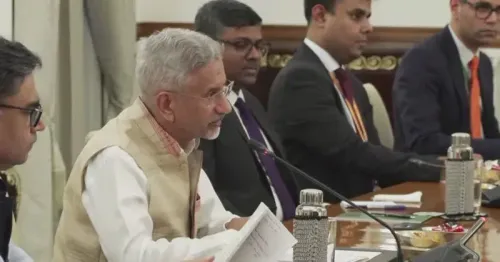
Jaishankar Greets Kiribati on 47th Independence Day

Synopsis
External Affairs Minister Dr. S. Jaishankar on 12 July 2026 greeted Kiribati on its 47th Independence Day, reinforcing India's steady diplomatic outreach to Pacific island nations through high-level messaging and the FIPIC framework amid broader Indo-Pacific competition.
Key Takeaways
Jaishankar extended Independence Day greetings to Kiribati on 12 July 2026 , marking 47 years of Kiribati's sovereignty.
Kiribati gained independence from the United Kingdom on 12 July 1979 and comprises 33 atolls with a population of around 1.2 lakh .
India engages Pacific island nations through the Forum for India-Pacific Islands Cooperation (FIPIC) , established in 2014 .
The Pacific region is contested diplomatically by China , Australia , and other Indo-Pacific actors, making India's consistent outreach strategically significant.
Kiribati is among the nations most threatened by sea-level rise, linking India's diplomatic engagement to broader climate diplomacy goals.
Union External Affairs Minister Dr. S. Jaishankar on Sunday, 12 July 2026, extended warm greetings to the government and people of Kiribati on the Pacific island nation's Independence Day, marking 47 years since it gained sovereignty from the United Kingdom.
Context
Kiribati declared independence on 12 July 1979, becoming one of the world's smallest and most remote sovereign nations. The country comprises 33 atolls and reef islands spread across the central Pacific Ocean, with a population of approximately 1.2 lakh people. Its low-lying geography makes it one of the nations most acutely vulnerable to rising sea levels driven by climate change.
Dr. Jaishankar's post on X read: 'Warm greetings to the Government and people of Kiribati on their Independence Day.' The message was accompanied by the Indian and Kiribati national flag emojis and tagged the official @KiribatiGov handle, signalling a direct, government-to-government acknowledgement.
Policy Backdrop
India has engaged Pacific island nations through the Forum for India-Pacific Islands Cooperation (FIPIC), launched in 2014 to institutionalise ties on development, climate resilience, and connectivity. The forum groups 14 Pacific island states, including Kiribati, and has served as the principal multilateral architecture for New Delhi's outreach to the region.
National-day greetings from senior ministers form a consistent strand of India's diplomatic signalling toward smaller states. The Pacific island nations are simultaneously courted by China, Australia, and other Indo-Pacific actors, making high-level messaging from New Delhi a calibrated instrument of soft-power engagement rather than a purely ceremonial gesture.
Stakeholders and Impact
For Kiribati, acknowledgement from a major power such as India carries diplomatic weight disproportionate to the bilateral trade volume, reinforcing the island nation's standing in multilateral forums on climate finance and ocean governance. India's engagement also signals to regional players that New Delhi views the Pacific not as a distant periphery but as an integral part of its Indo-Pacific vision.
Civil society groups and climate negotiators in Pacific nations have long sought stronger commitments from large emitters. India's sustained diplomatic contact, even through routine gestures, keeps the channel open for substantive cooperation on climate adaptation and capacity building.
What's Next
Observers will watch for the next FIPIC summit or a high-level Indian visit to the Pacific as a barometer of how far bilateral warmth translates into concrete deliverables. With global COP climate negotiations drawing increasing attention to small island developing states, India's posture toward nations like Kiribati will remain a visible indicator of its commitments on climate finance and maritime cooperation.
Point of View
Public diplomatic acknowledgement at a time when China has been actively deepening security and economic ties with Pacific island states. India's FIPIC architecture gives these gestures an institutional backbone, and sustained high-level contact — even symbolic — helps preserve New Delhi's credibility as a partner of choice for small island nations navigating great-power competition. The next concrete test will be whether India translates this goodwill into climate finance or capacity-building commitments ahead of upcoming multilateral negotiations.
NationPress
10 Oct 2026
Frequently Asked Questions
When did Kiribati gain independence?
Kiribati gained independence from the United Kingdom on 12 July 1979 , making 12 July 2026 its 47th Independence Day .
What is FIPIC and how does India use it?
The Forum for India-Pacific Islands Cooperation (FIPIC) was launched by India in 2014 to institutionalise engagement with 14 Pacific island nations on development, climate resilience, and connectivity. It is the primary multilateral framework through which New Delhi channels its Pacific outreach.
Why does India engage small Pacific island nations diplomatically?
India views the Pacific as part of its broader Indo-Pacific strategy. Sustained engagement with small island states counters growing influence from rival powers, supports climate diplomacy goals, and reinforces India's image as a responsible partner for vulnerable nations.
What did Jaishankar say about Kiribati?
Dr. Jaishankar posted on X : 'Warm greetings to the Government and people of Kiribati on their Independence Day,' tagging @KiribatiGov and including both nations' flag emojis.
Is Kiribati affected by climate change?
Yes. Kiribati is one of the world's most climate-vulnerable nations. Its 33 low-lying atolls face existential risk from rising sea levels, making climate finance and adaptation central to its foreign policy priorities and to India's engagement with it.