Jaishankar Greets Malawi on 62nd Independence Day
Synopsis
External Affairs Minister Dr. S. Jaishankar on 6 July 2026 greeted Malawi on its 62nd Independence Day, addressing FM Dr. George T. Chaponda and highlighting India's long-standing ties with the southern African nation rooted in cooperation since 1964.
Key Takeaways
Jaishankar extended Independence Day greetings to Malawi on 6 July 2026 , the country's 62nd Independence Day .
The message was addressed to Foreign Minister Dr.
Chaponda , the Malawian government, and its people.
India and Malawi have maintained formal diplomatic relations since 1964 , the year of Malawi's independence.
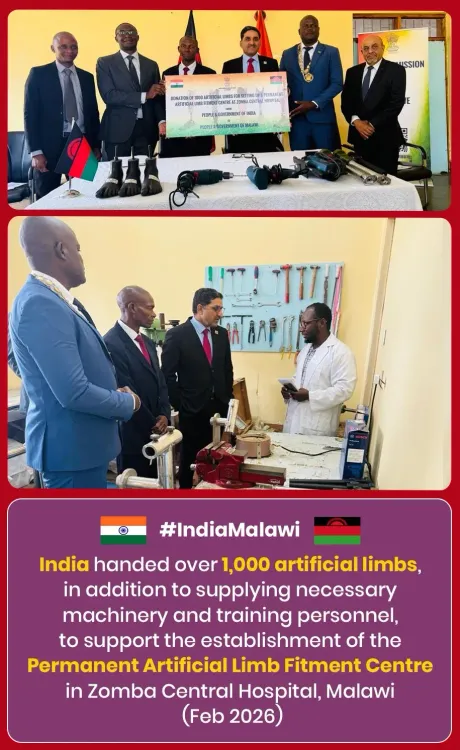
India has extended lines of credit, ITEC scholarships , and technical training programmes to Malawi over the decades.
The greeting is part of India's consistent diplomatic practice of marking African independence days , aligned with its South-South cooperation framework.
Next steps to watch include potential bilateral talks and Malawi's role in the upcoming India-Africa Forum Summit .
Union External Affairs Minister Dr. S. Jaishankar on Monday, 6 July 2026 extended congratulations to Malawi on the occasion of its Independence Day, addressing the message to Foreign Minister Dr. George T. Chaponda, the government, and the people of the southern African nation. The minister underscored the 'long-standing ties' between the two countries in a post on X.
Context
Malawi attained independence on 6 July 1964, making this its 62nd Independence Day. The country, located in southern Africa, has maintained uninterrupted diplomatic relations with India since that year. Dr. Jaishankar's message, directed at @ForeignMalawi, follows the standard diplomatic protocol of India's external affairs ministry marking African independence days with formal greetings.
In his post, Dr. Jaishankar wrote: 'Congratulations to FM Dr. George T. Chaponda, the Government and people of Malawi on the occasion of their Independence Day. Cherish our long-standing ties.' The message was accompanied by the Indian and Malawian flags.
Policy Backdrop
India and Malawi established formal diplomatic ties in 1964, and New Delhi has since extended lines of credit, technical training programmes, and ITEC (Indian Technical and Economic Cooperation) scholarships to Malawian nationals. These instruments form the backbone of India's capacity-building engagement across the African continent.
The broader framework for India-Africa engagement is anchored in the India-Africa Forum Summit (IAFS) process, which has brought together African heads of state and government with Indian leadership across multiple editions. South-South cooperation, trade facilitation, and human resource development remain the stated pillars of this relationship.
Stakeholders and Impact
The immediate stakeholders are the Malawian government, including FM Dr. George T. Chaponda, and Indian diplomatic missions operating across Africa. For Malawi, recognition from one of the continent's largest trade and development partners carries symbolic and practical weight, reinforcing the bilateral channel ahead of any potential engagement at multilateral forums.
For India, the message is consistent with its broader continental strategy of maintaining warm, people-to-people and government-to-government ties with all 54 African Union member states. Malawi is among the beneficiaries of Indian development assistance, and continued engagement supports New Delhi's positioning as a preferred partner for the Global South.
What's Next
Observers will watch for any follow-up bilateral discussions, new lines of credit, or Malawi's participation in the next edition of the India-Africa Forum Summit. The Independence Day greeting, while ceremonial, often serves as a diplomatic touchpoint that precedes more substantive engagement. India's outreach to African nations has been intensifying as part of its Act Africa and broader multilateral diplomacy priorities.
Point of View
Consistent with India's structured outreach to all African Union member states. It reflects New Delhi's long-term strategy of maintaining warm bilateral channels as a foundation for deeper economic and institutional engagement. The message fits into the broader arc of India positioning itself as the partner of choice for the Global South, particularly ahead of the next India-Africa Forum Summit cycle. While ceremonial in form, such gestures keep diplomatic lines active and signal continuity of intent to partner governments.
NationPress
5 Oct 2026
Frequently Asked Questions
When did India establish diplomatic relations with Malawi?
India established formal diplomatic relations with Malawi in 1964 , the same year Malawi attained independence from British rule on 6 July 1964 .
Why did Jaishankar congratulate Malawi on 6 July 2026?
6 July is Malawi's Independence Day , marking the anniversary of the country's independence in 1964. Dr. Jaishankar extended greetings as part of India's standard diplomatic practice of acknowledging African independence days.
Who is Dr. George T. Chaponda?
Dr. George T. Chaponda is the Foreign Minister of Malawi , to whom Dr. Jaishankar addressed his Independence Day congratulatory message on behalf of India.
What is India's development cooperation with Malawi?
India has extended lines of credit, ITEC scholarships , and technical training programmes to Malawi since the establishment of diplomatic ties in 1964, forming part of India's broader South-South cooperation framework in Africa.
What is the India-Africa Forum Summit?
The India-Africa Forum Summit (IAFS) is a multilateral diplomatic mechanism through which India engages African heads of state and government on trade, investment, capacity-building, and development cooperation. Malawi is among the participating African nations.