Jaishankar Highlights Modi's Mann Ki Baat on Kargil, Defence Deals
Synopsis
On Kargil Vijay Diwas, EAM Dr. S. Jaishankar amplified PM Modi's 136th Mann Ki Baat, spotlighting the BrahMos-Astra deal with Indonesia, the Vikram-1 private rocket launch, a Science Olympiad clean sweep, Ronaldo Laishram's galaxy discovery, and landmark sporting wins at Lord's and the Japan Open.
Key Takeaways
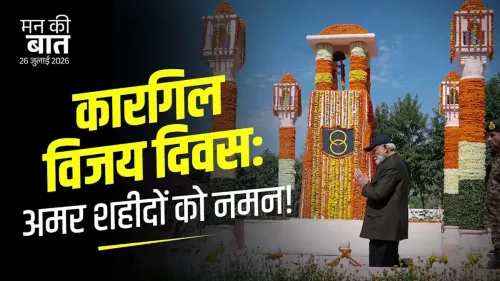
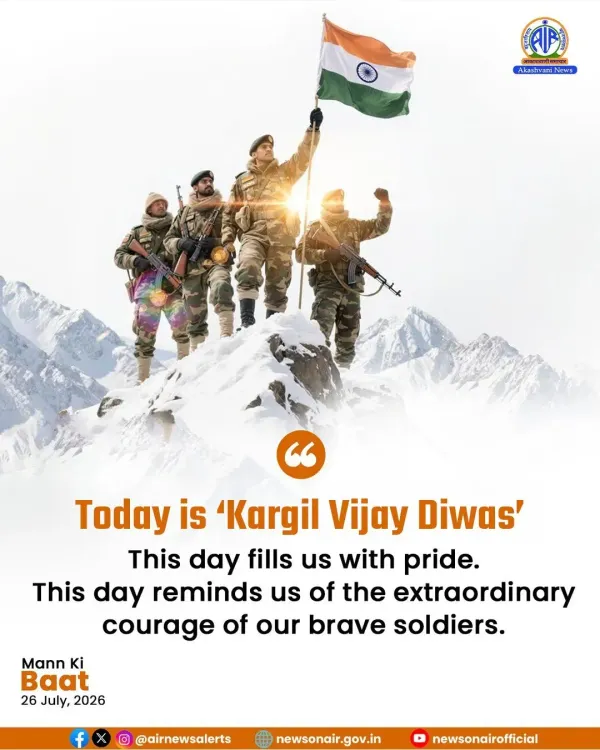
PM Modi's 136th Mann Ki Baat was broadcast on Kargil Vijay Diwas, July 26, 2026 , honouring the 1999 war heroes.
India concluded a major defence agreement with Indonesia covering BrahMos and Astra missiles earlier in July.
Vikram-1 , India's first privately developed rocket, was successfully launched, marking a milestone for the liberalised space sector.
Indian students won medals in all four Science Olympiads — Physics, Chemistry, Biology, and Mathematics .
Manipuri astrophysicist Ronaldo Laishram named a newly discovered galaxy cluster the 'Loktak Proto Cluster' after Manipur's Loktak lake.
India won the first-ever women's Test at Lord's by 270 runs , and P.V.
Sindhu became the first Indian to win the Japan Open .
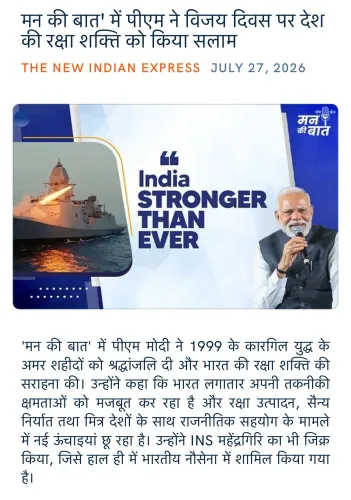
Union External Affairs Minister Dr. S. Jaishankar on Sunday, July 26, 2026 — Kargil Vijay Diwas — shared key highlights from the 136th episode of Mann Ki Baat, Prime Minister Narendra Modi's monthly radio address, underscoring a sweep of national achievements spanning defence, space, science, and sport.
Context
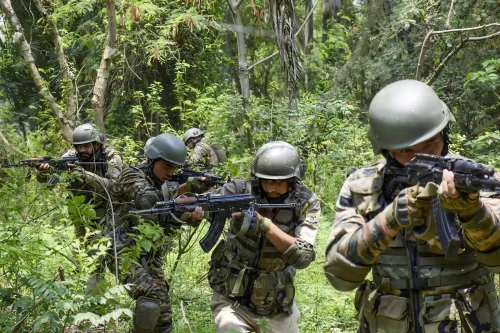
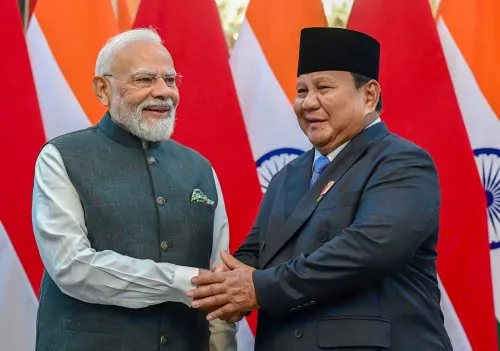
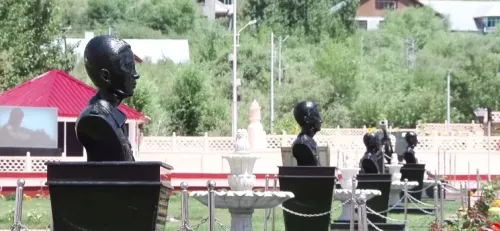
Kargil Vijay Diwas, observed every July 26, marks India's victory in the 1999 Kargil conflict with Pakistan. PM Modi used the occasion's 136th Mann Ki Baat episode to invoke the 'extraordinary courage of our brave soldiers,' framing the day as a source of national pride. Dr. Jaishankar amplified the address on X, attaching four images to the post.
The episode covered a notably wide canvas — from a bilateral missile agreement to a galaxy cluster named after a Manipuri lake — reflecting the programme's established role as a platform to project India's domestic and international momentum across sectors.
Policy Backdrop
A central highlight was a major defence agreement with Indonesia covering BrahMos and Astra missiles, concluded earlier in July. The deal fits squarely within India's Atmanirbhar Bharat defence-export push, which has prioritised growing global confidence in Indian-made weapons systems since 2020. BrahMos, a supersonic cruise missile developed jointly with Russia, and Astra, an indigenously developed beyond-visual-range air-to-air missile, represent the sharpest edge of India's defence technology portfolio.
On space, PM Modi cited the launch of Vikram-1, described as India's first rocket developed by the private sector. The milestone flows directly from the 2020 liberalisation of the space sector and the creation of IN-SPACe, the nodal body enabling private participation. Modi framed it as proof that 'opening of the Space sector to private enterprise' is 'allowing youngsters to show their talent.'
Stakeholders and Impact
The episode also celebrated India's science students, who won medals across all four Science Olympiads — Physics, Chemistry, Biology, and Mathematics — a clean sweep that the government has highlighted as validation of its sustained STEM education focus. Ronaldo Laishram, an astrophysicist from Manipur working in Japan, was individually named for his role in discovering a massive cluster of young galaxies, which he named the 'Loktak Proto Cluster' — a tribute to Manipur's Loktak lake, India's largest freshwater lake.
In sport, India registered a landmark win in women's cricket, defeating England by 270 runs to claim the first-ever women's Test match at Lord's cricket ground. Separately, badminton star P.V. Sindhu became the first Indian to win the Japan Open. Modi also extended wishes to the Indian contingent at the Commonwealth Games in Glasgow, which had begun days earlier.
What's Next
The Indonesia missile deal is likely to attract close attention from regional defence watchers, with follow-on questions around delivery timelines and the broader expansion of India's defence export pipeline. Private space launches under the IN-SPACe framework are expected to accelerate, with further missions from domestic firms anticipated in the coming months.
India's clean sweep at the Science Olympiads and the women's cricket victory at Lord's add to a pattern of soft-power milestones that the government has consistently used to build a narrative of rising national capability — a narrative Dr. Jaishankar reinforced by amplifying the Mann Ki Baat highlights on the diplomatically significant date of Kargil Vijay Diwas.
Point of View
A combination the External Affairs Ministry has deployed with increasing deliberateness. The Indonesia missile deal, if it proceeds as described, would mark one of India's most significant defence export milestones in Southeast Asia, reinforcing the Act East dimension of Atmanirbhar Bharat. Highlighting a Manipuri scientist working in Japan alongside a domestic rocket launch signals a conscious effort to link diaspora achievement with the domestic innovation narrative. Taken together, the post functions as diplomatic messaging as much as domestic outreach — projecting a confident, multi-domain India to an international audience that follows Jaishankar's feed.
NationPress
24 Oct 2026
Frequently Asked Questions
What is Mann Ki Baat and what was discussed in the 136th episode?
Mann Ki Baat is Prime Minister Narendra Modi's monthly radio address to the nation. The 136th episode, aired on July 26, 2026, covered Kargil Vijay Diwas tributes, the BrahMos-Astra missile deal with Indonesia, the Vikram-1 private rocket launch, India's Science Olympiad medals, astrophysicist Ronaldo Laishram's galaxy discovery, the Commonwealth Games, and landmark cricket and badminton victories.
What is the BrahMos and Astra missile deal with Indonesia?
A major defence agreement covering BrahMos supersonic cruise missiles and Astra beyond-visual-range air-to-air missiles was concluded with Indonesia earlier in July 2026. It reflects India's growing defence export ambitions under the Atmanirbhar Bharat initiative.
What is Vikram-1 and why is it significant?
Vikram-1 is India's first rocket developed entirely by the private sector. Its launch is a direct outcome of the 2020 liberalisation of the Indian space sector and the creation of IN-SPACe, which opened the industry to private firms and startups.
Who is Ronaldo Laishram and what is the Loktak Proto Cluster?
Ronaldo Laishram is an astrophysicist from Manipur working in Japan who was part of a team that discovered a massive cluster of young galaxies. He named it the 'Loktak Proto Cluster' after Manipur's Loktak lake, India's largest freshwater lake.
Did India win the women's cricket Test at Lord's?
Yes, according to PM Modi's Mann Ki Baat address on July 26, 2026, India won the first-ever women's Test match at Lord's cricket ground, defeating England by 270 runs — a historic first for Indian women's cricket.