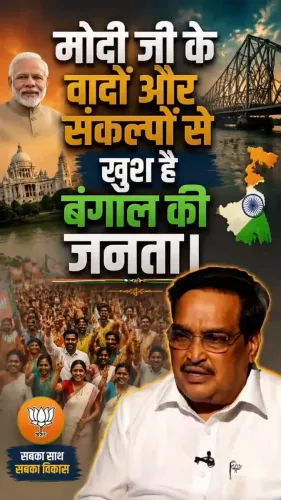
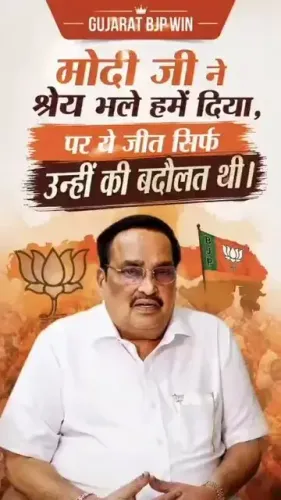
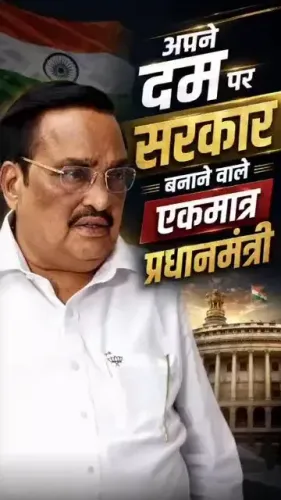
Jal Shakti Minister Paatil Defends PM Modi's Record, Calls Silence Proof of Democracy
Synopsis
Union Jal Shakti Minister C. R. Paatil posted on X defending PM Narendra Modi, arguing that bearing political attacks silently across a 23-year unblemished career — not a single stain in 10 years at the Centre and 13-14 years as Gujarat CM — is the greatest proof of democracy.
Key Takeaways
Union Jal Shakti Minister C.
Paatil posted on X on August 9, 2026 defending PM Narendra Modi against political criticism.
Paatil cited 10 years of majority governance at the Centre, 13-14 years as Gujarat Chief Minister, and a 23-year public career with 'not a single stain'.
He argued that absorbing abuse without retaliation is not compulsion but the 'greatest proof of democracy'.
The post included a video, suggesting the remarks originated in a speech or public address.
The messaging follows a long-standing BJP communications pattern of framing Modi's silence under attack as democratic statesmanship.
Enduring abuse in silence is not weakness — it is, Union Jal Shakti Minister C. R. Paatil argued on Sunday, August 9, 2026, the highest proof of democracy. In a pointed post on X, Paatil held up Prime Minister Narendra Modi's decades-long public record as a shield against what he described as relentless political attacks.
Translating his Hindi post, Paatil wrote: 'जो गालियां पड़ रही हैं, जिस प्रकार का ज़ुल्म हम पर हो रहा है, चुपचाप सहते जाना... मजबूरी नहीं है!' — 'The abuses being hurled, the kind of oppression being inflicted on us — bearing it silently is not compulsion!' He then catalogued what he called an unblemished career: 10 years leading the world's largest democracy with a full majority, 13-14 years as Gujarat's Chief Minister, and a 23-year public life — 'not a single stain.' A man absorbing all this without uttering a word, Paatil concluded, is the greatest proof democracy can offer.
The Record Paatil Is Defending
Modi served as Chief Minister of Gujarat from 2001 to 2014 before leading the BJP to a majority government at the Centre in 2014, a campaign built on promises of clean administration and anti-corruption governance. That 'spotless' narrative has been a cornerstone of BJP political messaging ever since — and Paatil's post slots squarely into that established tradition. The framing is deliberate: by pairing the scale of criticism with the length of Modi's record, Paatil is making a democratic-tolerance argument — that choosing not to retaliate, when you have the platform and the power to do so, is itself a democratic virtue. It is a rhetorical move the party has deployed repeatedly, casting opposition attacks as noise and the PM's silence as statesmanship.Combative Politics, Restrained Messenger
Paatil himself is no stranger to high-decibel political battles. A senior BJP leader and former Gujarat BJP state president, he has been one of the party's most reliable voices in the west. His current role as Union Minister of Jal Shakti — overseeing India's water security agenda — gives him a national platform, and he has used it here to wage a reputational defence of the Prime Minister rather than a policy argument. The post arrives with a video attached, suggesting the remarks may be drawn from a speech or public address, amplifying their reach beyond a text post alone. In Indian politics, where the volume of attack-and-counter rarely drops, Paatil's message is a reminder that silence, framed correctly, can be its own form of offence. The question opposition parties will now answer: does staying quiet look like strength, or does it invite more?Point of View
He converts a defensive posture into an offensive one, daring critics to name a specific charge that sticks. The framing of silence as democratic virtue is shrewd: it elevates restraint above retaliation and positions the PM as above the fray. Whether that argument lands depends entirely on whether the public reads the silence as dignity or as disengagement — a distinction opposition parties will be eager to exploit.
NationPress
9 Aug 2026
Frequently Asked Questions
What did C. R. Paatil say about PM Modi on X?
Paatil said that Modi bearing political abuse silently across a 23-year unblemished career — including 10 years at the Centre and 13-14 years as Gujarat CM — is the greatest proof of democracy, and that enduring it is not compulsion but a democratic virtue.
How long has Narendra Modi been in politics according to Paatil's post?
Paatil cited a 23-year public life for Modi, encompassing roughly 13-14 years as Chief Minister of Gujarat and over 10 years as Prime Minister of India.
Who is C. R. Paatil?
C. R. Paatil is the Union Minister of Jal Shakti and a senior BJP leader. He previously served as president of the BJP's Gujarat state unit and is one of the party's prominent voices in western India.
What is the BJP's 'clean governance' narrative?
Since 2014, the BJP has consistently argued that Modi's extended tenure at both the state and national level is free of personal corruption, using this record to deflect opposition attacks and reinforce its anti-corruption brand.
Why did Paatil call Modi's silence a proof of democracy?
Paatil argued that a leader who holds a full parliamentary majority and a long unblemished record, yet chooses not to retaliate against intense public criticism, demonstrates democratic restraint — framing silence as strength rather than weakness.