Jal Shakti Minister Paatil hails Varanasi's Suryakund makeover
Synopsis
Union Jal Shakti Minister C. R. Paatil celebrated the hi-tech makeover of Varanasi's ancient Suryakund, which now features a world-class musical fountain and a 3D laser light show projecting Kashi's millennia-old history onto water — a flagship moment in PM Modi's heritage and night-tourism push.
Key Takeaways
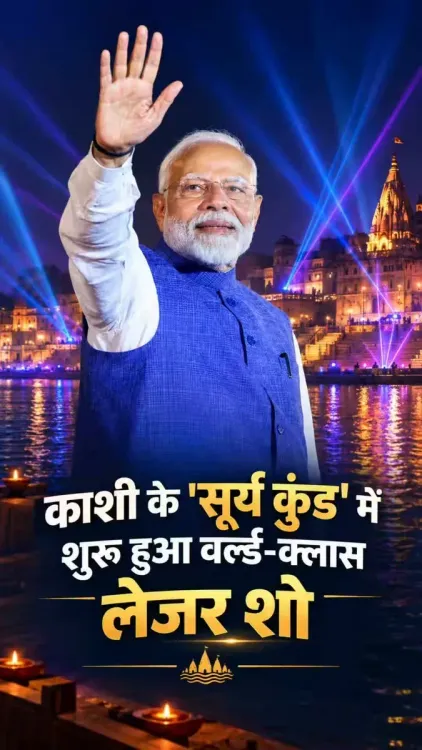
Suryakund , an ancient water tank in Varanasi , has been revamped with a world-class musical fountain and a 3D laser light show .
The 3D projection system displays thousands of years of Kashi's history on the surface of water after dark.
Union Jal Shakti Minister C.
Paatil credited the project to PM Narendra Modi's heritage and tourism vision.
The intervention forms part of the broader Namami Gange programme (launched 2015 ) and Smart Cities Mission riverfront upgrades in Varanasi.
Paatil framed the project as lifting Banaras's night tourism to an international standard.
Ancient spirituality meets twenty-first-century spectacle on the ghats of Varanasi — and Union Jal Shakti Minister C. R. Paatil wants the world to take notice. On 30 September 2026, Paatil took to X to celebrate the sweeping transformation of the historic Suryakund, an ancient water tank in the sacred city, crediting the heritage and tourism vision of Prime Minister Narendra Modi for turning Kashi's nights as 'hi-tech and magical' as its days are spiritual.
What rose at Suryakund: a world-class fountain meets 3D history
The centrepiece of the makeover, according to Paatil's post, is a world-class musical fountain paired with a 3D laser light show — a combination that projects thousands of years of Kashi's history onto the surface of the water after dark. The minister described the intervention as far more than a cleaning drive: the ghats were restored and, on top of that, an immersive night-time experience was layered in. 'Now, through 3D projection on water waves at night, Kashi's history of thousands of years is being shown,' he wrote, signing off with 'Har Har Mahadev' — the city's ancient invocation of Lord Shiva.
Namami Gange and Varanasi's decade-long riverfront revival
Suryakund's transformation fits into a larger, sustained infrastructure push that has reshaped Varanasi since 2014. The Namami Gange programme, launched in 2015, provided the central framework: ghat cleaning, riverfront infrastructure, and Ganga rejuvenation work running in parallel across dozens of towns. Varanasi, as Modi's own parliamentary constituency, became the flagship showcase — with successive phases adding lighting, visitor facilities, and riverfront walkways under the Smart Cities Mission and associated heritage initiatives. The musical fountain and 3D show at Suryakund represent the latest — and arguably most theatrically ambitious — addition to that decade-long effort.
Night tourism as the new frontier for India's heritage cities
Paatil's post frames the Suryakund project explicitly as a boost to 'night tourism' — the emerging policy idea that heritage destinations must give visitors a reason to stay after sunset. By extending the active visitor window into the evening, cities can multiply economic activity around hospitality, food, and guided experiences without adding pressure to already-crowded daytime circuits. Similar light-and-sound installations at monuments across India have demonstrated measurable upticks in footfall. The pattern is clear: the government is systematically converting spiritual geography into round-the-clock destination tourism, and Varanasi is the most visible laboratory for that ambition.
Whether Suryakund's musical fountain triggers a comparable roll-out at other Ganga ghats and towns will be the real test of this model's scalability — and the metric that planners and investors alike will be watching closely.
Point of View
Already deployed at several monument sites, is becoming a template the Centre appears ready to replicate across other Ganga towns. The political subtext is equally legible: keeping Varanasi's transformation visible and celebratory ahead of any electoral cycle reinforces the BJP's core narrative of cultural revival married to developmental governance.
NationPress
30 Sept 2026
Frequently Asked Questions
What is the new attraction at Suryakund Varanasi?
Suryakund in Varanasi now features a world-class musical fountain and a 3D laser light show that projects Kashi's thousands of years of history onto the surface of water after dark, according to Union Jal Shakti Minister C. R. Paatil.
What is Suryakund in Varanasi?
Suryakund is an ancient water tank in Varanasi associated with the city's heritage sites. It has recently undergone a major revamp that added modern light-and-sound installations alongside ghat-cleaning work.
How is the Namami Gange programme connected to Varanasi ghat development?
The Namami Gange programme, launched in 2015, funds Ganga rejuvenation and ghat infrastructure across India. In Varanasi, it has supported successive phases of ghat cleaning, lighting, and visitor-facility upgrades, of which the Suryakund makeover is the latest example.
What is night tourism and why is the government promoting it in Varanasi?
Night tourism refers to attractions and activities that keep visitors engaged after sunset. By adding a musical fountain and 3D light show at Suryakund, the government aims to extend visitor hours, boost local hospitality spending, and position Varanasi as an international-level destination around the clock.
Why did C. R. Paatil post about Varanasi's Suryakund?
As a senior BJP leader and Union Jal Shakti Minister overseeing the Namami Gange programme, Paatil posted on 30 September 2026 to highlight the Suryakund transformation as an achievement of PM Modi's heritage and tourism vision for Kashi.