Jal Shakti Minister Paatil hails Kashi Station's multimodal makeover
Synopsis
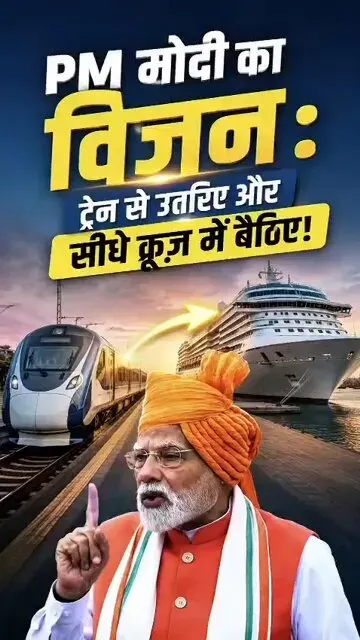
Union Jal Shakti Minister C. R. Paatil has spotlighted the Rs 300-crore-plus redevelopment of Kashi Railway Station in Varanasi, which will connect the station to the Ganga riverfront via a skywalk to Namo Ghat and an Inland Waterway Terminal, alongside a new double-decker bridge — positioning it as India's only tri-modal rail-road-water station.
Key Takeaways
Union Jal Shakti Minister C.
Paatil highlighted the Kashi Railway Station redevelopment on 19 July 2026 .
The project is estimated to cost over Rs 300 crore , according to the minister's post.
A skywalk will directly connect the station to Namo Ghat and an Inland Waterway Terminal on the Ganga.
A double-decker bridge adjacent to the station will carry trains on the lower deck and road vehicles on the upper deck.
The station is described as India's only facility linked simultaneously by rail, road, and inland waterway .
The project converges funding and mandates from National Waterway 1 , Namami Gange , and the central railway redevelopment programme.
Union Jal Shakti Minister C. R. Paatil on Sunday, 19 July 2026, highlighted the ongoing redevelopment of Kashi Railway Station in Varanasi, describing it as a landmark multimodal project that will connect the station directly to the Ganga riverfront by rail, road, and water.
Posting in Hindi on X, Paatil wrote: 'क्या आपने कभी ऐसे रेलवे स्टेशन की कल्पना की है, जहाँ से आप सीधे गंगा जी की लहरों तक पहुँच सकें?' ('Have you ever imagined a railway station from which you can reach the waves of the Ganga directly?'). He credited the project to the 'visionary leadership' of Prime Minister Narendra Modi.
Context
According to the minister's post, the Kashi Railway Station redevelopment is being undertaken at a cost of over Rs 300 crore. The project is positioned as India's only station to be connected simultaneously by water, road, and rail — what the post terms 'jal, thal aur rail' (water, land, and rail). A dedicated skywalk is being constructed to link the station directly to Namo Ghat and an Inland Waterway Terminal on the Ganga.
The post also describes a double-decker bridge coming up adjacent to the station, with train movement on the lower deck and road traffic on the upper deck. Paatil characterised the finished station as offering airport-like amenities for domestic and international tourists, signing off with the devotional phrase 'Har Har Mahadev' — a salutation associated with Varanasi, the city of Lord Shiva.
Policy Backdrop
The Kashi Station redevelopment sits at the intersection of several central government programmes. National Waterway 1 (NW-1), formally developed from 2016, runs along the Ganga river linking Varanasi to Haldia in West Bengal, and includes inland waterway terminals at key points along the route. The Namami Gange programme, launched in 2014, has funded ghat development and riverfront infrastructure in Varanasi, including Namo Ghat.
A broader railway station redevelopment drive, expanded from 2015, has sought to upgrade major stations with improved passenger amenities. Varanasi has also been a focus city under the Smart City Mission, with integrated urban and tourism infrastructure receiving central funding since 2015. The convergence of these streams makes the Kashi Station project a test case for multimodal connectivity at a heritage pilgrimage site.
Stakeholders and Impact
Varanasi receives millions of pilgrims and tourists annually, drawn to its ghats, temples, and the Ganga. Seamless connectivity between the railway station and the riverfront has long been a logistical challenge, with visitors typically relying on auto-rickshaws and cycle-rickshaws for the last mile to the ghats. A direct skywalk to Namo Ghat and the waterway terminal would significantly reduce transit time and congestion for this footfall.
Local transport operators, hoteliers, and the broader tourism ecosystem stand to benefit from higher tourist throughput and smoother visitor movement. The inland waterway terminal, once operational, could also enable river cruise connectivity along NW-1, opening a new tourism corridor between Varanasi and downstream destinations.
What's Next
The phased completion of the skywalk and the double-decker bridge will be closely watched as indicators of project progress. The rollout of additional inland waterway terminals along NW-1 is also expected to determine how effectively the Varanasi terminal integrates with the broader river transport network.
If delivered as described, the Kashi Station project could serve as a blueprint for similar multimodal nodes at other riverine pilgrimage centres across India, where rail, road, and water infrastructure currently remain disconnected.
Point of View
Amplifying a flagship infrastructure project in Varanasi — a constituency of deep symbolic importance to the BJP — ahead of what is likely continued political focus on the city. The framing of Kashi Station as India's sole tri-modal node is a branding move that ties together three separate central schemes — railway redevelopment, Namami Gange, and NW-1 — into a single, voter-legible narrative. As a Jal Shakti minister, Paatil's public enthusiasm for a railway-and-waterway project underscores the Centre's strategy of presenting cross-ministry convergence as a hallmark of the Modi government's infrastructure approach. The broader pattern — similar multimodal announcements for other riverine pilgrimage cities — suggests Varanasi is being positioned as the proof-of-concept for a replicable model.
NationPress
18 Oct 2026
Frequently Asked Questions
What is the Kashi Railway Station redevelopment project?
The Kashi Railway Station redevelopment is a project in Varanasi costing over Rs 300 crore, aimed at transforming the station into a multimodal hub connected by rail, road, and the Ganga inland waterway via a skywalk to Namo Ghat and an Inland Waterway Terminal.
What is Namo Ghat in Varanasi?
Namo Ghat is a riverfront ghat in Varanasi developed under central river conservation and beautification schemes, including the Namami Gange programme. It is set to be linked to Kashi Railway Station by a dedicated skywalk.
What is the double-decker bridge near Kashi Station?
A double-decker bridge is being built adjacent to the redeveloped Kashi Railway Station, with train movement on the lower level and road vehicle traffic on the upper level, improving connectivity in the Varanasi area.
What is National Waterway 1 and how does it relate to Varanasi?
National Waterway 1 is India's inland waterway route along the Ganga river, linking Varanasi to Haldia in West Bengal. An Inland Waterway Terminal at Varanasi, connected to the redeveloped Kashi Station, is part of this NW-1 infrastructure.
Why did Jal Shakti Minister C. R. Paatil post about a railway station project?
The Kashi Station project integrates inland waterway infrastructure — which falls under the Jal Shakti ministry's broader mandate for river and water connectivity — with railway and road upgrades, making it relevant for Paatil to highlight as an example of cross-ministry convergence.