Jal Shakti Minister Paatil hails Varanasi as BRICS Culture hub
Synopsis
Union Jal Shakti Minister C. R. Paatil on 17 June 2026 highlighted Varanasi's role as host of the BRICS Culture Working Group meeting, drawing a parallel with Kyoto and crediting PM Modi's 'heritage with development' vision for the city's rising global profile.
Key Takeaways
Paatil , Union Jal Shakti Minister, posted on 17 June 2026 celebrating Varanasi's selection to host the BRICS Culture Working Group meeting.
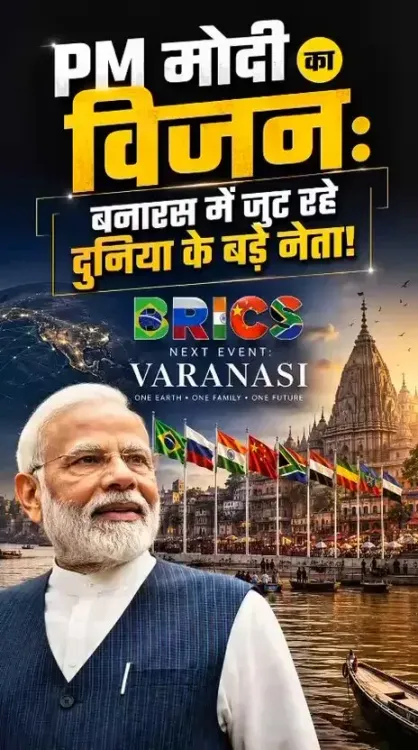
Representatives from Brazil, Russia, China and South Africa are set to gather in Varanasi in June 2026 to discuss heritage conservation and culture.
Paatil compared Varanasi to Kyoto , framing it as India's equivalent of a globally recognised heritage-diplomacy city.
The minister invoked the 'विरासत भी, विकास भी' ('heritage too, development too') philosophy, directly linked to government schemes such as HRIDAY , the Smart Cities Mission and the Kashi Vishwanath Corridor .
The event is part of India's broader strategy of using historic non-metro cities as venues for multilateral cultural diplomacy to project soft power.
PM Narendra Modi 's parliamentary constituency of Varanasi has been a flagship urban-renewal and cultural-projection site since 2014 .
Union Jal Shakti Minister C. R. Paatil on Wednesday, 17 June 2026 celebrated Varanasi's emerging role as a global cultural diplomacy venue, highlighting the city's scheduled hosting of the BRICS Culture Working Group meeting in June 2026 as a landmark moment for India's ancient heritage capital.
Context
Paatil posted in Hindi, asking rhetorically: 'क्या आपने कभी सोचा था कि हमारी प्राचीन काशी, क्योटो की तरह दुनिया के सबसे बड़े कूटनीतिक और सांस्कृतिक आयोजनों का केंद्र बनेगी?' — 'Did you ever think that our ancient Kashi would become a centre of the world's biggest diplomatic and cultural events, like Kyoto?' He drew a direct parallel between Varanasi and Kyoto, Japan's globally recognised heritage city, framing India's own ancient capital as its equivalent on the world stage.
The minister credited Prime Minister Narendra Modi for this transformation, stating that under his leadership, Kashi's global identity has reached 'a new milestone.' The post noted that representatives from Brazil, Russia, China and South Africa — fellow BRICS members — would gather on Varanasi's soil to deliberate on 'heritage conservation' and culture.
Policy Backdrop
Varanasi has been a consistent focus of central government investment since 2014, when PM Modi chose it as his parliamentary constituency. The Kashi Vishwanath Corridor, inaugurated in 2019, physically reconnected the iconic temple to the Ganga ghats and drew millions of visitors, signalling the government's intent to position the city as a living symbol of India's civilisational continuity.
The city has also been included under the HRIDAY (Heritage City Development and Augmentation Yojana) and Smart Cities Mission, blending conservation with modern urban infrastructure. This 'heritage with development' philosophy — 'विरासत भी, विकास भी' ('heritage too, development too') — is the precise formulation Paatil invoked in his post.
BRICS, the grouping of Brazil, Russia, India, China and South Africa, has progressively expanded its agenda beyond economics and security to include people-to-people exchanges and cultural cooperation. India hosted the 2021 BRICS Summit and has consistently advocated for stronger cultural tracks within the grouping.
Stakeholders and Impact
For Varanasi's residents, artisans, temple trusts, and the tourism and hospitality sector, hosting a multilateral BRICS cultural meeting represents both economic opportunity and symbolic recognition. Heritage professionals and conservation experts are among the direct stakeholders, as 'heritage preservation' is listed as a core agenda item for the working group discussions.
At a broader level, the event fits India's deliberate strategy of using historic non-metro cities as backdrops for multilateral diplomacy — projecting soft power while simultaneously driving investment and visibility to cities beyond New Delhi and Mumbai. The Kyoto comparison in Paatil's post signals an ambition to brand Varanasi internationally as a permanent cultural-diplomacy venue rather than a one-time host.
What's Next
The official agenda, delegation lists from BRICS member states, and any joint statements emerging from the June 2026 BRICS Culture Working Group meeting in Varanasi will be closely watched. Outcomes could shape India's cultural diplomacy posture within BRICS and may feed into the country's broader 2026 cultural calendar.
If the meeting produces a substantive joint declaration on heritage conservation, it would mark one of the more concrete multilateral cultural outcomes hosted outside a national capital in recent years — and further cement Varanasi's positioning as a node in India's soft-power architecture.
Point of View
Weaving together civilisational pride, Modi's personal association with Varanasi, and India's multilateral ambitions into a single narrative. The Kyoto comparison is deliberate — it positions Varanasi not as a pilgrimage city but as a peer of the world's most respected heritage capitals, a framing that serves both domestic electoral messaging and international soft-power goals. The invocation of 'heritage too, development too' signals continuity with a well-established BJP governmental philosophy that has underpinned investment in Varanasi since 2014. If the BRICS Culture Working Group meeting delivers tangible outcomes, it will validate a strategy of decentralising India's diplomatic footprint beyond New Delhi.
NationPress
22 Sept 2026
Frequently Asked Questions
What is the BRICS Culture Working Group meeting in Varanasi about?
The BRICS Culture Working Group meeting scheduled in Varanasi in June 2026 is focused on heritage conservation and cultural cooperation among BRICS member states — Brazil, Russia, India, China and South Africa.
Why is Varanasi hosting a BRICS meeting?
Varanasi has been positioned by the central government as a flagship heritage-and-development city, making it a symbolic choice to host multilateral cultural diplomacy events that align with India's soft-power strategy.
What did C. R. Paatil say about Varanasi and Kyoto?
Paatil asked rhetorically whether anyone imagined ancient Kashi becoming a centre of global diplomatic and cultural events like Kyoto, drawing a direct parallel to highlight Varanasi's rising international profile under PM Modi's leadership.
What is the 'heritage too, development too' philosophy linked to Varanasi?
The phrase refers to the central government's approach of combining heritage conservation — through projects like the Kashi Vishwanath Corridor and the HRIDAY scheme — with modern urban infrastructure under the Smart Cities Mission in Varanasi.
What is C. R. Paatil's role in the government?
C. R. Paatil is the Union Minister of Jal Shakti, a senior BJP leader and former Gujarat state president. His post on Varanasi reflects party-level enthusiasm for the city's global cultural projection rather than a Jal Shakti ministry initiative.