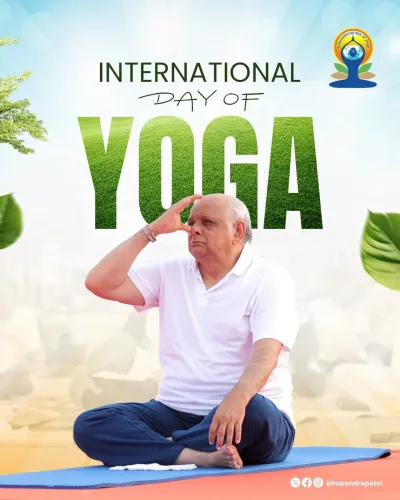
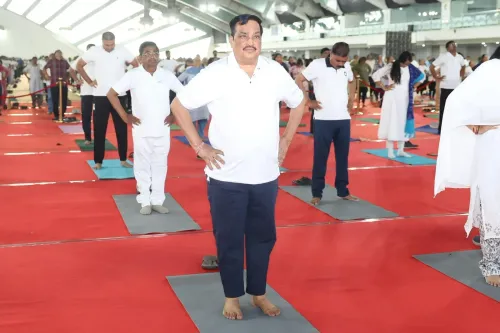
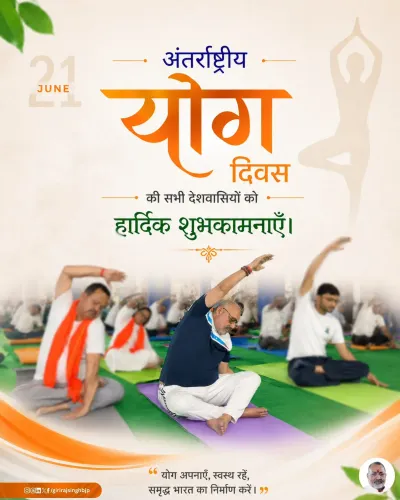
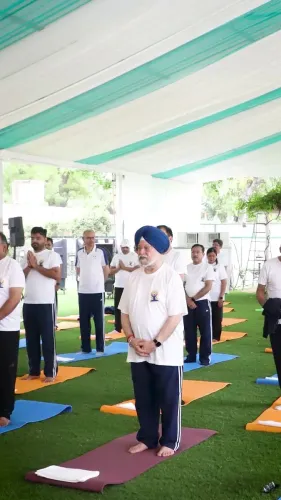
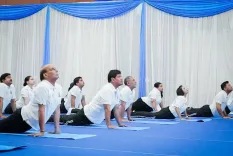
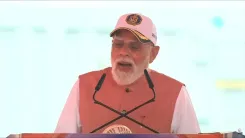
Jal Shakti Minister Paatil Marks International Yoga Day

Synopsis
Union Jal Shakti Minister C. R. Paatil marked International Yoga Day on 21 June by crediting PM Modi with making yoga a global mass movement and urging all Indians to adopt the practice daily as part of the Viksit Bharat vision.
Key Takeaways
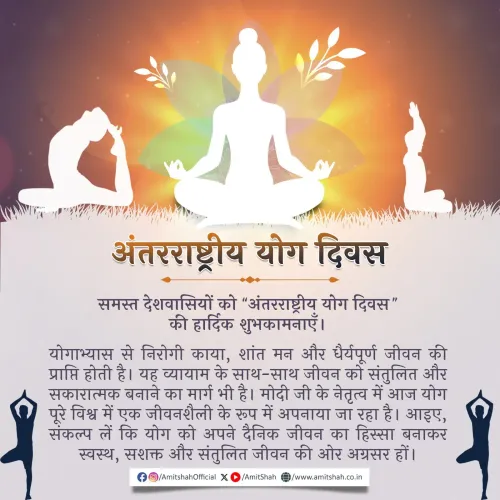
Paatil posted greetings on International Yoga Day, 21 June , calling yoga an invaluable gift of Indian culture to the world.
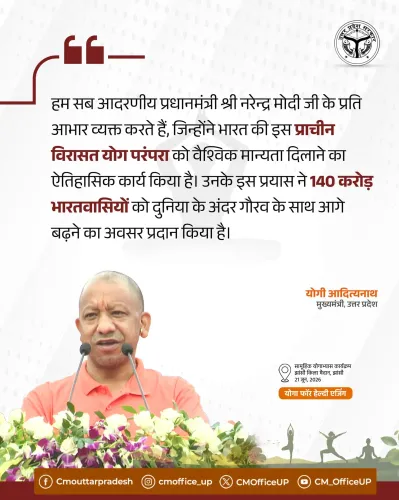
He credited Prime Minister Narendra Modi with turning yoga into a worldwide mass movement embraced by crores of people.
The minister appealed to citizens to make yoga a daily habit in pursuit of Swasth Bharat and Viksit Bharat .
International Yoga Day was established by the UN General Assembly in 2014 following PM Modi's proposal, with over 190 countries participating annually.
India has consistently used the observance as a soft-power and cultural diplomacy platform since its inception.
Union Jal Shakti Minister C. R. Paatil greeted citizens on International Yoga Day, 21 June, calling yoga an invaluable gift of Indian culture to humanity and urging every Indian to make it a daily practice in service of a healthy and developed India.
Context
In a post on X, Minister Paatil wrote: 'जब भारत अपनी सांस्कृतिक धरोहर को दुनिया के साथ साझा करता है, तो वह केवल परंपरा नहीं, बल्कि मानवता के कल्याण का मार्ग भी प्रस्तुत करता है' — 'When India shares its cultural heritage with the world, it offers not merely tradition but also a path to the welfare of humanity.' He credited Prime Minister Narendra Modi with transforming yoga into a global mass movement, noting that crores of people have embraced the practice to lead healthier, more balanced, and more positive lives.
The minister concluded with a direct appeal to citizens: adopt yoga as part of your daily routine and thereby strengthen the resolve of a Swasth Bharat (Healthy India) and Viksit Bharat (Developed India).
Policy Backdrop
International Yoga Day owes its existence to a proposal Prime Minister Modi made at the United Nations General Assembly in 2014, shortly after assuming office. The UN adopted 21 June as the International Day of Yoga that same year, with an unprecedented number of co-sponsoring nations, marking one of the fastest resolutions of its kind in UN history.
Since then, the Indian government has consistently used the occasion to advance cultural diplomacy, organising large-scale events both domestically and at Indian missions abroad. Successive editions have seen participation from heads of state, defence personnel, schoolchildren, and diaspora communities across 190-plus countries. The day has become a flagship element of India's soft-power narrative, linking ancient wellness traditions to contemporary public-health goals.
Stakeholders and Impact
For Indian citizens, the annual observance reinforces institutional messaging around preventive healthcare, mental well-being, and lifestyle discipline. Yoga's integration into school curricula and government wellness programmes has expanded its reach beyond urban practitioners to rural communities.
Globally, the day gives Indian cultural institutions, embassies, and diaspora organisations a coordinated platform to project India's civilisational contributions. For the BJP, of which Minister Paatil is a senior leader and former Gujarat state president, yoga advocacy dovetails with the broader cultural-nationalist agenda that positions India's heritage as a solution to modern challenges.
What's Next
Attention will now turn to the scale of official participation in this year's central government events and whether new institutional steps — such as deeper yoga integration in national health schemes or school timetables — are announced in the coming weeks. Minister Paatil's appeal to citizens to embed yoga in daily life signals continued political investment in the practice as a pillar of the Viksit Bharat vision, suggesting the government will sustain high-visibility programming around the observance in future years as well.
Point of View
But it reinforces a deliberate and decade-long government strategy of anchoring India's global identity in civilisational heritage. By explicitly linking yoga to the 'Viksit Bharat' development narrative, the BJP continues to fuse cultural soft power with its domestic political brand. The repeated invocation of PM Modi as the architect of yoga's global spread personalises institutional achievement in ways that serve both diplomatic and electoral messaging. As the 2026 observance unfolds, the government's ability to demonstrate concrete health outcomes — rather than just scale of participation — will determine whether yoga diplomacy deepens or plateaus.
NationPress
21 Jun 2026
Frequently Asked Questions
When is International Yoga Day celebrated?
International Yoga Day is celebrated every year on 21 June , a date established by the UN General Assembly in 2014 following a proposal by Prime Minister Narendra Modi .
What did C. R. Paatil say on International Yoga Day 2026?
Minister C. R. Paatil greeted citizens and called yoga an invaluable gift of Indian culture to humanity, credited PM Modi with making it a global movement, and urged all Indians to practise yoga daily to strengthen the Viksit Bharat vision.
Who is C. R. Paatil?
C. R. Paatil is the Union Minister of Jal Shakti , a senior BJP leader, and a former president of the BJP Gujarat state unit .
How did International Yoga Day start?
PM Narendra Modi proposed an international yoga day at the UN General Assembly in 2014 ; the UN adopted 21 June as the International Day of Yoga that same year, with an unprecedented number of co-sponsoring nations.
What is Viksit Bharat?
' Viksit Bharat ' — meaning 'Developed India' — is the Indian government's overarching vision for transforming India into a fully developed nation, which ministers including C. R. Paatil link to initiatives spanning health, culture, and economic growth.