Jal Shakti Minister Paatil meets Assam's Piyush Hazarika

Synopsis
Union Jal Shakti Minister C. R. Paatil met Assam Agriculture and Irrigation Minister Piyush Hazarika to discuss water-resource management, irrigation expansion and Centre-state coordination on Jal Shakti issues, pledging work on Assam's water security under Prime Minister Narendra Modi's guidance.
Key Takeaways
Union Jal Shakti Minister C.
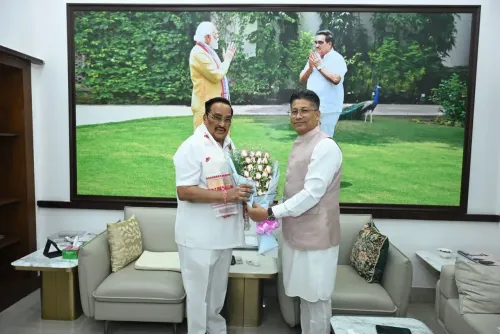
Paatil met Assam Agriculture, Irrigation and Parliamentary Affairs Minister Piyush Hazarika on 25 November 2026.
Talks covered water-resource management, irrigation expansion and Jal Shakti Ministry issues in Assam.
Paatil said the Centre and state are committed to Assam's sustainable development and water security under PM Narendra Modi's guidance.
National schemes framing the agenda include Pradhan Mantri Krishi Sinchayee Yojana (2015) and Jal Jeevan Mission (2019).
Assam's flood-and-irrigation challenge along the Brahmaputra remains the practical test of Centre-state coordination.
Union Jal Shakti Minister C. R. Paatil on 25 November 2026 met Assam Agriculture, Irrigation and Parliamentary Affairs Minister Piyush Hazarika to align work on water-resource management and irrigation in Assam. The talks, he said, covered how the Centre and the state can tighten coordination on Jal Shakti subjects that decide whether farms get water — or floods do.
Posting in Hindi after the meeting, Paatil said he had held a सार्थक चर्चा (meaningful discussion) on better management of Assam's water resources, expansion of irrigation facilities, and various subjects linked to the Jal Shakti Ministry. He added: 'Under the guidance of Hon'ble Prime Minister Shri Narendra Modi, we are committed to ensuring Assam's sustainable development and water security through mutual coordination of the Centre and state governments.'
Paatil and Hazarika lock on Assam irrigation
Hazarika holds the Agriculture, Irrigation and Parliamentary Affairs portfolio in the Assam government — the state-side brief that sits closest to canals, command areas and crop calendars. Paatil, a senior BJP leader and former Gujarat state president, heads the Union ministry that steers national water resources, irrigation and drinking-water missions.
The minister's message does not list project-wise outcomes. What it does flag is the agenda: better water-resource management in Assam, a wider irrigation footprint, and a live Centre-state channel on Jal Shakti files.
PMKSY and Jal Jeevan Mission set the frame
National irrigation and water missions already sit behind such meetings. The Pradhan Mantri Krishi Sinchayee Yojana, launched in 2015, was designed to expand irrigation coverage and lift water-use efficiency. The Jal Jeevan Mission, announced in 2019, aims at functional household tap connections and water conservation, including in northeastern states such as Assam.
Northeastern states have drawn focused attention for flood management along the Brahmaputra and for irrigation expansion through central schemes. Assam's farmers and rural households are the people who feel both the monsoon surplus and the dry-season shortfall. Coordination of this kind is how state priorities get lined up with national water-security objectives — the work after the handshake is funding, clearances and construction.
Watch for follow-up project announcements or funding releases for irrigation works in Assam, and for any joint review between the Jal Shakti Ministry and the Assam government. For Assam's fields, the meeting will count when more command area actually receives water — and when floodwaters do not wash the same investment away.
Point of View
Invokes Prime Minister Narendra Modi, and restates a shared commitment without listing a rupee or a kilometre of canal. Assam's water story is not scarcity alone; it is flood, silt and last-mile irrigation together, especially along the Brahmaputra. Schemes such as PMKSY and Jal Jeevan Mission give the Centre a standing role in state water files. The political signal is alignment; the governance test is whether Dispur and Delhi convert talking points into sanctioned works before the next flood season.
NationPress
25 Nov 2026
Frequently Asked Questions
Who did C. R. Paatil meet on 25 November 2026?
He met Assam Agriculture, Irrigation and Parliamentary Affairs Minister Piyush Hazarika. The Union Jal Shakti minister said they discussed water-resource management, irrigation expansion and related Jal Shakti issues.
What is the Jal Shakti Ministry?
It is the Union ministry responsible for national water resources, irrigation and related schemes. C. R. Paatil currently heads the ministry.
Which central schemes cover irrigation and tap water in Assam?
The Pradhan Mantri Krishi Sinchayee Yojana, launched in 2015, aims to expand irrigation coverage and water-use efficiency. The Jal Jeevan Mission, announced in 2019, seeks functional household tap connections and water conservation in states including Assam.
Who is Piyush Hazarika?
Piyush Hazarika is Assam's minister for Agriculture, Irrigation and Parliamentary Affairs. He is the state counterpart Paatil met on water and irrigation coordination.
Did the meeting announce new irrigation projects in Assam?
No specific project or funding outcome was listed in the minister's message. Paatil described a meaningful discussion and a commitment to Centre-state coordination on Assam's water security.