CM Sai Hails Jashpur's Four Bihan Didis as Drone Pilots
Synopsis
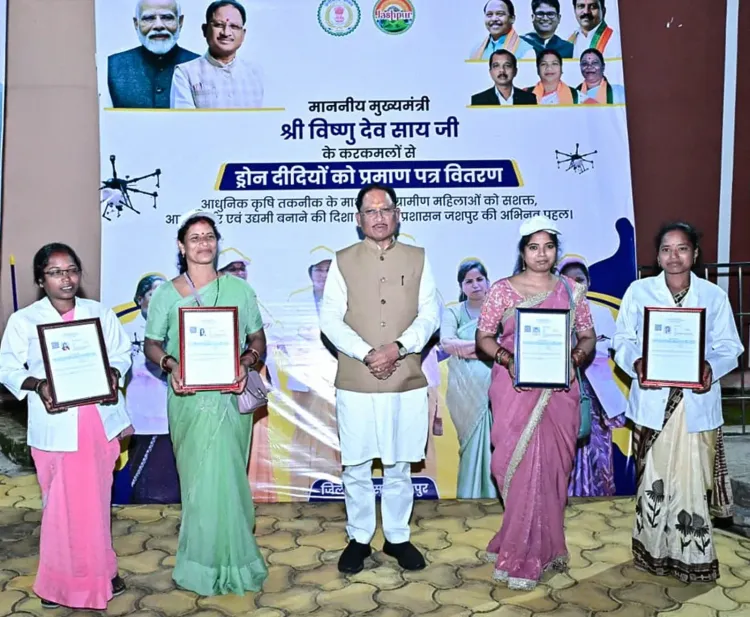
Four Bihan Didis from Jashpur district in Chhattisgarh have completed certified drone pilot training, with CM Vishnu Deo Sai hailing the achievement as a new milestone in rural women's self-reliance under the Atmanirbhar Bharat framework.
Key Takeaways
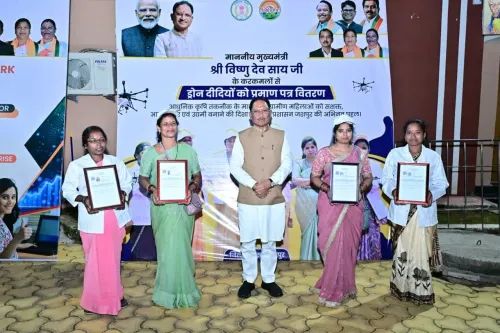
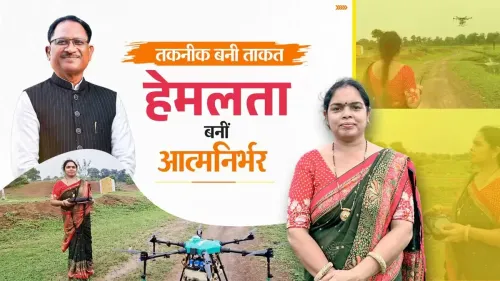
Four Bihan Didis from Jashpur district , Chhattisgarh, have completed certified drone pilot training.
CM Vishnu Deo Sai publicly celebrated the milestone on 5 November 2026 , calling it a 'new example of self-reliance'.
Bihan Didis are members of Chhattisgarh's self-help group network under the National Rural Livelihood Mission (NRLM) , launched nationally in 2011 .
Jashpur has a large tribal and rural population, making the achievement significant in a historically underserved district.
Drone training for SHG women is part of the broader Atmanirbhar Bharat push to connect rural women with emerging agricultural technologies.
The key policy watch is whether Chhattisgarh scales the programme to additional districts with budget allocations for equipment and certification.
Four women from Jashpur district in northern Chhattisgarh have done something that would have seemed implausible in a tribal rural belt just a few years ago — they have cleared certified drone pilot training, turning an ambition into a licence. Chhattisgarh Chief Minister Vishnu Deo Sai took to X on Thursday, 5 November 2026 to celebrate the milestone, calling it a 'new example of self-reliance' set by the state's daughters.
Posting in Hindi, CM Sai wrote: 'Jab Chhattisgarh ki betiyan apne hausle aur mehnat se safalta ki nayi udaan bharti hain, toh man garv se bhar uthta hai' — 'When the daughters of Chhattisgarh take flight on the wings of courage and hard work, the heart swells with pride.' He identified the four women as Bihan Didis — members of Chhattisgarh's flagship self-help group programme — and credited Prime Minister Narendra Modi's leadership for connecting rural women with modern technology.
Who are the Bihan Didis of Jashpur?
The Bihan initiative is Chhattisgarh's implementation of the National Rural Livelihood Mission (NRLM), a central government programme that has supported skill training for women's self-help groups since 2011. Bihan Didis are typically SHG members drawn from rural and often tribal communities, enrolled in livelihood and vocational programmes ranging from agri-finance to now — drones. Jashpur, a district with a large tribal population tucked into Chhattisgarh's northern tip, is exactly the kind of geography these programmes target: resource-rich but opportunity-scarce.
Completing certified drone pilot training is not a checkbox exercise. It involves hours of ground theory, flight simulation, and supervised hands-on flying under Civil Aviation requirements — a genuinely technical credential. For four women from rural Jashpur, clearing that bar is a concrete, verifiable leap.
Drones, Didis, and the Atmanirbhar Bharat Arc
Drone training for SHG women has emerged as a signature strand of Atmanirbhar Bharat messaging in BJP-governed states. The logic is deliberate: drones have immediate, revenue-generating applications in precision agriculture — spraying, field mapping, crop health monitoring — meaning a trained pilot in a farming district is not a novelty, she is an asset. By channelling that opportunity through the existing SHG network, the state links women's economic agency to a technology sector growing fast enough to absorb new entrants.
Similar drone pilot cohorts for rural women have been rolled out in other states under NRLM extensions, but Chhattisgarh's tribal belt adds a layer of significance: these are communities where basic digital literacy was itself a recent achievement. Jashpur's four new pilots land, in that sense, well ahead of where policy projections placed them.
What comes next for Chhattisgarh's drone pipeline
The immediate question is scale. A batch of four is a proof of concept; a programme is what changes livelihoods at district level. Watchers of Chhattisgarh's rural development budget will be looking for signals on whether the state expands training cohorts to other districts, allocates funds for drone equipment and ongoing certification, and builds an agricultural services market that actually employs these pilots once licensed.
CM Sai's public celebration of the Jashpur four is itself a political signal — that the government intends to keep this story visible. Whether the pipeline widens from four to four hundred is the number that will determine whether today's pride becomes lasting policy.
Point of View
Trusted SHG infrastructure to a high-visibility emerging technology, making the story legible both locally and nationally. The real test, however, is whether this remains a symbolic first batch or becomes a scalable pipeline — the gap between the two is exactly where rural development policy in India most often stalls. Analysts tracking women's economic empowerment in Chhattisgarh will watch district-level budget lines, not press releases, for the answer.
NationPress
5 Nov 2026
Frequently Asked Questions
Who are Bihan Didis in Chhattisgarh?
Bihan Didis are women members of self-help groups under Chhattisgarh's Bihan programme, which is the state's implementation of the National Rural Livelihood Mission (NRLM). They receive skill and livelihood training ranging from agri-finance to, now, drone piloting.
What is the drone pilot training for rural women in India?
Several state governments, under extensions of the NRLM framework and Atmanirbhar Bharat schemes, have been training women SHG members as certified drone pilots. The training covers ground theory, flight simulation, and supervised flying, giving women a marketable credential for agricultural drone services.
Where is Jashpur district in Chhattisgarh?
Jashpur is a district in northern Chhattisgarh with a significant tribal population. It is one of the state's rural districts targeted by livelihood and skill development programmes for women.
What did CM Vishnu Deo Sai say about the Jashpur drone pilots?
CM Sai posted on X on 5 November 2026 that the four Bihan Didis from Jashpur had 'set a new example of self-reliance' by completing drone pilot training, expressing pride in the achievement and crediting PM Modi's leadership for connecting rural women with modern technology.
What is the Atmanirbhar Bharat scheme for women?
Atmanirbhar Bharat is a broad government initiative promoting self-reliance across sectors. For rural women, it has manifested in skill development programmes under NRLM, including drone pilot training, to link SHG members with emerging technologies that have direct agricultural income potential.