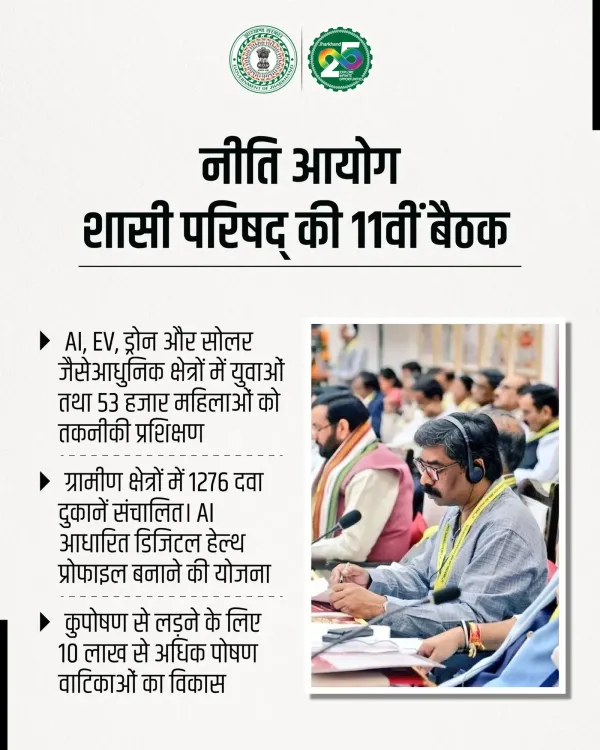
Jharkhand CMO flags AI health profile plan, 1,276 drug shops
Synopsis
The Jharkhand CMO announced an AI-enabled Digital State Health Profile to fast-track management of anaemia, malaria and sickle cell disease, crediting SAAMAR and Poshan Abhiyan for malnutrition gains, and cited 1,276 medicine shops serving remote communities.
Key Takeaways
The Jharkhand CMO announced plans for an AI-enabled Digital State Health Profile targeting anaemia, malaria and sickle cell disease management.
The state credits the SAAMAR programme and Poshan Abhiyan with notable improvement in malnutrition outcomes.
1,276 medicine shops are operational to deliver healthcare access in remote and tribal areas of Jharkhand.
The digital health initiative aligns with the national Ayushman Bharat Digital Mission (2021) and the National Sickle Cell Anaemia Elimination Mission targeting 17 crore tribal residents by 2047 .
Jharkhand's tribal communities, malnourished children and women in forested districts are the primary beneficiaries.
Integration of the AI profile with existing health management information systems remains a key milestone to watch.
The Chief Minister's Office of Jharkhand announced on Thursday, 11 June 2026 that the state is preparing an AI-enabled Digital State Health Profile to accelerate management of anaemia, malaria and sickle cell disease, while citing notable progress in malnutrition reduction through the SAAMAR programme and Poshan Abhiyan. The post also noted that 1,276 medicine shops are operational to extend health services to remote areas.
Context
The post, shared in Hindi, states: 'SAAMAR karyakram va Poshan Abhiyan ke zariye kuposan mein ullekhaniya sudhar aaya hai' ('Significant improvement in malnutrition has come through the SAAMAR programme and Poshan Abhiyan'). It further says an AI-enabled Digital State Health Profile is being prepared for rapid management of diseases such as anaemia, malaria and sickle cell. The announcement underscores the state government's intent to bridge digital health infrastructure with ground-level nutrition delivery.
Policy Backdrop
SAAMAR is a Jharkhand-specific scheme targeting severe acute malnutrition and anaemia through community interventions, particularly in tribal districts. It runs alongside Poshan Abhiyan, India's National Nutrition Mission launched in 2018, which aims to reduce stunting, under-nutrition and anaemia among children and women nationwide.
The proposed digital profile aligns with the Ayushman Bharat Digital Mission, rolled out in 2021 to build digital health records across states. On sickle cell disease specifically, the National Sickle Cell Anaemia Elimination Mission — announced in the 2023 Union Budget — targets 17 crore tribal residents and aims to eliminate the disease as a public health problem by 2047. Jharkhand, with its large tribal population, is among the priority states for that mission.
Stakeholders and Impact
The primary beneficiaries are Jharkhand's tribal communities and rural residents in remote and forested areas where malaria and sickle cell anaemia remain endemic and geographic barriers limit healthcare access. Malnourished children and women stand to gain most directly from the combined nutrition and digital surveillance push.
The 1,276 medicine shops cited in the post are positioned as a last-mile delivery mechanism. Their operational reach into Jharkhand's interior districts — if sustained — would address a longstanding gap in medicine availability in areas underserved by conventional pharmacy networks. The AI-enabled health profile, once integrated with existing health management information systems, could enable faster disease surveillance and targeted intervention.
What's Next
Key questions going forward include the rollout timeline for the AI-enabled Digital State Health Profile and how it will be integrated with national platforms such as the Ayushman Bharat Digital Mission and existing health management information systems. The scale and geographic spread of the 1,276 medicine shops will also be watched for operational impact data.
If the digital health profile is successfully deployed, Jharkhand could serve as a replicable model for other tribal-majority states grappling with similar disease burdens — particularly as India's broader push for AI-assisted public health surveillance gains momentum ahead of 2047 health targets.
Point of View
But its value will depend entirely on integration with existing systems and last-mile data quality. The simultaneous mention of SAAMAR, Poshan Abhiyan and 1,276 medicine shops signals a deliberate effort to present a layered, multi-channel health strategy rather than a single-point intervention. The sickle cell focus is politically and programmatically significant given the 2023 Union Budget mission and the 2047 elimination target — Jharkhand's tribal demography makes it a bellwether state for that agenda. The real test will be whether the digital profile moves from announcement to operational deployment with measurable disease-response timelines.
NationPress
29 Jul 2026
Frequently Asked Questions
What is the SAAMAR programme in Jharkhand?
SAAMAR is a Jharkhand state scheme that targets severe acute malnutrition and anaemia through community-level interventions, particularly in tribal districts of the state.
What is the AI-enabled Digital State Health Profile announced by Jharkhand?
It is a proposed digital tool that the Jharkhand government plans to develop to enable rapid identification and management of diseases such as anaemia, malaria and sickle cell among the state's population, especially in remote areas.
How many medicine shops are operating in remote areas of Jharkhand?
According to the Jharkhand CMO's post, 1,276 medicine shops are operational to extend health services to remote and underserved parts of the state.
What is the National Sickle Cell Anaemia Elimination Mission?
It is a central government mission announced in the 2023 Union Budget to screen and eliminate sickle cell disease as a public health problem by 2047 , with a focus on India's 17 crore tribal residents.
How does Poshan Abhiyan relate to Jharkhand's malnutrition efforts?
Poshan Abhiyan is India's National Nutrition Mission launched in 2018 to reduce stunting, under-nutrition and anaemia. Jharkhand runs it alongside its own SAAMAR scheme, and the CMO's office has cited both programmes for contributing to malnutrition improvement in the state.