Is 'Jihad' Being Deliberately Misused? IMCR's Mohammad Adeeb Supports Madani's Statements
Click to start listening
Synopsis
Mohammad Adeeb, the IMCR Chairman, asserts that the term 'jihad' is being deliberately distorted, opposing the narrative of violence. He emphasizes its true essence as a fight against injustice, drawing parallels with Hindu teachings. His remarks come amid a heated debate following Maulana Madani's
Key Takeaways
- Jihad is fundamentally about fighting injustice.
- The concept has been distorted in political discourse.
- Importance of addressing Waqf property issues.
- Political narratives can lead to misunderstandings between communities.
- Upcoming elections may heighten sectarian tensions.
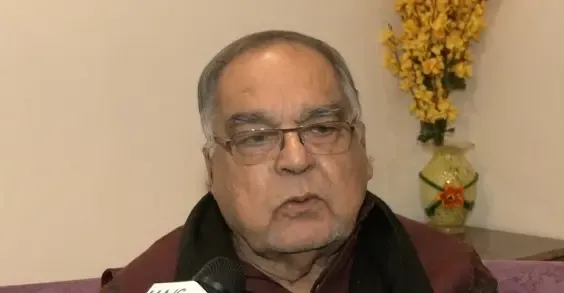
New Delhi, Dec 13 (NationPress) The Chairman of Indian Muslims for Civil Rights (IMCR) and former MP, Mohammad Adeeb, stated on Saturday that the notion of jihad is being "intentionally misused" by certain individuals, drawing comparisons to the teachings found in the Mahabharata.
His comments arise amidst a political uproar regarding the recent statement made by Maulana Mahmood Madani, president of Jamiat Ulama-e-Hind (JUH), asserting that the concept of 'jihad' is crucial not just for Muslims but for the entire country. He advocated for its inclusion in school curricula to help children grasp its true meaning and purpose.
In an interview with IANS, Adeeb emphasized that 'jihad' signifies the "fight against injustice," and pointed out that the teachings of Lord Krishna in the Mahabharata serve as a relevant example of what 'jihad' embodies.
Adeeb also referred to a recent meeting between the All India Muslim Personal Law Board (AIMPLB) delegation and Union Parliamentary Affairs Minister Kiren Rijiju, where the Minister assured them that actions would be taken regarding the registration of Waqf properties.
Additionally, Adeeb discussed topics such as the recent Delhi terror blast, the film 'Dhurandhar', and the suspended Trinamool Congress MLA Humayun Kabir.
Here are some highlights from the interview:
IANS: What are your thoughts on Maulana Mahmood Madani's'jihad'?
Mohammad Adeeb: The challenge we face in this country is that the term 'jihad' has been intentionally distorted. Through media and governmental narratives, it's been framed as synonymous with violence and killing. Maulana Madani has articulately clarified the authentic meaning of 'jihad' and countered efforts to tarnish it. Jihad is fundamentally about raising one's voice against injustice and assisting the oppressed.
In Hinduism, what did Krishna instruct Arjuna? He told him to 'strike them, stop them.' Does that imply it is acceptable in Hinduism to kill family members? Absolutely not. Krishna advocated for fighting against injustice; that is the essence of 'jihad'. The manner in which the idea of 'jihad' has been perverted in this country — land jihad, love jihad — is profoundly incorrect.
IANS: Regarding the Delhi terror blast, several Kashmiri doctors have been arrested, and actions have been taken against Al Falah University. What is your perspective?
Mohammad Adeeb: In light of the recent Delhi terror blast, Muslims in this country are facing undue scrutiny. We accept the government's position that those apprehended were involved in the incident. If it is a terrorist attack, then the individuals responsible must face the most severe consequences.
However, is it just to shut down a university, one that was established by the government, and have the medical council revoke its license within a day? This action has drastically disrupted the lives of students in their third, fourth, and fifth years of medical training.
Many cases of terror attacks reveal that after 15 or even 20 years, the Supreme Court or High Courts declare the accused not guilty, but by then, those individuals have lost significant years of their lives. A bombing occurred, lives were lost, so who is truly accountable? This is a tactic used by security agencies to demonstrate their effectiveness.
A terrorist attack is typically planned over an extended period; it does not occur spontaneously. Authorities should take the necessary time to identify the true culprits and impose the harshest penalties on them. However, due to overreactions, conviction rates remain exceedingly low.
IANS: The AIMPLB delegation met Union Minister Kiren Rijiju concerning Waqf property registration issues. What was the outcome?
Mohammad Adeeb: I was part of that delegation. We presented our issues comprehensively. I am pleased that the minister listened attentively, treated us with respect, and promised to make efforts in this area. A discussion also occurred regarding extending the deadline.
One positive aspect about this government is that when one articulates concerns, they are acknowledged. We hope that Rijiju, who is himself from a minority background, takes action accordingly. Although we opposed the Waqf Amendment Bill, it was eventually passed. Nevertheless, we would like to see amendments addressing the challenges within the Act.
IANS: A film titled 'Dhurandhar' has been released, revealing Pakistan's involvement in the 26/11 terror attacks. However, there is opposition to the film's release. What do you think?
Mohammad Adeeb: This has turned into a spectacle regarding films, and you keep inquiring about our (the Muslim leaders') connection to Pakistan. We have never recognized Pakistan, so why are we being associated with it? The government engages in trade with Pakistan, espionage incidents have been reported recently, and individuals were apprehended just days ago. Yet, blame is directed at us. We are vehemently opposed to Pakistan; families were divided, relatives were estranged, and all contact was severed. So why should we be linked to Pakistan?
Regrettably, the current political climate in this country revolves around how much one party can persecute a single community. The politics of hatred is spreading in India.
With elections approaching in Bengal next year, preparations are already underway. One individual (referring to suspended Trinamool Congress MLA Humayun Kabir) has proclaimed his intention to build the Babri Masjid. What connection does Babur have with Indian Muslims? Babur came to plunder India, so why should a mosque be erected in his honor?
Point of View
I emphasize the importance of understanding the true essence of such concepts to foster unity and combat divisive narratives. The insights shared by Adeeb and Madani contribute significantly to this dialogue.
NationPress
13/12/2025
Frequently Asked Questions
What does jihad truly mean according to Adeeb?
Adeeb defines jihad as the fight against injustice and helping the oppressed, contrasting it with its misrepresentation in society.
How did Adeeb respond to the Delhi terror blast arrests?
He expressed concern over Muslims facing scrutiny and emphasized the need for justice without hastily shutting down institutions.
What was discussed in the meeting with Kiren Rijiju?
Adeeb noted that the AIMPLB raised concerns regarding Waqf property registrations and that Rijiju promised to address these issues.
What is Adeeb's stance on the film 'Dhurandhar'?
He criticized the linking of Muslims to Pakistan and condemned the politics of hatred associated with the film's release.
What is the significance of the upcoming elections in Bengal?
Adeeb highlighted that the election atmosphere is charged with divisive politics, affecting community relations in the region.