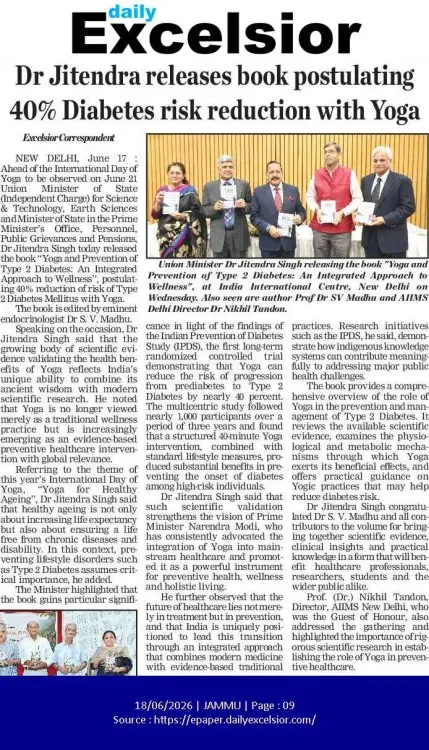
Dr Jitendra Singh releases book on Yoga cutting Diabetes risk by 40%
Synopsis
Union Science and Technology Minister Dr. Jitendra Singh released a book on 18 June 2026 postulating a 40 per cent reduction in diabetes risk through yoga, days before International Day of Yoga, reinforcing India's policy push to integrate yoga into preventive healthcare.
Key Takeaways
Jitendra Singh released a book on 18 June 2026 linking yoga to a 40 per cent reduction in diabetes risk .
The release precedes International Day of Yoga on 21 June , observed globally since India's 2014 UN initiative .
India's National Health Policy 2017 formally incorporated yoga into preventive and promotive health strategies.
The Ministry of AYUSH , established in November 2014 , oversees evidence-based integration of traditional practices including yoga into mainstream healthcare.
The NPCDCS , launched in 2010 , already includes lifestyle interventions aligned with structured yoga modules for non-communicable disease control.
Validation of the 40 per cent risk-reduction claim through peer-reviewed trials could influence future NPCDCS guidelines and state diabetes programmes.
Union Minister of State (Independent Charge) for Science and Technology Dr. Jitendra Singh released a book on Thursday, 18 June 2026 that postulates a 40 per cent reduction in diabetes risk through regular yoga practice, sharing the development on his official X account ahead of International Day of Yoga.
Context
The book, released by Dr. Singh, advances the claim that sustained yoga practice can reduce an individual's risk of developing diabetes by up to 40 per cent. The release comes days before 21 June, the International Day of Yoga, observed globally each year following a 2014 United Nations General Assembly resolution moved at India's initiative. The timing underscores the government's sustained push to position yoga not merely as a cultural practice but as a clinically relevant preventive health intervention.
Policy Backdrop
India's integration of yoga into mainstream public health policy has deepened since the creation of the Ministry of AYUSH in November 2014, which elevated the then-Department of AYUSH to bring Ayurveda, Yoga, Unani, Siddha and Homeopathy under a dedicated central ministry. The National Health Policy 2017 formally incorporated yoga within preventive and promotive health strategies, and the National Programme for Prevention and Control of Cancer, Diabetes, Cardiovascular Diseases and Stroke (NPCDCS), launched in 2010, had already included lifestyle interventions that later aligned with structured yoga modules. Dr. Singh, who also holds charge of the Ministry of Earth Sciences and serves as Minister of State in the Prime Minister's Office, has previously championed the scientific validation of traditional practices, making the book release consistent with his ministerial portfolio's broader thrust.
Stakeholders and Impact
India carries one of the world's largest burdens of diabetes, making any credible, scalable preventive intervention a matter of significant public health consequence. A claim of a 40 per cent risk reduction through yoga — an accessible, low-cost practice — would, if validated through peer-reviewed clinical evidence, have direct implications for NPCDCS guidelines, state-level diabetes control programmes, and community health worker training modules. AYUSH researchers, yoga practitioners, and the country's large population of pre-diabetic individuals are the primary stakeholders watching how the book's findings are received by the broader scientific community.
What's Next
The book release is likely to feed into discussions at International Day of Yoga events scheduled for 21 June 2026, where government-led programming routinely highlights health evidence supporting yoga. Analysts will watch whether the Ministry of AYUSH or the Ministry of Science and Technology commissions further peer-reviewed trials to substantiate the postulated risk-reduction figure, and whether updated NPCDCS guidelines or state diabetes control programmes incorporate validated yoga modules in their next revision cycle. Ministerial endorsement of such research typically accelerates its entry into policy deliberations, raising the stakes for independent scientific scrutiny of the underlying data.
Point of View
Quantified health outcome from yoga — just days before International Day of Yoga — is a deliberate act of policy signalling, not merely a ceremonial gesture. It fits a well-established pattern in which the current administration uses ministerial endorsement of traditional-medicine research to build a scientific legitimacy narrative around AYUSH, with an eye on both domestic health programming and India's global soft-power projection through yoga. The 40 per cent risk-reduction figure, if it withstands peer scrutiny, would give policymakers a concrete metric to justify embedding yoga modules in national non-communicable disease programmes. The real test, however, lies in whether independent clinical evidence is forthcoming — without it, the claim risks being received as advocacy rather than science.
NationPress
17 Sept 2026
Frequently Asked Questions
What did Dr. Jitendra Singh release about yoga and diabetes?
Dr. Jitendra Singh released a book on 18 June 2026 that postulates regular yoga practice can reduce the risk of developing diabetes by up to 40 per cent.
Can yoga really reduce diabetes risk by 40 per cent?
The book released by Dr. Singh postulates a 40 per cent diabetes risk reduction through yoga; however, this figure requires independent peer-reviewed clinical validation before it can be treated as established medical consensus.
Why did Dr. Jitendra Singh release this book in June 2026?
The release coincides with the lead-up to International Day of Yoga on 21 June, an annual occasion the Indian government uses to highlight yoga's health and cultural significance globally.
What is India's policy on yoga and diabetes prevention?
India's National Health Policy 2017 incorporated yoga into preventive health strategies, and the National Programme for Prevention and Control of Cancer, Diabetes, Cardiovascular Diseases and Stroke has included lifestyle interventions aligned with yoga modules since 2010.
What is the Ministry of AYUSH's role in yoga and health research?
The Ministry of AYUSH, established in November 2014, promotes evidence-based integration of Ayurveda, Yoga, Unani, Siddha and Homeopathy into mainstream healthcare, often collaborating on studies targeting lifestyle diseases such as diabetes.