How Can JNU Graduates Contribute to Nation-Building?
Synopsis
Vice-President C.P. Radhakrishnan inspires JNU graduates to leverage their education for national development. He emphasizes the importance of character, intellectual honesty, and social equity while honoring India's rich academic traditions. This compelling address calls for a collective commitment to implement decisions for the greater good.
Key Takeaways
Nation-Building: Education should be directed towards building a stronger nation.
Character Development: Learning must foster character and self-reliance.
Intellectual Honesty: Graduates should pursue truth with integrity.
Social Inclusion: It is essential to mitigate inequalities in society.
Respect for Traditions: Emphasizing India's rich educational history is crucial.
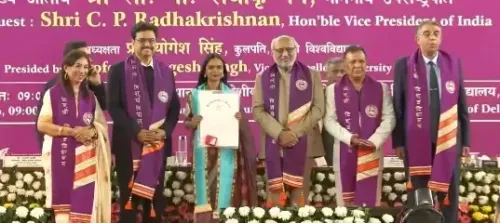
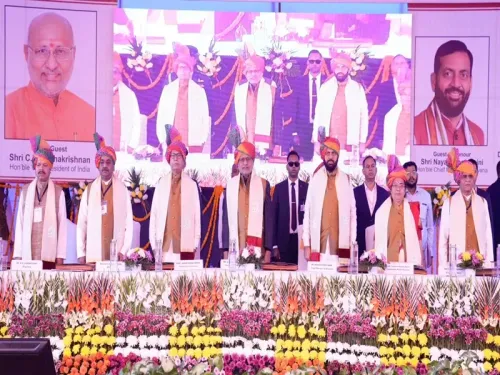
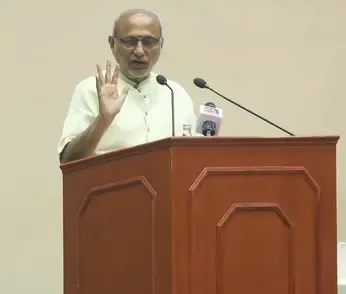
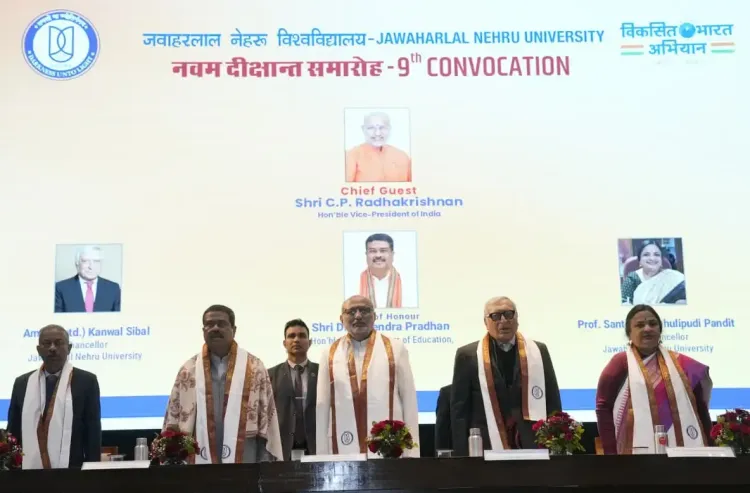
New Delhi, Jan 12 (NationPress) Vice-President (V-P) C.P. Radhakrishnan, during the ninth Convocation of Jawaharlal Nehru University (JNU) on Monday, called upon new graduates to channel their education and skills towards nation-building.
In his address, V-P Radhakrishnan highlighted that only through education and effective training can the youth of India achieve Prime Minister Narendra Modi's vision of a Viksit Bharat @2047.
Reflecting on the teachings of Swami Vivekananda on his birth anniversary, he noted that education should transcend mere degrees, focusing instead on developing character, enhancing intellect, and empowering individuals to be self-reliant.
The Vice-President urged the graduates to embrace three essential responsibilities: intellectual honesty in the search for truth, social inclusion to mitigate inequalities, and an active role in national development.
He encouraged them to be guided by constitutional values and the rich civilizational ethos of India, and to always show respect for their parents and teachers.
Referencing India's illustrious tradition of knowledge, he cited ancient educational hubs like Nalanda and Takshashila, reminding that Indian scriptures and classics—from the Upanishads and the Bhagavad Gita to Kautilya's Arthashastra and Thiruvalluvar's Thirukkural—have always placed learning at the heart of moral and social life.
He stressed that true education shapes conduct and character, extending beyond the mere acquisition of degrees.
The Vice-President asserted the need for modern science to harmonize with traditional values.
Discussing JNU's democratic ethos, he remarked that debate, discussion, dissent, and even confrontation are vital components of a healthy democracy.
However, he emphasized the importance of reaching a conclusion from these discussions.
Once a decision is made, he insisted, there must be a collective commitment to work together for its successful implementation, ensuring effective governance.
He praised JNU's inclusive environment and its initiatives to promote equity and social inclusion in student admissions and faculty recruitment.
Additionally, he commended the university's leadership for broadening academic engagement into emerging and civilizational fields, including the establishment of new Centres for Hindu, Jain, and Buddhist Studies at the School of Sanskrit and Indic Studies.
He also acknowledged JNU's ongoing efforts to promote Indian languages through initiatives like the Special Centre for Tamil Studies and programs in languages such as Assamese, Odia, Marathi, and Kannada, asserting that knowledge creation should thrive in mother tongues, aligned with the ethos of the National Education Policy.
Point of View
The Vice-President's address at JNU underscores a critical juncture in India's educational landscape. By urging graduates to embrace their roles in nation-building, he aligns with the national vision of progress and unity, fostering a sense of responsibility among today's youth.
NationPress
24 Sept 2026
Frequently Asked Questions
What was the main message from Vice-President Radhakrishnan?
Vice-President Radhakrishnan urged JNU graduates to dedicate their skills and knowledge towards nation-building and emphasized the importance of education that fosters character and social responsibility.
How did he reference India's educational history?
He highlighted ancient centers of learning like Nalanda and Takshashila, stressing that India's rich educational tradition has always valued knowledge as central to societal and ethical life.
What responsibilities did he assign to the graduates?
He outlined three core responsibilities: intellectual honesty in seeking truth, promoting social inclusion, and actively contributing to national development.
What did he say about the relationship between modern science and traditional values?
Radhakrishnan emphasized the need for modern science to grow alongside traditional values, suggesting a harmonious coexistence for holistic development.
What initiatives did he commend at JNU?
He praised JNU for its inclusive atmosphere, efforts to promote equity in admissions and faculty recruitment, and initiatives to advance Indian languages in education.