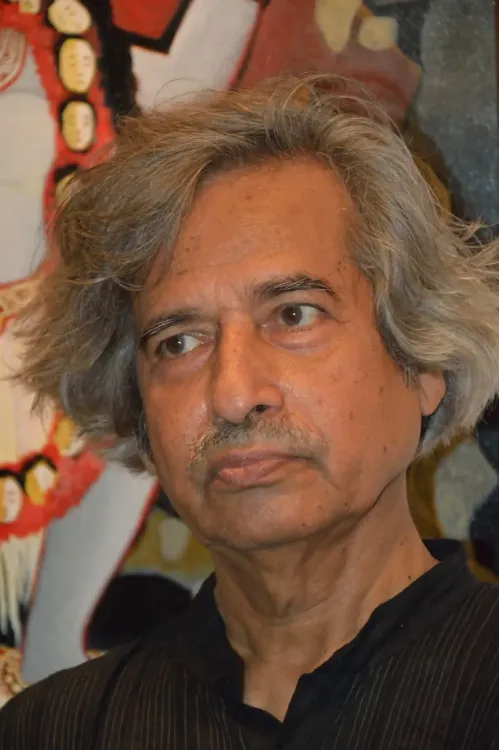
Jogen Chowdhury, legendary painter and ex-Rajya Sabha MP, dies at 87
Synopsis
Jogen Chowdhury — the satirical painter who depicted politics and society with a uniquely Bengali eye, and later served as a Rajya Sabha MP — has died at 87 in Kolkata after 14 months of battling blood cancer. His passing closes the chapter on an artistic career that bridged Partition-era Bengal, Parisian modernism, and the corridors of Parliament.
Key Takeaways
Renowned painter Jogen Chowdhury passed away on 25 October 2026 in Kolkata at the age of 87 .
He had been battling blood cancer for 14 months and was also suffering from a urinary tract infection with symptoms of sepsis.
Born on 16 February 1939 in Faridpur , British India, he relocated to Kolkata after Partition.
He served as a Rajya Sabha member from West Bengal on a TMC nomination from 2014 to 2020 .
He studied in Paris in 1965 and later served as curator at the Art Gallery of the Presidential Palace .
His satirical paintings, influenced by both Indian and European art movements, earned him recognition at home and abroad.
Renowned Bengali painter and former All India Trinamool Congress (TMC) Rajya Sabha member Jogen Chowdhury passed away on Sunday, 25 October 2026, in Kolkata. He was 87. His death marks the end of a distinguished career that spanned more than six decades and left an indelible mark on contemporary Indian art.
Circumstances of His Death
Chowdhury had been battling blood cancer for the past 14 months and was undergoing chemotherapy, according to hospital sources. He fell ill on 16 October — the day of Shasthi — and was admitted to a hospital in Kolkata. His condition was critical at the time of admission, with symptoms of sepsis also reported due to a urinary tract infection. When his condition deteriorated on Saturday, he was placed on ventilation. According to family sources, he breathed his last on Sunday morning.
Early Life and Artistic Roots
Chowdhury was born on 16 February 1939 in Daharpara village of Faridpur in British India. His father, Pramathanath Chowdhury, was a landlord. It was his mother's skill in creating alpana — traditional decorative floor and wall paintings — that first kindled his interest in drawing. During the Partition, the family relocated to Kolkata, where he began his formal art education. He later taught drawing at Howrah District School and joined the Kolkata Handloom Board as a designer in 1962.
Career: From Paris to the Presidential Palace
In 1965, Chowdhury travelled to Paris for advanced training, an experience that deepened the European influence visible in his mature style. He later served as a curator at the Art Gallery of the Presidential Palace. His work was celebrated for its sharp satirical edge — paintings that skewered politics and society while drawing on both Indian and European art movements. Notably, he also contributed to Durga Puja aesthetics in Kolkata, sketching the idol of Behala Nutan Dal Puja in 2017 and serving as designer for the idol of Thakurpukur State Bank Park Sarbajanin.
Political Life and Honours
In 2014, the TMC-led state government nominated Chowdhury to the Rajya Sabha from West Bengal, a position he held until 2020. His entry into Parliament was widely seen as recognition of his stature as a cultural ambassador of Bengal. He received numerous awards both in India and abroad over the course of his career. The cultural and political establishment of West Bengal is expected to mourn his passing deeply.
Legacy and What Comes Next
Chowdhury's death leaves a significant void in Indian contemporary art — particularly in the tradition of socially conscious, satirical painting that he helped define. His body of work continues to be held in major collections across India and internationally. Tributes from artists, politicians, and cultural figures are expected to pour in as the news spreads across the country.
Point of View
Making his canvases both aesthetically striking and socially legible. His TMC nomination to the Rajya Sabha was a double-edged recognition: it honoured his stature but also drew him into the partisan ecosystem, a tension that many artist-politicians navigate uneasily. What his passing underscores is how thin the pipeline of such polymath figures has become in Bengal — an artistic tradition that once produced internationally recognised voices now struggles to find successors with comparable range and conviction.
NationPress
25 Oct 2026
Frequently Asked Questions
Who was Jogen Chowdhury?
Jogen Chowdhury was a celebrated Indian painter known for his satirical depictions of politics and society, and a former Rajya Sabha member from West Bengal on a TMC nomination. Born in 1939 in Faridpur, he studied in Kolkata and later in Paris, building a career that spanned over six decades.
What was the cause of Jogen Chowdhury's death?
Chowdhury died on 25 October 2026 after battling blood cancer for 14 months. He was also suffering from a urinary tract infection that led to sepsis, and was placed on ventilation when his condition deteriorated the day before his death, according to hospital and family sources.
What was Jogen Chowdhury's political career?
In 2014, the TMC-led West Bengal government nominated Chowdhury to the Rajya Sabha, India's upper house of Parliament. He served in that capacity until 2020, representing West Bengal as a cultural figure turned parliamentarian.
What is Jogen Chowdhury known for in the art world?
He was celebrated for paintings that satirised politics and society, drawing on both Indian and European art movements. He also studied in Paris in 1965, served as a curator at the Art Gallery of the Presidential Palace, and contributed to Kolkata's Durga Puja cultural traditions.
Where was Jogen Chowdhury born and what shaped his early life?
He was born on 16 February 1939 in Daharpara village of Faridpur in British India. His mother's practice of alpana — traditional decorative painting — first sparked his interest in art. After Partition, his family moved to Kolkata, where he began his formal art education.