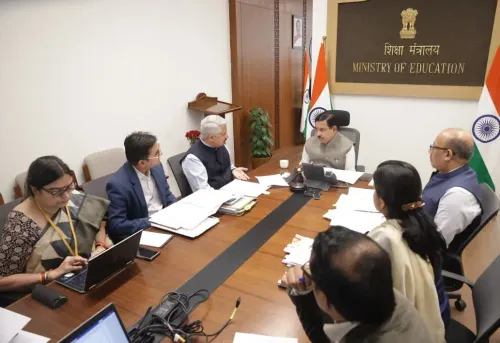
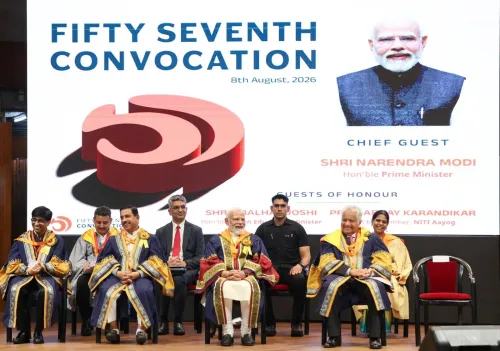
Pralhad Joshi Addresses IIT Delhi–Abu Dhabi's 1st Convocation
Synopsis
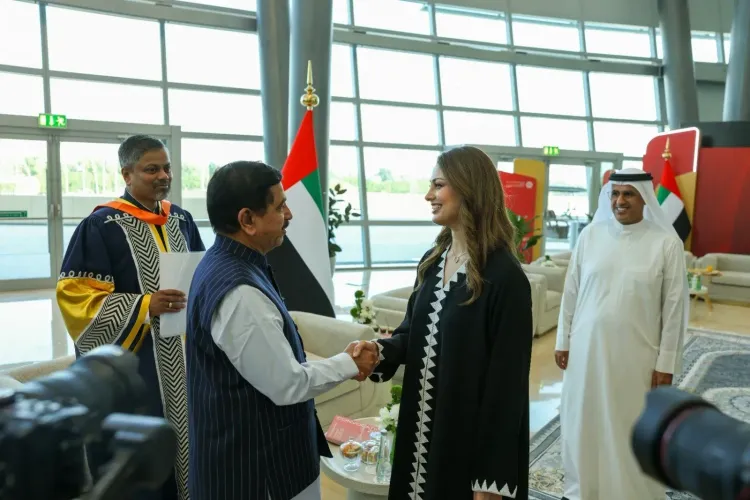
Union Minister Pralhad Joshi addressed the inaugural convocation of IIT Delhi–Abu Dhabi on November 19, 2026, celebrating the Class of 2026 and framing the overseas campus as a flagship outcome of NEP 2020 and PM Modi's vision for globalising Indian higher education.
Key Takeaways
IIT Delhi–Abu Dhabi held its first-ever convocation on November 19, 2026 , graduating its pioneer batch.
Union Minister Pralhad Joshi was the keynote speaker, alongside Harish Salve (Chairperson, IIT Delhi Board of Governors) and senior UAE officials.
The campus is framed as a direct outcome of the National Education Policy 2020 , which allows Indian institutions to set up campuses abroad.
Key Abu Dhabi partners — ADEK and Altanaami — were acknowledged for enabling the initiative.
Joshi invoked Vasudhaiva Kutumbakam in urging graduates to use their skills for humanity's larger good.
The campus deepens the broader India–UAE strategic partnership across education, soft power, and bilateral diplomacy.
India's premier technical education just crossed a border — literally. Union Consumer Affairs and New and Renewable Energy Minister Pralhad Joshi addressed the first-ever Convocation of IIT Delhi–Abu Dhabi on Thursday, November 19, 2026, marking a milestone in India's quiet but deliberate push to plant its top institutions on foreign soil.
India's IIT footprint lands in the Gulf
The ceremony brought together a high-profile gathering: Rima Al Mokarrab, Executive Director of Strategic Affairs at the Executive Affairs Authority of Abu Dhabi; eminent jurist Harish Salve, Chairperson of IIT Delhi's Board of Governors; and India's Ambassador to the UAE, among other dignitaries. Joshi congratulated the graduating Class of 2026 — the campus's first batch — and urged them to carry forward what he described as IIT Delhi's 'spirit of innovation and excellence.'
The IIT Delhi–Abu Dhabi campus is one of the earliest, most visible outcomes of the National Education Policy (NEP) 2020, which explicitly opened the door for India's top institutions to establish campuses abroad. Joshi invoked Prime Minister Narendra Modi's vision for internationalising Indian higher education, framing the Abu Dhabi campus as proof of concept — that the IIT brand can travel and compete globally.
Abu Dhabi's role and the India–UAE education bridge
The minister extended appreciation to the Government of Abu Dhabi, the Abu Dhabi Department of Education and Knowledge (ADEK), and local partner Altanaami for enabling the initiative. That trilateral support — an Indian federal institution, a Gulf emirate's education authority, and a local strategic partner — reflects how carefully the Abu Dhabi campus was constructed as a bilateral diplomatic asset, not just an academic outpost.
India and the UAE have steadily deepened ties across trade, energy, and diaspora affairs. Education cooperation adds a soft-power dimension: an IIT degree awarded in Abu Dhabi carries both Indian institutional prestige and Gulf-market proximity, an attractive combination for students across South Asia and the wider Arab world.
Vasudhaiva Kutumbakam as a graduating-class compass
Joshi closed his address with a philosophical note, urging graduates to embrace the Sanskrit ideal of Vasudhaiva Kutumbakam — 'the world is one family' — and to deploy their skills 'for the larger good of humanity.' The choice of that phrase was deliberate: it anchors an elite technical institution's global ambition in the vocabulary of Indian civilisational values, a framing that has become a signature of Modi-era cultural diplomacy.
The graduating Class of 2026 leaves as the first cohort to hold an IIT Delhi degree earned entirely outside India — a small but pointed symbol of where the country's higher education ambitions are heading. The question now is whether Abu Dhabi stays a singular experiment or becomes a template for the next IIT, the next city, the next country.
Point of View
But the Abu Dhabi campus demonstrates that the government is willing to see that idea through to brick-and-mortar reality in a strategically important partner country. Joshi's presence signals that the Centre views overseas IIT campuses as a Cabinet-level priority, not an administrative footnote. If Abu Dhabi succeeds in attracting a diverse, high-quality student cohort, it creates momentum — and political pressure — for similar expansions in other Gulf or South-East Asian cities.
NationPress
19 Nov 2026
Frequently Asked Questions
What is IIT Delhi–Abu Dhabi and when did it open?
IIT Delhi–Abu Dhabi is the first overseas campus of the Indian Institute of Technology Delhi, established in Abu Dhabi under the National Education Policy 2020 framework, which allows Indian institutions to operate abroad. Its first graduating batch received degrees at the inaugural convocation on November 19, 2026.
What is NEP 2020 and how does it relate to overseas IIT campuses?
The National Education Policy 2020, approved by the Indian government in July 2020, explicitly promotes the internationalisation of higher education, including allowing top Indian institutions to set up campuses in foreign countries. IIT Delhi–Abu Dhabi is one of the earliest tangible results of that provision.
Who is Harish Salve and what is his role at IIT Delhi?
Harish Salve is a prominent Indian jurist who serves as Chairperson of the Board of Governors of IIT Delhi. He was present at the first convocation of the Abu Dhabi campus.
Why did India choose Abu Dhabi for an IIT campus?
Abu Dhabi represents a convergence of India's deepening strategic and economic ties with the UAE, a large Indian diaspora presence in the Gulf, and Abu Dhabi's own ambition to position itself as a global education hub. The UAE government, through ADEK and local partner Altanaami, actively supported the campus's establishment.
What did Minister Pralhad Joshi say at the IIT Delhi–Abu Dhabi convocation?
Joshi congratulated the graduating Class of 2026, urged students to carry forward IIT Delhi's spirit of innovation and excellence, and invoked the Sanskrit principle of Vasudhaiva Kutumbakam — meaning 'the world is one family' — encouraging graduates to serve humanity as global citizens rooted in Indian values.