Joshi calls BRE Summit 2026 a blueprint for global green energy
Synopsis
Union Minister Pralhad Joshi hailed the BRE Summit 2026 as a landmark for India's renewable energy leadership, calling it a blueprint for global sustainability and a showcase for India's clean energy ecosystem to international partners.
Key Takeaways
Union Minister Pralhad Joshi described BRE Summit 2026 as a 'powerful testament' to India's rising leadership in renewable energy.
The summit aimed to anchor global green partnerships and display India's domestic clean energy ecosystem internationally.
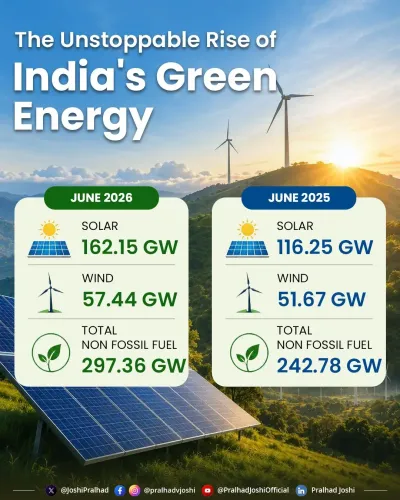
India is the third-largest energy consumer in the world and has committed to 500 GW non-fossil fuel capacity by 2030 .
India co-founded the International Solar Alliance in 2015 , establishing an early foundation for multilateral renewable diplomacy.
Joshi posted in both English and Kannada , signalling outreach to domestic and international audiences simultaneously.
Follow-up bilateral and multilateral green energy agreements in coming months will determine the summit's concrete legacy.
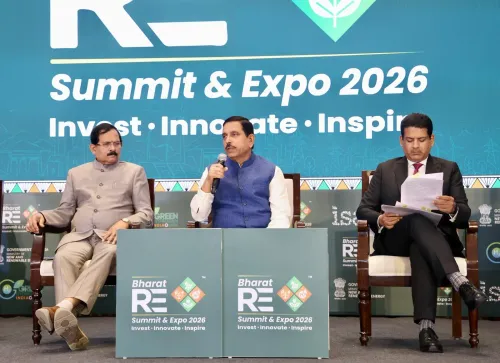
India's clean energy ambitions took centre stage at the BRE Summit 2026, with Union Minister for New and Renewable Energy Pralhad Joshi declaring the gathering a defining moment for the country's rising stature in global renewable energy diplomacy, on Friday, 6 November 2026.
Joshi, posting in both English and Kannada, described the summit as a 'powerful testament to India's rising leadership in renewable energy,' adding that it had 'successfully paved a definitive blueprint for collective global sustainability.' The bilingual post underscored the minister's outreach to his home state of Karnataka as much as to a national and international audience.
India's green-diplomacy moment at BRE Summit 2026
The summit, Joshi said, served two interlocking purposes: anchoring new global green partnerships and showcasing India's domestic clean energy ecosystem to the world. That framing is consistent with a strategy New Delhi has pursued since co-founding the International Solar Alliance in 2015 — using multilateral platforms to simultaneously attract investment and project soft power.
India is the third-largest energy consumer globally, and its renewable ambitions are proportionally large. At COP26 in 2021, the government committed to 500 GW of non-fossil fuel energy capacity by 2030 and net-zero emissions by 2070. Summits of this nature serve as diplomatic checkpoints — moments to signal progress and secure partner commitments that keep those targets on track.
From ISA to BRE: India's expanding clean-energy architecture
India's renewable diplomacy has evolved steadily over the past decade. The International Solar Alliance now counts over 120 member nations as signatories, and successive governments have linked domestic energy security directly with multilateral clean-technology partnerships. The BRE Summit 2026 appears to sit within that expanding architecture — another node in a network India is consciously building.
Joshi's ministry oversees the operational machinery behind those targets: grid integration, capacity addition, and the regulatory environment that makes foreign green investment viable. His framing of the summit as a 'blueprint' signals that the conversations were substantive, not merely ceremonial.
The months ahead will be telling — whether fresh bilateral or multilateral green energy agreements crystallise from the summit's outcomes, and whether India's annual renewable capacity additions keep pace with the steep trajectory the 2030 target demands.
India has rarely lacked ambition on clean energy. The real test is always execution speed — and the BRE Summit 2026 has just raised the stakes one more time.
Point of View
Ministerial momentum-building through such summits serves both a diplomatic and a domestic-signalling function. The bilingual post — English for global reach, Kannada for the home constituency — reflects the dual audience a Union Minister from Karnataka must constantly play to. The real measure of the summit's value will come in verifiable capacity additions and signed partnership agreements, not in the communiqué language alone.
NationPress
6 Nov 2026
Frequently Asked Questions
What is the BRE Summit 2026?
The BRE Summit 2026 is an international renewable energy summit where India sought to consolidate global green partnerships and present its clean energy ecosystem, as described by Union Minister Pralhad Joshi.
What is India's renewable energy target by 2030?
India has committed to achieving 500 GW of non-fossil fuel energy capacity by 2030 , a pledge made at COP26 in 2021, alongside a net-zero emissions target of 2070.
What is Pralhad Joshi's role in India's energy sector?
Pralhad Joshi is the Union Minister of New and Renewable Energy, overseeing India's clean energy policy, capacity expansion, and international green partnerships.
What is the International Solar Alliance and India's role in it?
The International Solar Alliance is a multilateral body co-launched by India in 2015 to accelerate solar energy deployment globally; it now counts over 120 member nations among its signatories.
Why is India important in global renewable energy diplomacy?
As the world's third-largest energy consumer, India's scale of clean energy adoption and its multilateral initiatives like the International Solar Alliance give it significant weight in shaping global climate and energy policy.