Joshi fires back at Rahul Gandhi's Columbia University remarks

Synopsis
Union Minister Pralhad Joshi fires back at Rahul Gandhi's Columbia University remarks branding India an 'economic disaster,' marshalling IMF, Goldman Sachs, PLFS unemployment and higher-education data to argue that global institutions tell a sharply different story.
Key Takeaways
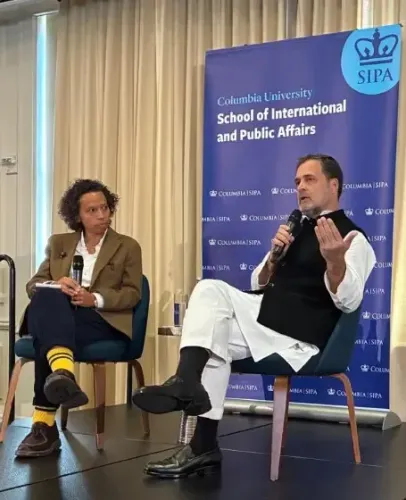
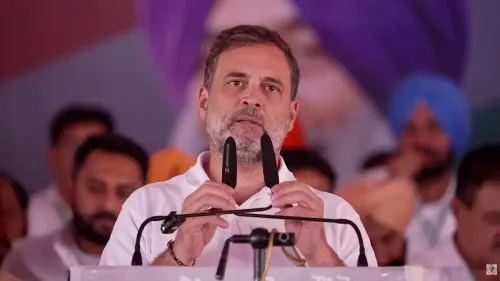
Rahul Gandhi reportedly described India as an 'economic disaster' in a speech at Columbia University, New York .
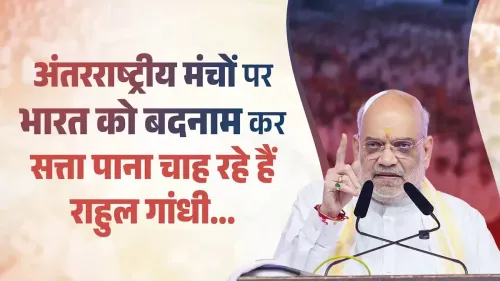
Union Minister Pralhad Joshi rebutted the remarks on 18 November 2026 , calling Gandhi a 'peddler of pessimism' and 'Chief Exporter of Anti-India Propaganda.' Joshi cited IMF, Moody's, and S&P Global upgrades placing India's growth outlook at ~7 per cent , and a Goldman Sachs projection of 7.2 per cent growth in 2027 .
The PLFS October 2026 figure quoted by Joshi puts unemployment at 4.9 per cent ; higher-education enrolment has risen by 31.5 per cent .
The clash continues a decade-long pattern of BJP ministers countering Congress overseas commentary with multilateral data and investment-climate arguments.
A Columbia University speech by Congress leader Rahul Gandhi describing India as an 'economic disaster' has drawn a sharp, data-laden rebuttal from Union Consumer Affairs Minister Pralhad Joshi, who on Wednesday, 18 November 2026 accused Gandhi of running 'anti-India propaganda' on foreign soil while citing a string of international growth assessments to argue the opposite case.
What Rahul Gandhi said — and what triggered Joshi's response
Gandhi's remarks at the prestigious New York institution, addressing what appears to have been a diaspora and academic audience, framed India's economic trajectory in deeply negative terms. For the BJP, that framing — delivered on American soil — was a red flag. Joshi, a senior party leader from Karnataka, wasted no time, posting a detailed counter-offensive on X that branded Gandhi a 'part-time politician and full-time peddler of pessimism' and 'India's Chief Exporter of Anti-India Propaganda.'
The broadside fits a well-worn pattern: since 2014, ruling-party ministers have repeatedly accused Congress figures of making remarks during overseas visits that they argue damage India's investment climate and international image. This time, however, Joshi chose to anchor his response not in rhetoric alone but in a list of institutional data points.
The numbers Joshi deployed
The minister cited four specific indicators to build his counter-narrative. The IMF, Moody's, and S&P Global have all, he said, upgraded India's growth outlook to around 7 per cent. Goldman Sachs projects the economy to expand at 7.2 per cent in 2027. On employment, Joshi pointed to the Periodic Labour Force Survey (PLFS) for October 2026, which he said showed unemployment declining to 4.9 per cent. He also highlighted a 31.5 per cent surge in higher-education enrolment as evidence of a widening opportunity base.
The PLFS, it is worth noting, replaced India's older quinquennial employment surveys in 2017 precisely to deliver more frequent and timely labour-market readings — making it the government's primary tool for tracking jobs data in real time.
The decade-long battle over India's economic story
This exchange is not an isolated flare-up. For the better part of a decade, the contest over who gets to narrate India's economic record — and to whom — has been one of the most persistent fault lines in Indian politics. Opposition leaders, Gandhi prominent among them, have used international platforms to highlight concerns about inequality, unemployment, and democratic backsliding. The government, in turn, has consistently deployed multilateral endorsements — G20 presidency moments, World Bank Ease of Doing Business rankings, IMF forecasts — as proof that the criticism is partisan rather than factual.
Joshi's post closes with a pointed contrast: while Prime Minister Narendra Modi 'earns global respect and takes the pride of the Tiranga [the tricolour] to new heights,' Gandhi, in the minister's framing, chips away at that image every time he boards a flight abroad. 'India is rising with confidence,' Joshi wrote. 'It is the Congress party's political relevance that is in decline.'
Whether Gandhi's office responds — and whether the exchange moves into a formal parliamentary debate on the economy — will determine how far this particular round travels.
Point of View
The government reaches for multilateral endorsements to reframe the domestic political contest as a question of patriotism versus partisanship. By anchoring his rebuttal in IMF, Goldman Sachs and PLFS figures, Joshi attempts to shift the debate from the legitimacy of Gandhi's concerns to the credibility of Gandhi himself. The 'foreign soil' framing is deliberate — it activates a nationalist register that tends to consolidate the BJP's base while putting the Congress on the defensive. How Gandhi's team responds, and whether any of these data points become the subject of parliamentary scrutiny, will reveal whether this skirmish stays on social media or widens into a fuller economic accountability debate.
NationPress
18 Nov 2026
Frequently Asked Questions
What did Rahul Gandhi say at Columbia University about India?
According to Union Minister Pralhad Joshi's post on 18 November 2026 , Rahul Gandhi described India as an 'economic disaster' in a speech at Columbia University in New York. Gandhi's office has not issued a formal public rebuttal as of this report.
What economic data did Pralhad Joshi cite to counter Rahul Gandhi?
Joshi cited four indicators: IMF, Moody's, and S&P Global upgrades placing India's growth at ~ 7 per cent ; a Goldman Sachs projection of 7.2 per cent growth in 2027 ; an unemployment rate of 4.9 per cent per the PLFS October 2026 ; and a 31.5 per cent surge in higher-education enrolment.
What is the PLFS and why does the government use it?
The Periodic Labour Force Survey (PLFS) is released by the Ministry of Statistics and replaced the older quinquennial Employment-Unemployment Survey in 2017 to provide more frequent, timely labour-market data. It is the government's primary tool for tracking unemployment trends in India.
Is this the first time BJP has accused Congress of anti-India remarks abroad?
No. Since 2014 , ruling-party ministers have repeatedly accused Congress leaders of making remarks during overseas visits that they argue harm India's investment climate and international image. The 18 November 2026 exchange fits a well-established partisan pattern.
What is Pralhad Joshi's current ministerial role?
Pralhad Joshi is a senior BJP leader from Karnataka who currently holds the portfolios of Union Minister for Consumer Affairs, Food and Public Distribution, and Minister for New and Renewable Energy.