Pralhad Joshi Marks World Music Day, Hails Music's Unifying Power
Synopsis
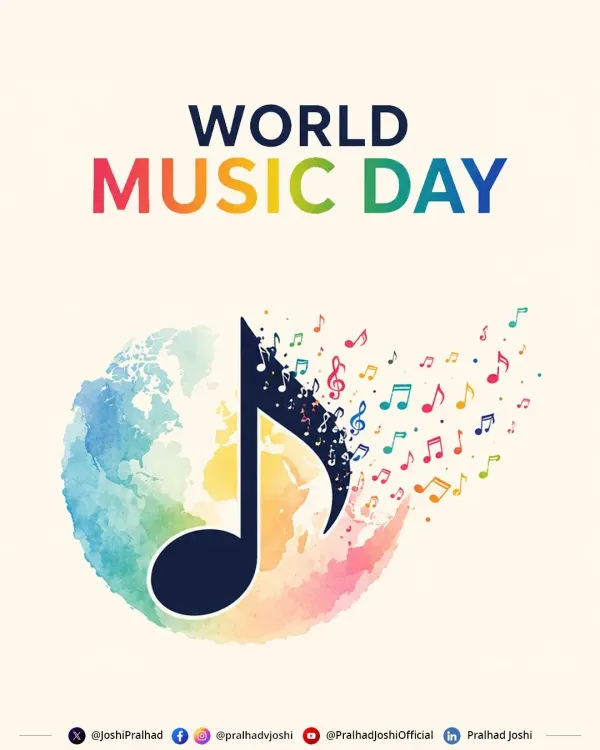
Union Minister Pralhad Joshi marked World Music Day on 21 June 2026 with a bilingual English-Kannada message, calling music a timeless force that transcends borders and celebrating India's rich musical heritage as a pillar of culture and spirituality.
Key Takeaways
Union Consumer Affairs Minister Pralhad Joshi posted a World Music Day greeting on 21 June 2026 in both English and Kannada.
He described music as a 'timeless force that transcends boundaries, cultures and languages.' The Kannada portion of the post highlighted India's musical heritage as a symbol of 'culture, spirituality and artistic glory.' World Music Day , also known as Fête de la Musique , has been observed globally every 21 June since 1982 .
India's National Education Policy 2020 mandates integration of music and performing arts into school curricula.
No new policy measures or funding announcements were made in the post.
Union Consumer Affairs Minister Pralhad Joshi on Sunday, 21 June 2026, marked World Music Day with a bilingual post on X, celebrating music as a timeless force that transcends language, culture, and borders, and extending greetings in both English and Kannada to people across the country.
Context
World Music Day, observed annually on 21 June, originated as Fête de la Musique in France in 1982 and has since grown into a global celebration encouraging musicians and communities to perform and appreciate music in public spaces. The date coincides with the summer solstice in the northern hemisphere, lending it additional cultural significance.
Minister Joshi quoted the aphorism 'Where words fail, music speaks' to open his message, describing music as a 'timeless force that transcends boundaries, cultures and languages' that 'inspires creativity, nurtures harmony and connects hearts across the world.'
Policy Backdrop
India's National Education Policy 2020 explicitly mandates the integration of music and performing arts into school curricula, recognising their role in fostering creativity and cultural awareness among young learners. The policy reflects a broader governmental acknowledgement that the arts are central to holistic education and national identity.
Successive governments have also deployed music and cultural diplomacy as instruments of soft power, featuring Indian classical and folk traditions at international festivals and bilateral exchanges. Minister Joshi's Kannada-language greeting — 'ಸರ್ವರಿಗೂ ವಿಶ್ವ ಸಂಗೀತ ದಿನಾಚರಣೆಯ ಶುಭಾಶಯಗಳು' [Greetings to all on World Music Day] — underscores the domestic cultural dimension, particularly the rich musical heritage of Karnataka, which encompasses both Carnatic classical traditions and a vibrant folk music landscape.
The Kannada post further noted that music is 'a wonderful power that unites minds beyond language, borders and differences' and that 'India's rich musical heritage is a symbol of our culture, spirituality and artistic glory.'
Stakeholders and Impact
The observance is of direct relevance to musicians, classical performers, folk artists, and cultural practitioners across India, who look to governmental recognition as a signal of institutional support for the arts. Visibility from senior ministers on global cultural days reinforces the Ministry of Culture's mandate to promote India's diverse musical traditions.
For Karnataka specifically, the greeting in Kannada carries regional resonance, acknowledging a state with deep roots in Carnatic music, devotional compositions, and a thriving contemporary music scene. The dual-language post signals inclusivity, addressing both a national and a regional audience simultaneously.
What's Next
Observers of arts policy will watch for any references to dedicated funding for music education or cultural festivals in forthcoming parliamentary debates and the next Union Budget. While today's post carries no specific programmatic announcement, ministerial attention to cultural observances often precedes or accompanies broader policy conversations around India's creative industries and soft-power ambitions.
Point of View
Reinforcing his Karnataka identity through the Kannada greeting while aligning with the ruling party's broader 'unity in diversity' narrative. The invocation of India's musical heritage fits neatly into the government's sustained push to project cultural soft power domestically and internationally. While the post carries no policy weight on its own, it reflects a pattern where ministerial visibility on global observance days keeps the arts conversation alive ahead of budget and legislative cycles. The dual-language format also speaks to the balancing act senior BJP leaders from non-Hindi states routinely perform between national and regional constituencies.
NationPress
20 Sept 2026
Frequently Asked Questions
Why did Pralhad Joshi post about World Music Day?
Minister Pralhad Joshi posted to mark World Music Day on 21 June 2026 , a globally observed annual celebration of music's unifying power, extending greetings in both English and Kannada.
What is World Music Day and when is it celebrated?
World Music Day , also called Fête de la Musique , is an annual global observance held on 21 June each year, originating in France in 1982 , encouraging communities to celebrate and perform music publicly.
What did Pralhad Joshi say about India's musical heritage?
In his Kannada-language greeting, Minister Joshi described India's musical heritage as 'a symbol of our culture, spirituality and artistic glory' and called music 'a divine art that fills life with joy, peace and creativity.'
Does India have a government policy supporting music education?
Yes. India's National Education Policy 2020 mandates the integration of music and performing arts into school curricula to foster creativity and cultural awareness among students.
What is Pralhad Joshi's ministerial portfolio?
Pralhad Joshi is the Union Minister of Consumer Affairs, Food and Public Distribution, and also holds the portfolio of New and Renewable Energy. He is a senior BJP leader from Karnataka .