Pralhad Joshi Calls to End Child Labour on June 12
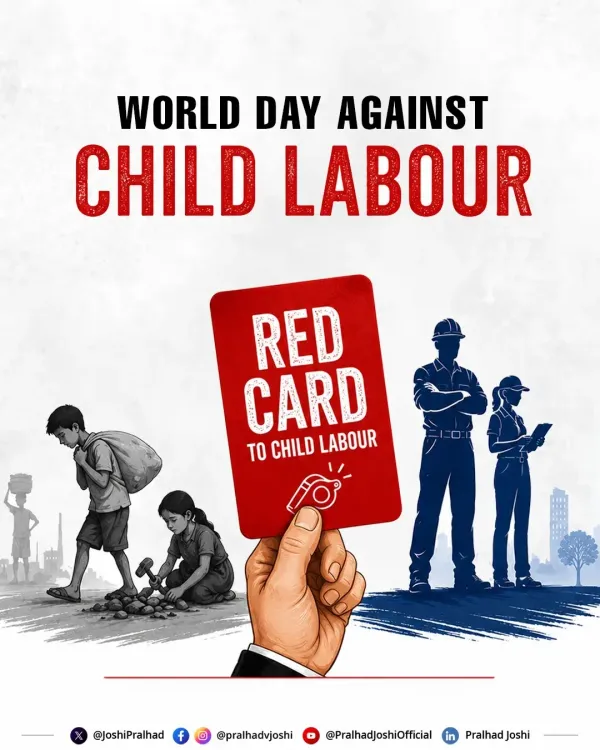
Synopsis
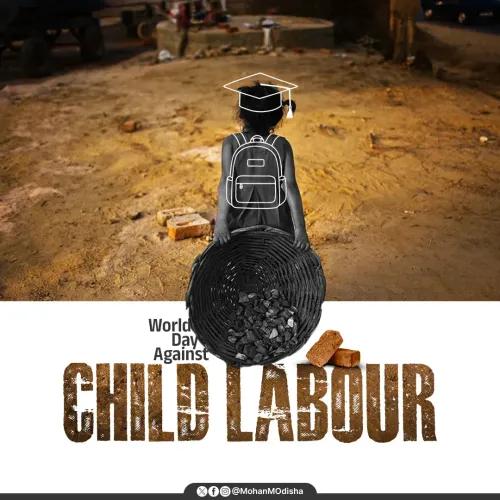
On World Day Against Child Labour, Union Minister Pralhad Joshi urged collective action to end child labour, posting in English and Kannada on 12 June 2026. He invoked India's legislative framework and the ILO's global campaign, calling for education, dignity, and opportunity for every child.
Key Takeaways
Union Consumer Affairs Minister Pralhad Joshi marked World Day Against Child Labour on 12 June 2026 with a bilingual English-Kannada post on X.
He called on citizens to 'show a red card to child labour' and reaffirmed the right of every child to education, health, and dignity.
India's Child Labour (Prohibition and Regulation) Amendment Act, 2016 bans employment of children below 14 years in all occupations.
India ratified ILO Conventions No.
182 in 2017 , committing to minimum age standards and elimination of the worst forms of child labour.
The National Child Labour Project Scheme , running since 1988 , provides rehabilitation and education to rescued children.
Progress will be tracked through the PENCIL portal and forthcoming Periodic Labour Force Survey data on child labour incidence.
Union Consumer Affairs Minister Pralhad Joshi marked World Day Against Child Labour on Friday, 12 June 2026, calling on citizens to renew their commitment to a society where every child can learn, grow, and dream free from the burden of work. The minister posted in both English and Kannada, underscoring his outreach to Karnataka audiences alongside the national message.
Context
Observed every year on 12 June, World Day Against Child Labour is coordinated by the International Labour Organization (ILO) to focus global attention on eliminating child labour and protecting children's rights. Joshi's post called on all to 'show a red card to child labour' — a phrase invoking the universal sporting gesture of disqualification — and to stand up for the 'rights, dignity and future of every child.'
In Kannada, the minister wrote: 'ಮಕ್ಕಳ ಕೈಯಲ್ಲಿ ಪುಸ್ತಕ ಇರಬೇಕು, ಕೆಲಸದ ಭಾರವಲ್ಲ' ['Children's hands should hold books, not the burden of work'], adding that every child deserves education, health, and a joyful life, and urging collective action to build a child-labour-free society.
Policy Backdrop
India's legislative framework against child labour rests on the Child Labour (Prohibition and Regulation) Amendment Act, 2016, which bans employment of children below 14 years in all occupations and prohibits adolescents from hazardous work. The law was reinforced when India ratified ILO Convention No. 138 on Minimum Age and ILO Convention No. 182 on the Worst Forms of Child Labour in 2017.
Complementing the ban, the National Child Labour Project Scheme — operational since 1988 and revised periodically — provides rehabilitation, education, and vocational training to rescued children. The Right of Children to Free and Compulsory Education Act, 2009, mandates free schooling for children aged 6 to 14, directly addressing the root conditions that drive families toward child labour. Together, these measures align with SDG Target 8.7, which calls for the elimination of all forms of child labour by 2025.
Stakeholders and Impact
The primary beneficiaries of sustained anti-child-labour efforts are school-age children, particularly those in India's vast informal economy — domestic work, agriculture, brick kilns, and small manufacturing — where enforcement remains challenging. Families in economic distress are the hardest to reach, making education entitlements and rehabilitation schemes critical levers alongside legislative prohibition.
The minister's bilingual post signals an intent to make the message resonate beyond English-speaking urban audiences. Kannada-language outreach on a UN observance day reflects the broader governmental pattern of using regional languages to normalise child rights discourse at the grassroots level in Karnataka and among the Kannada diaspora.
What's Next
Advocates and policymakers will watch for updated data from the Periodic Labour Force Survey on child labour incidence, which will indicate whether legislative and programmatic interventions are translating into measurable reductions. The PENCIL portal — the government's platform for enforcement tracking and complaint management on child labour — remains the primary digital mechanism for monitoring compliance on the ground.
As India approaches its commitments under the Sustainable Development Goals, annual observances such as this one serve as public accountability moments, pressuring both central and state governments to accelerate action beyond messaging and toward verifiable outcomes for every child.
Point of View
But the bilingual English-Kannada framing is a deliberate political choice that doubles as constituency outreach in Karnataka. The 'red card' metaphor is accessible and shareable, designed for social media amplification rather than policy announcement. More substantively, the post implicitly links the BJP-led government to a decade-long legislative arc — the 2016 amendment and 2017 ILO ratifications — without making new commitments. The real test of political will remains in enforcement data and rehabilitation funding, areas where advocacy groups continue to press for greater transparency.
NationPress
26 Oct 2026
Frequently Asked Questions
What is World Day Against Child Labour?
World Day Against Child Labour is observed every year on 12 June and is led by the International Labour Organization (ILO) to raise global awareness about child labour and promote action to eliminate it.
What did Pralhad Joshi say on World Day Against Child Labour 2026?
Minister Pralhad Joshi called on citizens to 'show a red card to child labour' and urged collective action to build a society where every child has access to education, health, and a dignified life, posting in both English and Kannada.
What is India's law against child labour?
The Child Labour (Prohibition and Regulation) Amendment Act, 2016 bans the employment of children below 14 years in all occupations and prohibits adolescents from working in hazardous industries.
What is the PENCIL portal?
The PENCIL portal is the Indian government's digital platform for tracking enforcement of child labour laws, managing complaints, and coordinating rehabilitation efforts across states.
How does India's Right to Education Act relate to child labour?
The Right of Children to Free and Compulsory Education Act, 2009 mandates free schooling for all children aged 6 to 14 , addressing the poverty and lack of access to education that are root drivers of child labour.