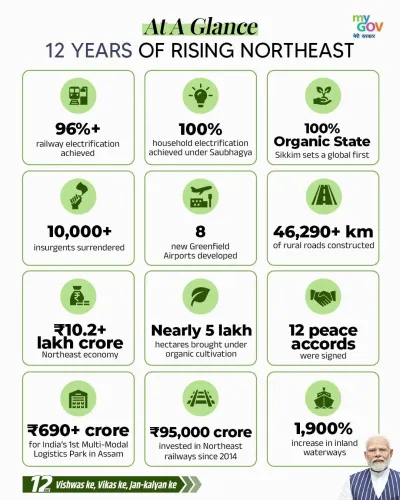
Pralhad Joshi hails Northeast India's rise on #12YearsOfRisingNorthEast
Synopsis
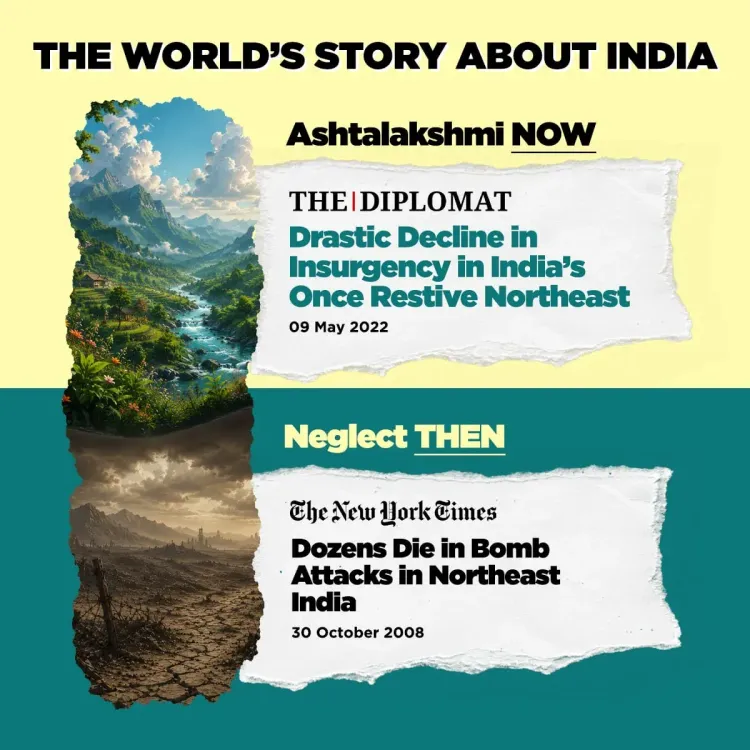
Union Minister Pralhad Joshi celebrated Northeast India's transformation under the #12YearsOfRisingNorthEast hashtag, citing the region's shift from decades of insurgency to infrastructure-driven growth. He invoked the 'Ashtalakshmi' identity of the eight northeastern states and positioned the region as a national growth engine.
Key Takeaways
Union Consumer Affairs Minister Pralhad Joshi posted on 20 June 2026 celebrating Northeast India's development under #12YearsOfRisingNorthEast .
He described the Northeast as having shed 'decades of rebellion and instability' to become a 'proud growth engine' of India.
The post invokes the Ashtalakshmi identity, referencing all eight northeastern states : Arunachal Pradesh, Assam, Manipur, Meghalaya, Mizoram, Nagaland, Sikkim, and Tripura.
The Act East Policy (2014) and the DoNER ministry form the core policy architecture behind the Northeast's development push.
Key peace agreements — the 2015 Naga Framework Agreement and the 2020 Bodo Accord — contributed to reduced insurgency-related incidents in the region.
Future focus is expected on Union Budget allocations for DoNER, NEC, and new projects under PM Gati Shakti .
Union Consumer Affairs Minister Pralhad Joshi on Saturday, 20 June 2026, celebrated the transformation of Northeast India, declaring that the region has shed decades of insurgency and instability to emerge as a proud growth engine of the nation. Writing in Kannada on X, the senior BJP leader invoked the region's cultural identity as the land of the Ashtalakshmis — the eight northeastern states — and credited infrastructure expansion, improved connectivity, and economic progress for the turnaround.
Context
Joshi's post, tagged #12YearsOfRisingNorthEast, marks what the ruling dispensation frames as twelve years of focused development in a region long defined by armed conflict and geographic isolation. In Kannada, he wrote: 'ದಶಕಗಳ ದಂಗೆ ಮತ್ತು ಅಸ್ಥಿರತೆಯ ಕಹಿನೆರಳು ಸರಿದು' — 'The bitter shadow of decades of rebellion and instability has lifted' — and described the Northeast as now marching on a new path of development. The term Ashtalakshmi refers to the eight states of Arunachal Pradesh, Assam, Manipur, Meghalaya, Mizoram, Nagaland, Sikkim, and Tripura, a nomenclature that frames the region as a site of prosperity rather than conflict.
Policy Backdrop
The hashtag anchors the post to the Act East Policy, announced in 2014, which repositioned the Northeast as India's strategic gateway to Southeast Asia and the ASEAN bloc. The policy accompanied a significant increase in capital expenditure on roads, railways, airports, and digital infrastructure across the eight states, channelled through the Ministry of Development of North Eastern Region (DoNER) — a dedicated central ministry established in 2001 and given expanded budgetary powers after 2014. On the security front, negotiated peace settlements — including the 2015 Naga Framework Agreement and the 2020 Bodo Accord — sought to bring armed groups into a political process, reducing insurgency-related incidents over the period. Together, these efforts form the policy lineage that Joshi's post implicitly celebrates.
Stakeholders and Impact
The primary beneficiaries of the development push are the roughly 50 million residents of the eight northeastern states, including local entrepreneurs, farmers, and communities historically cut off from mainland markets. Improved road and rail connectivity has reduced dependence on the narrow Siliguri Corridor — the sliver of land linking the Northeast to the rest of India — and opened new trade and tourism corridors. Official data over this period record a notable drop in insurgency-related incidents alongside rising tourist arrivals and increased private investment proposals in sectors ranging from horticulture to renewable energy, though specific figures from 2026 remain unverified at this stage.
What's Next
Attention will now turn to the next Union Budget allocation for the DoNER ministry and the North Eastern Council (NEC), as well as any new project announcements under the PM Gati Shakti national master plan or the Act East framework. For the BJP, the Northeast has become an important electoral and ideological frontier, with the party holding power in most of the region's states. Joshi's post signals that the government intends to keep the Northeast's development narrative prominent in public discourse as the region's integration with the national economy deepens.
Point of View
With the #12YearsOfRisingNorthEast hashtag signalling a party-wide messaging push. The framing — from 'security periphery' to 'growth engine' — reflects a deliberate shift in how the central government narrates the region, tying infrastructure investment to political legitimacy. The invocation of 'Ashtalakshmi' also carries cultural weight, positioning the BJP as custodian of the region's civilisational identity. Whether the narrative holds will depend on whether upcoming budget allocations and project completions match the rhetorical ambition.
NationPress
18 Sept 2026
Frequently Asked Questions
What is #12YearsOfRisingNorthEast about?
#12YearsOfRisingNorthEast is a hashtag used by BJP leaders to mark twelve years of the party's focused development push in Northeast India since 2014, highlighting infrastructure, connectivity, and peace-building initiatives across the eight northeastern states.
Who are the Ashtalakshmis of Northeast India?
The Ashtalakshmis refer to the eight northeastern states of India — Arunachal Pradesh, Assam, Manipur, Meghalaya, Mizoram, Nagaland, Sikkim, and Tripura — a term used to frame the region as a land of prosperity and cultural richness.
What is the Act East Policy and how does it affect Northeast India?
The Act East Policy, launched in 2014, positions Northeast India as a strategic gateway for trade and connectivity with Southeast Asia and the ASEAN bloc, driving large-scale investment in roads, railways, airports, and digital infrastructure across the region.
What peace accords were signed in Northeast India?
Key peace agreements include the 2015 Naga Framework Agreement aimed at resolving the long-running Naga insurgency, and the 2020 Bodo Accord that brought Bodo armed groups into a political settlement, both contributing to reduced conflict in the region.
What is the DoNER ministry?
The Ministry of Development of North Eastern Region (DoNER), established in 2001, is the dedicated central ministry responsible for planning and implementing development programmes across India's eight northeastern states, with its budgetary powers significantly expanded after 2014.