CM Rekha Gupta shares Modi's solar vision for farmers
Synopsis
At the Bharat RE event, PM Modi called on Indian farmers to become energy producers by installing solar panels on vacant land, and urged startups, IITs, and entrepreneurs to build household-scale solar models. Delhi CM Rekha Gupta shared the vision on X, framing it as India's next solar revolution.
Key Takeaways
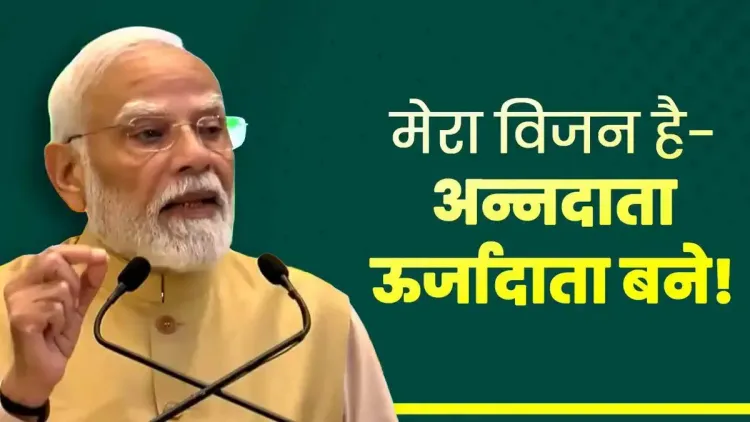
PM Modi coined the phrase 'अन्नदाता ऊर्जादाता' — farmers as both food and energy providers — at the #PMModiAtBharatRE event.
He called on IITs, startups, and entrepreneurs to build solar models that can meet an entire family's energy needs.
The push builds on the PM-KUSUM scheme (2019) , which allows farmers to earn income by feeding surplus solar power to the grid.
India's National Solar Mission (2010) laid the grid-connected solar foundation this household-level vision now seeks to extend.
Delhi CM Rekha Gupta shared the Prime Minister's appeal, amplifying the solar-for-farmers message on 2 November 2026 .
The emphasis on innovation signals a policy shift from pure capacity targets toward technology-driven, farmer-centric solar models.
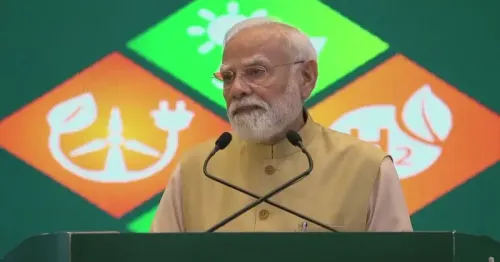
A farmer who grows food should also power the grid. That is the vision Prime Minister Narendra Modi articulated at the #PMModiAtBharatRE event, and Delhi Chief Minister Rekha Gupta amplified it on X on Monday, 2 November 2026 — urging that every idle patch of agricultural land become a node in India's solar future.
Quoting the Prime Minister directly, CM Gupta shared his call: 'अन्नदाता ऊर्जादाता बने' — 'let the food-giver become the energy-giver.' Modi's message was pointed: farmers should install solar panels on vacant land, and this must be scaled to as many villages as possible. The vision was not merely about adoption — it was explicitly tethered to innovation.
Modi's direct appeal to startups, IITs, and entrepreneurs
The Prime Minister made a specific appeal to India's innovation ecosystem. 'I will make a special request to my startups, IITs, innovators and entrepreneurs — come forward,' he said. 'Build models where a family's maximum needs are met through solar power.' That sentence is load-bearing: it shifts the conversation from large-scale grid projects to household-level energy sufficiency, with the farmer at the centre.
This is not a fresh direction — it is an acceleration of one. India's National Solar Mission, launched in 2010, set the grid-connected solar expansion in motion. The PM-KUSUM scheme, approved in 2019, went a step further: it allowed farmers to solarise agricultural feeders and earn additional income by selling surplus power back to the grid. What Modi articulated at the Bharat RE event is the next logical layer — a technology-innovation challenge layered on top of existing infrastructure policy.
Agrivoltaics and the dual land-use frontier
The model Modi described — solar panels on land not under active crop cultivation — sits at the heart of what energy researchers call agrivoltaics: the dual use of agricultural land for both food and energy production. India's successive renewable energy pushes have increasingly encouraged this approach, recognising that land scarcity is a real constraint and that farmer buy-in is the fastest route to rural solar penetration.
By calling on IITs and startups to engineer household-scale solar models, the Prime Minister is effectively setting an open innovation brief: reduce system cost, increase reliability, and make the economics work for a single rural family — not just an industrial power purchaser.
Whether the Bharat RE event produced specific targets, fresh funding, or new scheme components remains to be tracked as official announcements emerge. But the political signal from both the Prime Minister's address and CM Gupta's amplification is clear: the saur kranti — solar revolution — is being repositioned not as an infrastructure statistic, but as a farmer's income story and a startup's design challenge. That reframing, if backed by policy, could prove to be the real announcement of the day.
Point of View
Making solar expansion easier to sell to farming communities wary of land-use changes. By explicitly naming IITs and startups as solution-builders, the Prime Minister is offloading design risk to the innovation ecosystem while keeping policy credit centralised. CM Gupta's amplification reflects the BJP's broader effort to project a pro-farmer, pro-technology identity ahead of state-level electoral cycles. The Bharat RE event framing suggests the party sees agrivoltaics not just as an energy policy but as a political asset.
NationPress
3 Nov 2026
Frequently Asked Questions
What did PM Modi say about farmers and solar energy at Bharat RE?
PM Modi said his vision is for the 'annadata' (food-giver) to become the 'urjadata' (energy-giver) — farmers should install solar panels on vacant land so that more villages can generate their own power and farmers earn additional income.
What is the PM-KUSUM scheme?
PM-KUSUM is a central government scheme approved in 2019 that promotes solar pumps and grid-connected solar power plants for farmers, allowing them to solarise agricultural feeders and sell surplus power back to the grid for additional income.
Why did PM Modi appeal to IITs and startups at Bharat RE?
Modi called on IITs, startups, innovators, and entrepreneurs to build solar models capable of meeting a single family's entire energy needs, signalling that the next phase of India's solar revolution depends on technology innovation, not just large-scale adoption.
What is agrivoltaics and why is India focused on it?
Agrivoltaics refers to the dual use of agricultural land for both food production and solar energy generation. India is focused on it because land scarcity is a key constraint, and placing panels on idle farmland creates income for farmers without displacing crops.
Why did Delhi CM Rekha Gupta share PM Modi's solar speech?
Delhi CM Rekha Gupta shared PM Modi's remarks from the Bharat RE event to amplify the Prime Minister's vision of making every farmer an energy producer, aligning with the BJP's broader push to link renewable energy policy with rural welfare.