Pralhad Joshi pays tribute to Kittur Rani Chennamma on 248th Jayanti
Synopsis
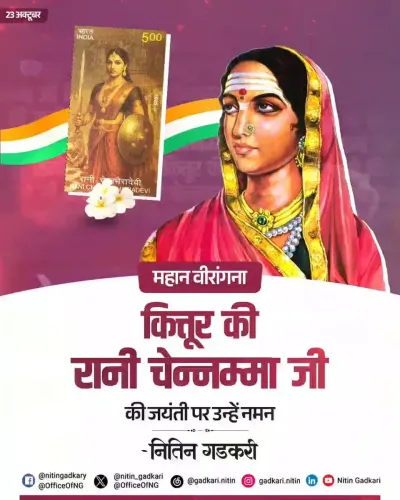
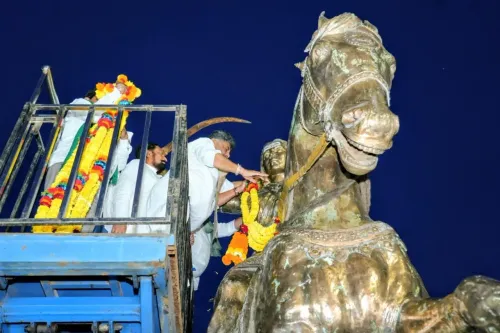
Union Minister Pralhad Joshi paid floral tribute to Kittur Rani Chennamma at her statue in Belagavi on her 248th birth anniversary, honouring the 19th-century queen whose armed resistance against the British East India Company in 1824 stands as one of India's earliest acts of anti-colonial defiance.
Key Takeaways
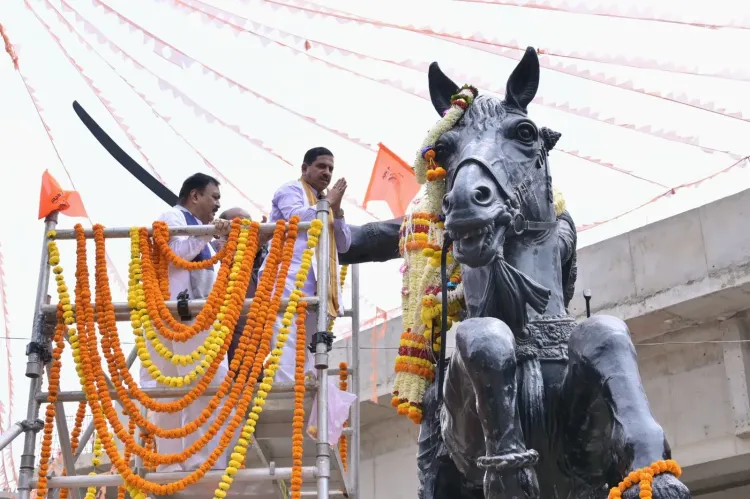
Union Minister Pralhad Joshi garlanded the statue of Kittur Rani Chennamma at Kittur Rani Chennamma Circle on October 23, 2026 .
The occasion marks Rani Chennamma's 248th birth anniversary .
Rani Chennamma led an armed revolt against the British East India Company in 1824 , predating the 1857 uprising by over 30 years.
Her kingdom, Kittur , is located in present-day Belagavi district, Karnataka .
Karnataka MLAs Mahesh Tenginkai, M R Patil, Shashi Bijwad, Shashi Dangannawar, and Mahantesh Shyagoti were present at the tribute.
A garland placed at a stone statue, a moment of silence at a busy roundabout — and a reminder that Karnataka's freedom story began nearly three decades before 1857. Union Consumer Affairs Minister Pralhad Joshi paid floral tribute to Kittur Rani Chennamma at her statue at Kittur Rani Chennamma Circle on Friday, October 23, 2026, marking the warrior queen's 248th birth anniversary.
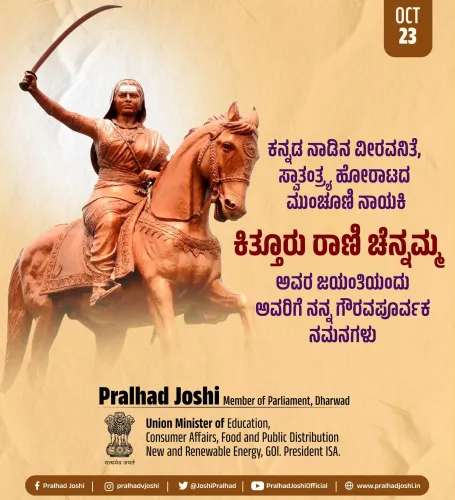
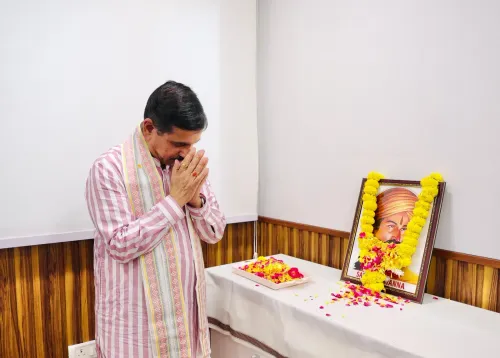
Posting in Kannada, Joshi described her as 'ಕನ್ನಡ ನಾಡಿನ ವೀರವನಿತೆ' — 'the valiant woman of the Kannada land' — and called her armed resistance against the British a clarion call for freedom that inspired generations of revolutionaries to follow. 'Her life of courage, sacrifice, and struggle is the proud history of our land,' he wrote, adding that her fight became a foreword for the freedom movement that would eventually sweep the subcontinent.The queen who said no to the Doctrine of Lapse
Rani Chennamma (born 1778, died 1829) ruled the princely state of Kittur, now part of Belagavi district, Karnataka. When the British East India Company invoked the Doctrine of Lapse to annex Kittur after the death of her adopted son in 1824, she did what few rulers dared — she raised an army and pushed back. Her forces famously defeated a Company contingent in that first engagement, capturing two British officers. The British returned with overwhelming force, and Chennamma was eventually captured and imprisoned at Bailhongal Fort, where she died in 1829. Her defiance predated the 1857 uprising by over three decades, making her one of the earliest armed resistors to colonial rule in southern India.MLAs and local leaders at the circle
Joshi was joined at the commemoration by several Karnataka legislators: Mahesh Tenginkai, M R Patil, Shashi Bijwad, Shashi Dangannawar, and Mahantesh Shyagoti, alongside other prominent citizens. The gathering at the eponymous circle underscored the occasion's civic weight — the site itself a daily reminder of the queen's place in Belagavi's public memory. For BJP leaders in Karnataka, marking the jayantis of pre-1857 regional figures is a consistent feature of the political calendar — a way of anchoring the party's nationalist identity to homegrown, pre-independence resistance rather than purely to the post-1947 state. Rani Chennamma, who cuts across caste lines in her popular appeal and is celebrated in Kannada folklore, is among the most resonant of those figures. Two hundred and forty-eight years after her birth, Chennamma's statue still stops traffic — and still starts conversations about who actually fired the first shots for Indian freedom.Point of View
Regionally beloved resistance figures, the party seeks to frame Indian nationalism as a long, locally rooted continuum rather than a product of the 20th-century independence movement alone. Chennamma's cross-caste appeal in north Karnataka makes her a particularly valuable symbol. For a senior Karnataka leader like Joshi, these jayanti observances also serve a constituency-maintenance function — maintaining visibility in a state where the party faces competitive electoral pressure. The consistent annual nature of such events suggests they are now institutionalised features of the BJP's Karnataka outreach calendar.
NationPress
23 Oct 2026
Frequently Asked Questions
Who was Kittur Rani Chennamma?
Kittur Rani Chennamma (1778–1829) was the queen of the princely state of Kittur in present-day Belagavi district, Karnataka. She led an armed revolt against the British East India Company in 1824 when they tried to annex her kingdom, making her one of India's earliest anti-colonial resistors.
Why is October 23 celebrated as Kittur Rani Chennamma Jayanti?
October 23 is observed as Kittur Rani Chennamma Jayanti to mark her birth anniversary. In 2026, the day marks her 248th birth anniversary and is commemorated across Karnataka with tributes, cultural events, and official functions.
What did Pralhad Joshi do on Kittur Rani Chennamma Jayanti 2026?
Union Consumer Affairs Minister Pralhad Joshi paid floral tribute at Rani Chennamma's statue at Kittur Rani Chennamma Circle on October 23, 2026, alongside several Karnataka MLAs and local dignitaries.
Where is Kittur located?
Kittur is a town in Belagavi district, Karnataka, and was the seat of the former princely state ruled by Rani Chennamma. A prominent circle (roundabout) in the area is named in her honour.
Why is Rani Chennamma's revolt historically significant?
Rani Chennamma's armed resistance in 1824 predated the more widely known 1857 uprising by over three decades, establishing her as one of the first rulers in southern India to take up arms against British colonial rule. Her struggle is celebrated as an early chapter in India's freedom movement.