Joshi Cites 7.8% Q1 Growth, Calls India Fastest-Growing Economy
Synopsis
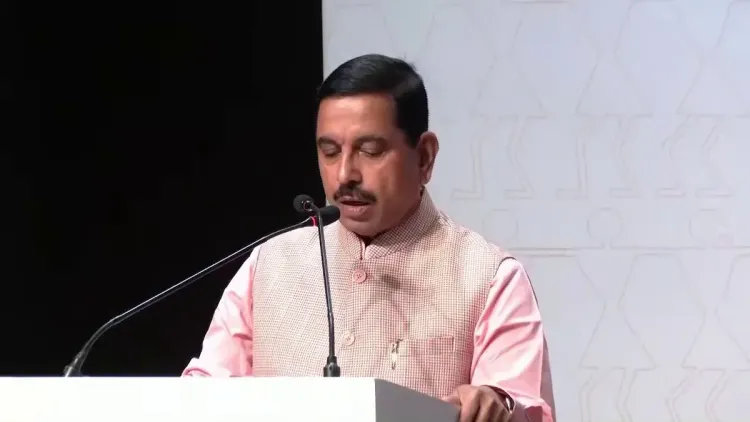
Union Minister Pralhad Joshi, speaking at the AgriVoltaics World Conference 2026, highlighted India's 7.8% first-quarter GDP growth under PM Modi's leadership, reinforcing New Delhi's positioning of India as the world's fastest-growing major economy despite global headwinds.
Key Takeaways
Union Minister Pralhad Joshi cited a 7.8% Q1 GDP growth rate at the AgriVoltaics World Conference 2026 on October 21, 2026 .
India is positioned as the fastest-growing major economy in the world , a claim the government has consistently made since 2021-22 .
The growth figure is presented as evidence of resilience despite ongoing global geopolitical and supply-chain disruptions .
The statement explicitly credits Prime Minister Narendra Modi's leadership for India's economic trajectory.
The AgriVoltaics World Conference platform links Joshi's renewable energy brief to the broader economic growth narrative.
Next quarterly GDP releases and the upcoming Economic Survey and Union Budget will be the next key markers to watch.
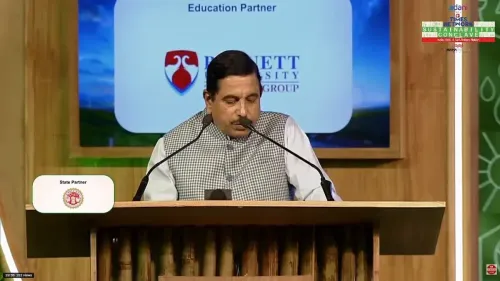
Even as geopolitical fault lines fracture global supply chains and major economies stutter, India is clocking growth that its peers can only envy — and Union Consumer Affairs Minister Pralhad Joshi wants the world to take note. Speaking at the margins of the AgriVoltaics World Conference 2026 on Wednesday, October 21, Joshi pointed to a 7.8% first-quarter GDP growth rate as proof that India's economic engine is running hot.
The 7.8% Number and What It Signals
Joshi's post places the Q1 figure of 7.8% at the centre of the argument — a rate that, if borne out by official data from the Ministry of Statistics and Programme Implementation, would rank India comfortably above every other large economy in the world right now. The government has consistently cited quarterly growth prints above 7% across several post-pandemic periods to buttress its claim of structural resilience, not a one-off bounce.
The broader pattern is deliberate and well-worn: New Delhi has, since at least 2021-22, positioned India's growth story as proof that domestic reforms, infrastructure investment, and policy continuity can insulate an emerging market from external shocks. The fastest-growing major economy label has appeared in official communications, international forums, and budget documents with near-clockwork regularity.
Modi Government's Growth Narrative at a Global Stage
Prime Minister Narendra Modi, in office since 2014, is the anchor of Joshi's framing — the post credits his leadership explicitly for the development trajectory. The choice of the AgriVoltaics World Conference 2026 as the platform is notable: agrivoltaics — the co-location of solar energy generation and agriculture — sits squarely at the intersection of Joshi's own renewable energy portfolio and the food-security mandate of his consumer affairs brief, making the growth message doubly resonant for that audience.
For global investors watching India, the optics matter as much as the data. Every senior minister reinforcing the same headline number — at international conferences, on social media, in bilateral meetings — is a coordinated signal that the policy establishment is aligned and the growth story is not a talking point but a target.
Why the Fastest-Growing Tag Still Has Weight
India's claim to the fastest-growing major economy title rests on comparison with the G20 cohort — the United States, China, the European Union's largest members, and Japan. With China navigating a prolonged property-sector correction and several Western economies wrestling with sticky inflation, a sub-8% India print is more than competitive — it is, for many institutional investors, the most compelling large-market growth story available. Joshi's post, brief as it is, drops that anchor firmly.
The next test will come with subsequent quarterly releases and the signals embedded in the upcoming Economic Survey and Union Budget cycle — whether the momentum holds or whether global headwinds finally land on Indian shores.
Point of View
Signalling policy coherence to a technically sophisticated global audience. The consistent 'fastest-growing major economy' framing, maintained across multiple years and ministers, suggests a centralised messaging architecture designed to compound credibility over time. Whether the 7.8% Q1 figure survives subsequent data revisions will determine how long this particular talking point stays in circulation.
NationPress
21 Oct 2026
Frequently Asked Questions
What is India's GDP growth rate in the first quarter of 2026?
Union Minister Pralhad Joshi cited a 7.8% GDP growth rate for India's first quarter of 2026, calling it among the highest for any major economy in the world.
Is India really the fastest-growing major economy in 2026?
The Indian government has consistently described India as the fastest-growing major economy, a claim supported by comparisons with the G20 cohort where most large economies are growing significantly slower. The 7.8% Q1 figure cited by Minister Joshi, if confirmed by official data, would substantiate this ranking.
What is the AgriVoltaics World Conference 2026?
The AgriVoltaics World Conference 2026 is an international event focused on agrivoltaics — the simultaneous use of land for solar energy production and agriculture. Minister Pralhad Joshi, who holds the New and Renewable Energy portfolio, referenced India's economic growth in statements at this conference.
What has Modi government said about India's economic growth?
Since at least 2021-22, the Modi government has regularly cited quarterly GDP growth rates above 7% as evidence of India's economic resilience, attributing the performance to domestic reforms, infrastructure investment, and policy continuity under Prime Minister Narendra Modi.
When will the next India GDP data be released?
India's quarterly GDP data is released by the Ministry of Statistics and Programme Implementation . The next major economic markers to watch are the subsequent quarterly release and signals from the upcoming Economic Survey and Union Budget cycle.