Joshi credits PMGKAY for lifting 25 crore out of poverty
Synopsis
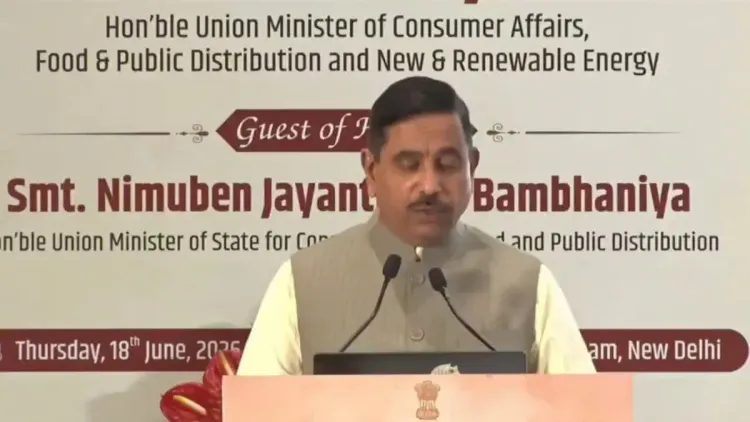
Union Consumer Affairs Minister Pralhad Joshi on June 18 credited PMGKAY and allied welfare measures with lifting nearly 25 crore Indians out of multidimensional poverty, calling the scheme one of the world's largest social welfare initiatives under PM Narendra Modi.
Key Takeaways
Union Consumer Affairs Minister Pralhad Joshi posted on June 18, 2026 highlighting PMGKAY's welfare outcomes.
The government claims nearly 25 crore people have exited multidimensional poverty, linked in part to PMGKAY and allied schemes.
PMGKAY provides 5 kg of free foodgrains per month to roughly 80 crore NFSA beneficiaries.
The scheme was originally launched in March 2020 as pandemic relief and has since been made a permanent entitlement.
The National Food Security Act, 2013 forms the legal backbone underpinning PMGKAY's beneficiary coverage.
A forthcoming NITI Aayog MPI update and the next Union Budget food subsidy allocation are the key near-term markers to watch.
Union Consumer Affairs Minister Pralhad Joshi on Thursday, June 18, 2026, highlighted the scale and impact of the Pradhan Mantri Garib Kalyan Anna Yojana (PMGKAY), attributing the scheme's reach to what the government describes as one of the world's largest social welfare initiatives under Prime Minister Narendra Modi.
Context
In his post, Joshi stated that PMGKAY and allied welfare measures have helped 'nearly 25 crore people come out of multidimensional poverty,' framing the achievement as a collective national effort rooted in a 'Nation First' spirit. He called on citizens to 'take pride in being part of this transformative journey.' The remarks come as the government continues to position large-scale food transfers as a cornerstone of its anti-poverty architecture.
PMGKAY provides 5 kg of free foodgrains per month to beneficiaries covered under the National Food Security Act (NFSA), a pool of roughly 80 crore individuals. Originally launched in March 2020 as emergency pandemic relief, the scheme was extended multiple times before being made a permanent feature of the food subsidy framework.
Policy Backdrop
The scheme's lineage traces back to the National Food Security Act, 2013, which established a legal entitlement to subsidised foodgrains for a majority of the Indian population. The Modi government built on this base after 2014, expanding in-kind food transfers and integrating them with direct benefit transfer mechanisms to broaden welfare delivery.
NITI Aayog's Multidimensional Poverty Index (MPI) reports — covering health, education, and living-standard indicators — have tracked a steady decline in multidimensional poverty since 2021. The government has consistently cited these reports to substantiate claims of large-scale poverty reduction, linking improvements to flagship schemes including PMGKAY.
Stakeholders and Impact
NFSA cardholders and households classified as multidimensionally poor are the primary beneficiaries of the scheme. For these households, free monthly grain allocations directly reduce food expenditure, freeing income for health, education, and other essentials — the very dimensions tracked by the MPI framework.
The scale of the programme makes it a significant fiscal commitment. Food subsidy allocations have remained among the largest line items in successive Union Budgets, and any revision to PMGKAY's scope or duration draws close attention from both beneficiary communities and fiscal analysts.
What's Next
Attention will now turn to the next Union Budget cycle and whether it carries an enhanced food subsidy outlay to sustain PMGKAY at its current coverage. A forthcoming update to the NITI Aayog MPI is also anticipated, which would either corroborate or refine the government's poverty-exit claims with fresh data.
Minister Joshi's statement signals that the ruling dispensation intends to keep PMGKAY's welfare narrative prominent ahead of any policy review, reinforcing the scheme's centrality to the BJP's broader social contract with India's poorest households.
Point of View
Anchoring the government's anti-poverty credentials to a scheme that enjoys both mass reach and high visibility. By invoking the NITI Aayog's multidimensional poverty framework, the BJP signals it is fighting the poverty debate on empirical terrain, not just political rhetoric. The timing — ahead of a likely MPI update and budget cycle — suggests the party is building a pre-emptive narrative around PMGKAY's permanence. The 25-crore figure, if validated by forthcoming official data, would represent one of the most cited statistics in India's welfare policy discourse for years to come.
NationPress
19 Sept 2026
Frequently Asked Questions
What is Pradhan Mantri Garib Kalyan Anna Yojana (PMGKAY)?
PMGKAY is a central government scheme that provides 5 kg of free foodgrains per month to each beneficiary covered under the National Food Security Act, covering approximately 80 crore Indians. It was launched in March 2020 as COVID-19 pandemic relief and was later made a permanent entitlement.
How many people has PMGKAY helped exit poverty?
The government, including Union Minister Pralhad Joshi , has stated that PMGKAY and allied welfare measures have helped nearly 25 crore people come out of multidimensional poverty, citing NITI Aayog MPI trend data. This figure is subject to confirmation by the latest official MPI release.
What is the Multidimensional Poverty Index (MPI) in India?
India's Multidimensional Poverty Index is published by NITI Aayog and measures poverty across health, education, and living-standard indicators — going beyond income alone. Reports published since 2021 have recorded a consistent decline in multidimensional poverty across Indian states.
Is PMGKAY still active in 2026?
As of the government's current communications in June 2026 , PMGKAY remains operational as a permanent component of India's food subsidy architecture. The next Union Budget allocation will indicate whether coverage and funding are maintained, expanded, or revised.
What is the National Food Security Act and how does it relate to PMGKAY?
The National Food Security Act, 2013 gave legal backing to subsidised foodgrain entitlements for a majority of India's population. PMGKAY is built on top of this framework, converting the subsidised entitlement into a fully free allocation for the same NFSA beneficiary base.