Joshi: Cabinet upgrades PMGKAY rice quality after 3 decades
Synopsis
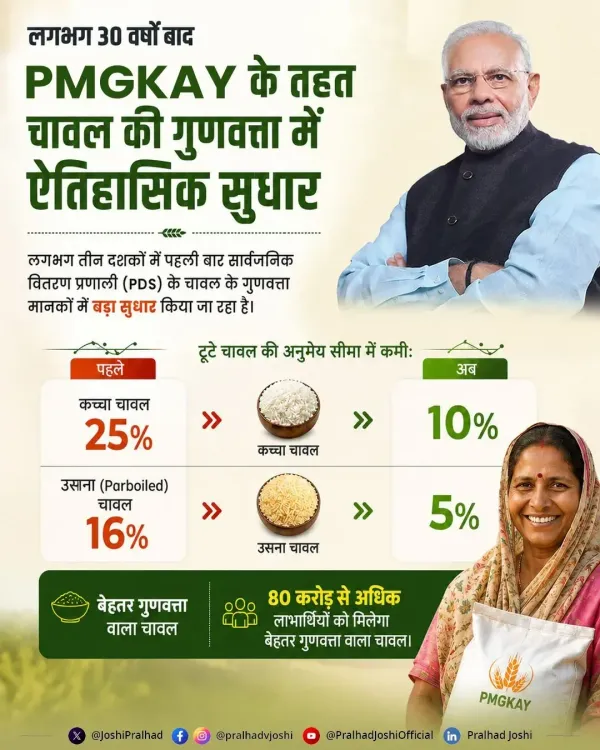
The Union Cabinet has approved the first upgrade to PMGKAY rice quality standards in nearly three decades, covering over 80 crore beneficiaries. The reform introduces higher-grade grain and QR-based traceability, announced by Consumer Affairs Minister Pralhad Joshi on 1 July 2026.
Key Takeaways
The Union Cabinet approved an upgrade to PMGKAY rice quality standards on 1 July 2026 — the first revision in nearly three decades .
More than 80 crore NFSA beneficiaries will receive higher-quality grain without any reduction in their entitled quantity.
QR-based traceability will be introduced across the supply chain to improve transparency and curb diversion.
The reform is framed around four pillars: better quality, optimal grain utilisation, traceability, and prudent cost management .
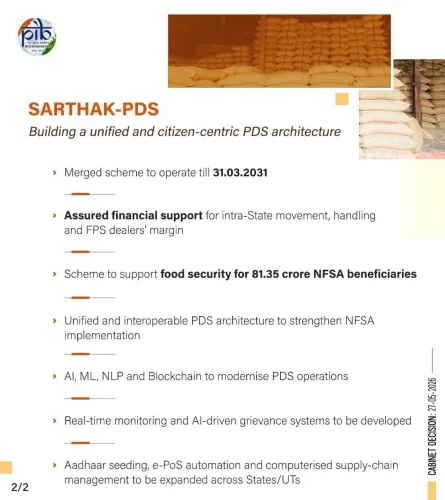
The decision extends the government's ongoing modernisation of the Public Distribution System , following earlier reforms such as One Nation One Ration Card and e-PoS devices.
Implementation will require revised procurement specifications for FCI and state agencies, with rollout timelines yet to be detailed.
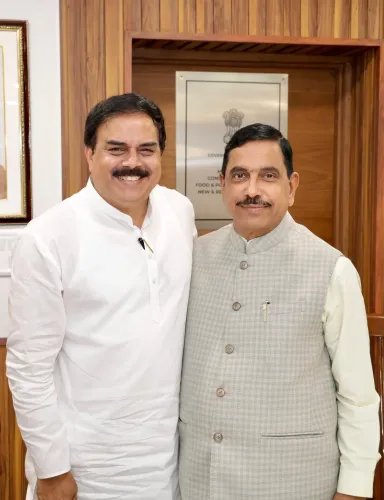
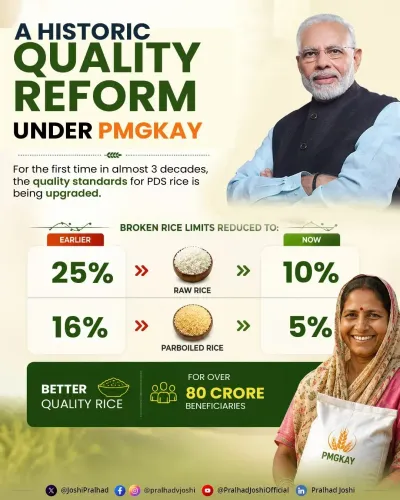
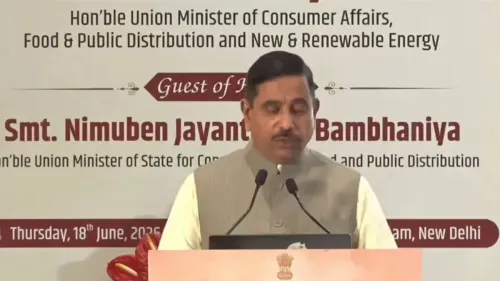
Union Consumer Affairs Minister Pralhad Joshi announced on Wednesday, 1 July 2026 that the Union Cabinet, under Prime Minister Narendra Modi, has approved a historic upgrade to the quality standards of rice distributed under the Pradhan Mantri Garib Kalyan Anna Yojana (PMGKAY) — the first such revision in nearly three decades — benefiting more than 80 crore beneficiaries across India.
Context
Posting on X, Minister Joshi described the Cabinet decision as 'ऐतिहासिक एवं परिवर्तनकारी' ('historic and transformative'), stating that for the first time in approximately three decades, the quality norms for rice distributed under PMGKAY are being upgraded. He emphasised that every eligible family will continue to receive their entitled quantity of food grain — but now at a higher quality standard.
The minister noted that the reform rests on four pillars: better quality grain, optimal utilisation of every grain, enhanced transparency through QR-based traceability, and prudent cost management. The announcement was tagged under #CabinetDecisions and #PMGKAY, signalling an official government communication.
Policy Backdrop
PMGKAY was launched in March 2020 to supply free food grains to beneficiaries covered under the National Food Security Act (NFSA), 2013, initially as an emergency measure during the COVID-19 pandemic. It was subsequently extended in multiple phases and eventually made a permanent feature of India's food security architecture, covering roughly 80 crore priority-household beneficiaries.
The NFSA legally entitles priority households to subsidised food grains through the Public Distribution System (PDS). Successive governments have layered technological interventions — including Aadhaar seeding, One Nation One Ration Card portability, and electronic Point-of-Sale (e-PoS) devices — onto this framework to reduce leakages and improve accountability. The introduction of QR-based traceability announced in this Cabinet decision is a direct continuation of that modernisation trajectory.
The last revision to rice quality specifications under the PDS is understood to predate the mid-1990s, making this a structurally significant administrative update to a programme that disburses millions of tonnes of grain annually through the Food Corporation of India (FCI) and state agencies.
Stakeholders and Impact
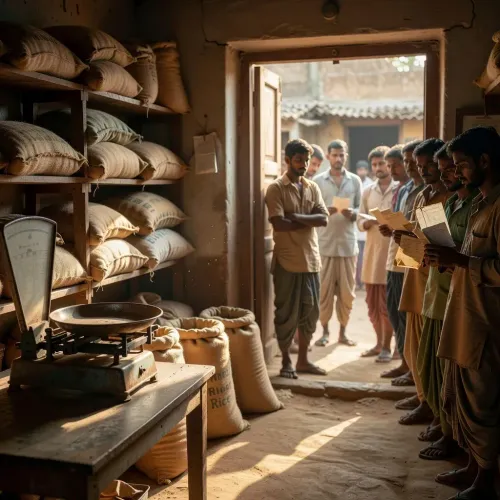
The primary beneficiaries are the more than 80 crore NFSA-covered individuals — largely low-income and Below Poverty Line (BPL) households — who depend on PDS rations as a core component of household food security. For these families, the upgrade means access to better-grade rice without any change in their entitled allocation or cost.
The QR-based traceability component is aimed at supply-chain actors: FCI godowns, state civil supplies corporations, fair-price shop dealers, and district-level distribution machinery. By enabling end-to-end tracking of grain consignments, the system is designed to deter adulteration and diversion, long-standing concerns in PDS administration. Prudent cost management, cited explicitly by the minister, suggests the government intends to absorb quality improvements within the existing food subsidy envelope rather than expanding it.
What's Next
Attention will now turn to the operational rollout: revised rice procurement and milling specifications will need to be communicated to FCI and state procurement agencies, while QR-code infrastructure will have to be deployed across warehousing and last-mile distribution points. Parliamentary scrutiny — including questions on implementation timelines, cost impact on the food subsidy bill, and third-party quality audits — is likely when the monsoon session of Parliament convenes.
If successfully implemented at scale, the quality upgrade could set a new baseline for welfare-food standards in India and strengthen the political case for PMGKAY as a long-term entitlement rather than an emergency measure — with implications for how food security is framed in future electoral cycles.
Point of View
The government simultaneously addresses two persistent PDS vulnerabilities: poor grain standards and supply-chain leakage. The announcement fits a broader BJP governance narrative of modernising legacy welfare architecture without dismantling it, reinforcing PMGKAY's transition from a pandemic-era measure to a permanent political asset ahead of state election cycles. The emphasis on cost neutrality, however, will face scrutiny once procurement and milling specifications are made public.
NationPress
30 Sept 2026
Frequently Asked Questions
What is PMGKAY and who benefits from it?
PMGKAY (Pradhan Mantri Garib Kalyan Anna Yojana) is a central government scheme that provides free food grains to over 80 crore beneficiaries covered under the National Food Security Act, 2013. It was launched in March 2020 and has since been made a permanent entitlement.
What has the Cabinet changed about PMGKAY rice quality?
The Union Cabinet has upgraded the quality standards for rice distributed under PMGKAY for the first time in nearly three decades. Beneficiaries will receive the same quantity of grain as before, but at a higher quality grade, along with QR-based traceability on consignments.
What is QR-based traceability in the Public Distribution System?
QR-based traceability means each consignment of food grain will carry a QR code that allows authorities to track it from the procurement or milling stage through FCI godowns and state agencies all the way to fair-price shops, reducing the risk of adulteration and diversion.
Will the food grain quantity for ration card holders change?
No. Minister Pralhad Joshi explicitly stated that every eligible family will continue to receive the same quantity of food grain they are currently entitled to — the only change is that the quality of rice will be better.
When was PMGKAY rice quality last revised before this Cabinet decision?
According to the government's announcement, the quality standards for rice distributed under PMGKAY had not been revised for approximately three decades, making the July 2026 Cabinet decision the first such upgrade in nearly thirty years.