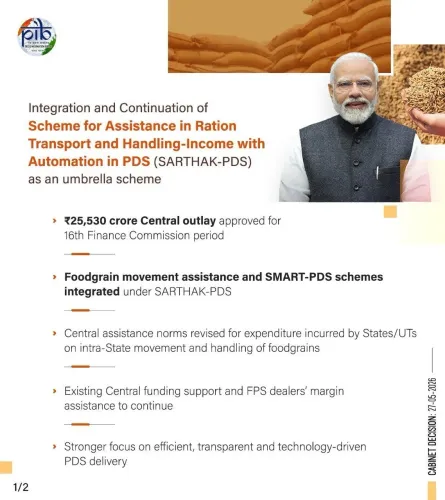
Cabinet Approves SARTHAK-PDS Scheme Worth Rs 25,530 Cr
Synopsis
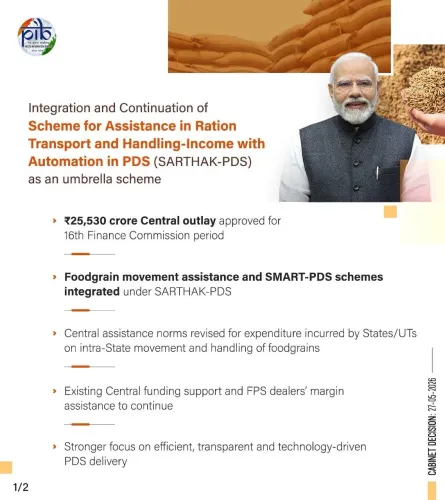
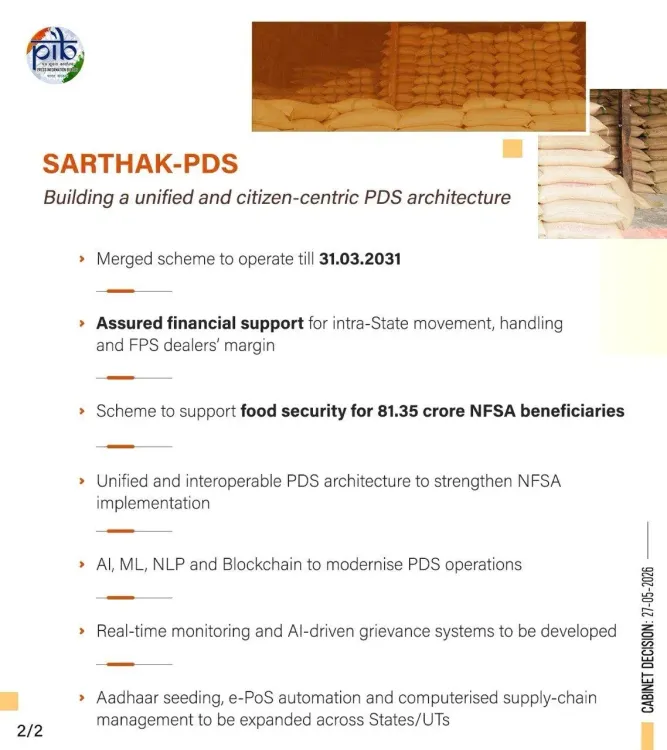
The Union Cabinet has approved the SARTHAK-PDS umbrella scheme with a Rs 25,530 crore central outlay for the 16th Finance Commission cycle. The scheme aims to modernise ration transport, support FPS dealers, and deploy AI, ML and blockchain tools across the Public Distribution System serving 81.35 crore NFSA beneficiaries.
Key Takeaways
The Union Cabinet, chaired by PM Narendra Modi , approved the SARTHAK-PDS scheme on 27 May 2026 .
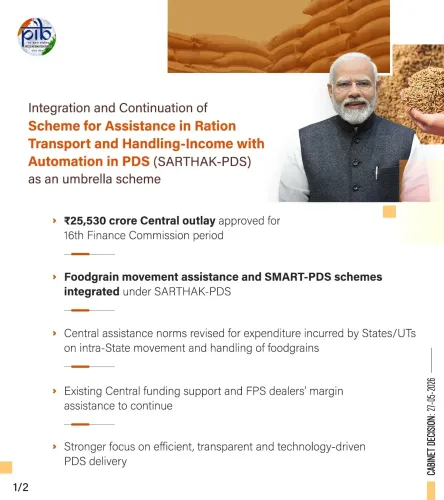
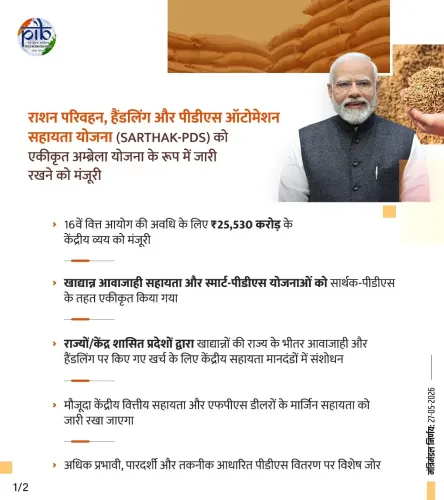
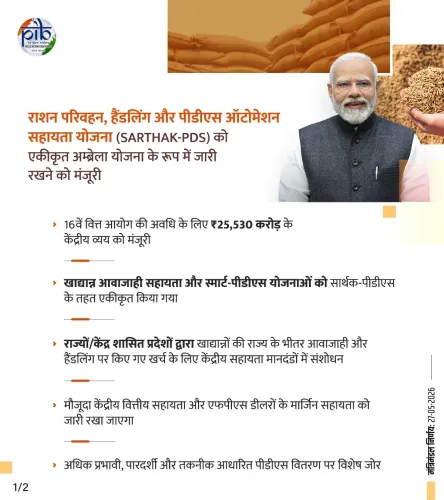
The central outlay for the scheme is Rs 25,530 crore , covering the 16th Finance Commission award cycle from 2026-27 onwards.
The scheme covers ration transport, handling assistance, and technology automation within the Public Distribution System .
Technologies to be deployed include Artificial Intelligence, Machine Learning, Blockchain and real-time monitoring systems.
The scheme targets 81.35 crore NFSA beneficiaries and specifically aims to enhance support for Fair Price Shop (FPS) dealers .
The approval extends a decade-long policy of digitising and modernising the PDS, building on the One Nation One Ration Card and earlier computerisation initiatives.
Union Consumer Affairs Minister Pralhad Joshi announced on Wednesday, 27 May 2026 that the Union Cabinet, chaired by Prime Minister Narendra Modi, has approved the continuation of the SARTHAK-PDS scheme — formally titled 'Scheme for Assistance in Ration Transport and Handling-Income with Automation in PDS' — as an umbrella scheme for the 16th Finance Commission award cycle, with a central outlay of Rs 25,530 crore.
Context
The Cabinet decision extends a framework that funds ration transport, handling charges, and technology upgrades within the Public Distribution System (PDS). Minister Joshi described the move as 'a major step towards ensuring transparent, efficient and citizen-centric food security' for 81.35 crore National Food Security Act (NFSA) beneficiaries — the largest legally entitled subsidised foodgrain programme in the world.
The NFSA, enacted in 2013, converted food security into a statutory entitlement, obligating the central government to supply subsidised rice, wheat, and coarse cereals through Fair Price Shops (FPS) spread across every state and union territory. The SARTHAK-PDS scheme is designed to strengthen the financial and operational backbone of that delivery chain.
Policy Backdrop
The current approval fits into a decade-long pattern of layering technology onto the PDS to reduce leakages and improve beneficiary targeting. The End-to-End Computerisation of Targeted PDS initiative, launched in 2012, first digitised ration cards and supply chains at scale. The One Nation One Ration Card portability scheme, rolled out from 2019, enabled migrant workers and inter-state households to access their entitlements from any FPS in the country.
SARTHAK-PDS advances this trajectory by embedding Artificial Intelligence (AI), Machine Learning (ML), Blockchain, and real-time monitoring systems directly within the transport-and-handling assistance framework. The 16th Finance Commission's award period — which governs central grants and tax devolution from 2026-27 onwards — provides the fiscal envelope for the scheme's continuation and expansion.
FPS dealers, who form the last-mile link between government godowns and beneficiary households, are a specific focus. The scheme is intended to enhance the financial support and operational efficiency of these dealers, many of whom operate on thin margins in rural and semi-urban areas.
Stakeholders and Impact
The primary beneficiaries are the 81.35 crore NFSA-entitled individuals across India, who depend on the PDS for subsidised foodgrains. Improved logistics tracking and automated processes are expected to reduce diversion and ensure timely delivery at the FPS level.
FPS dealers stand to gain from enhanced handling and transport assistance, while state food and civil supplies departments will be required to integrate with the new technology platforms. Blockchain-based record-keeping, in particular, is aimed at creating tamper-proof transaction logs across the supply chain — from central procurement to doorstep delivery.
The Rs 25,530 crore central share represents a significant fiscal commitment over the Finance Commission cycle, signalling the government's intent to treat PDS modernisation as a structural priority rather than a one-off pilot.
What's Next
Implementation will hinge on state-level guidelines and fund-release mechanisms that the Ministry of Consumer Affairs, Food and Public Distribution is expected to notify in the coming weeks. Integration milestones for AI and blockchain pilots in selected districts will be closely watched as indicators of on-ground progress.
The success of the scheme will ultimately be measured by reductions in PDS leakage rates, faster grievance redressal for beneficiaries, and the financial stability of FPS dealers — metrics that successive governments have struggled to move decisively. With a full Finance Commission cycle and a dedicated central outlay now committed, the SARTHAK-PDS framework will be a key test of whether technology-led welfare delivery can deliver at India's scale.
Point of View
Not a pilot project. The inclusion of blockchain and AI alongside the existing transport-subsidy framework is politically astute: it allows the government to claim both welfare continuity and digital-India credentials in a single Cabinet decision. The real test, however, will come at state-level implementation, where previous technology mandates have often stalled due to capacity gaps and coordination failures between the Centre and state food departments.
NationPress
14 Oct 2026
Frequently Asked Questions
What is the SARTHAK-PDS scheme approved by the Cabinet?
SARTHAK-PDS stands for 'Scheme for Assistance in Ration Transport and Handling-Income with Automation in PDS.' The Cabinet approved its continuation as an umbrella scheme on 27 May 2026, with a central outlay of Rs 25,530 crore for the 16th Finance Commission cycle, aimed at modernising ration transport, supporting FPS dealers, and deploying AI, ML and blockchain in the Public Distribution System.
How many people will benefit from the SARTHAK-PDS scheme?
The scheme is designed to strengthen food security delivery for 81.35 crore beneficiaries entitled under the National Food Security Act (NFSA), making it one of the largest welfare delivery programmes in the world.
What is the total budget outlay for the SARTHAK-PDS scheme?
The central government share approved for the SARTHAK-PDS scheme is Rs 25,530 crore, covering the award period of the 16th Finance Commission, which begins from 2026-27.
How does SARTHAK-PDS use technology in the PDS?
The scheme plans to integrate Artificial Intelligence, Machine Learning, Blockchain, and real-time monitoring systems into the Public Distribution System to reduce leakages, automate supply-chain tracking, and create tamper-proof transaction records from procurement to Fair Price Shop delivery.
What is the 16th Finance Commission and why does it matter for this scheme?
The 16th Finance Commission is a constitutional body that determines the sharing of central taxes and grants with states for a fixed award period starting 2026-27. Tying the SARTHAK-PDS scheme to this cycle ensures a committed, multi-year fiscal framework for its implementation across states.