Cabinet Approves Rs 25,530 Cr PDS Automation Scheme
Synopsis
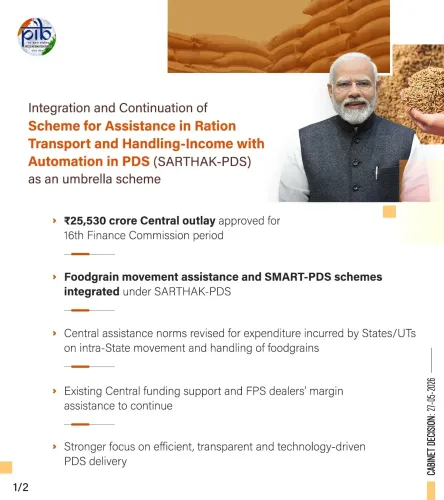
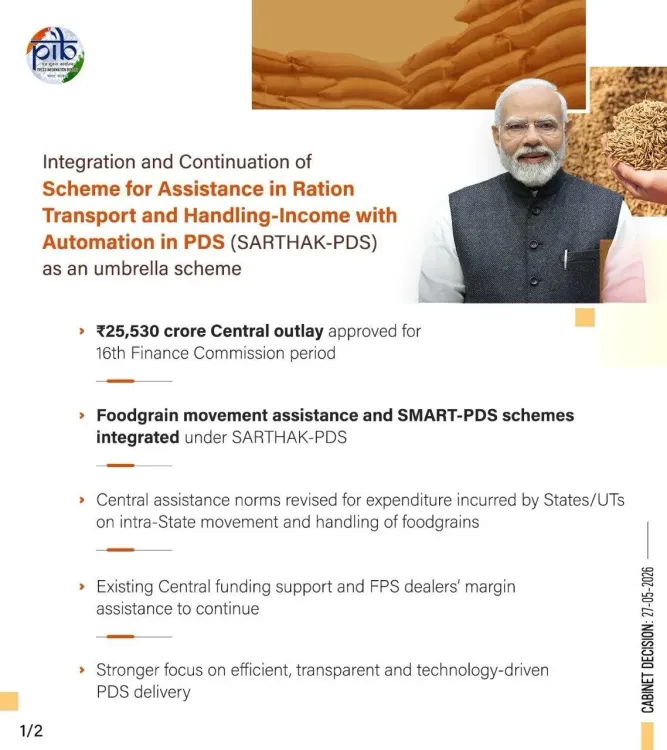
The Union Cabinet under PM Narendra Modi has approved the continuation of the PDS ration transport and automation umbrella scheme with a Central outlay of Rs. 25,530 crore for the 16th Finance Commission cycle, aiming to sustain subsidised food grain delivery and technology-driven reforms across India's fair price shop network.
Key Takeaways
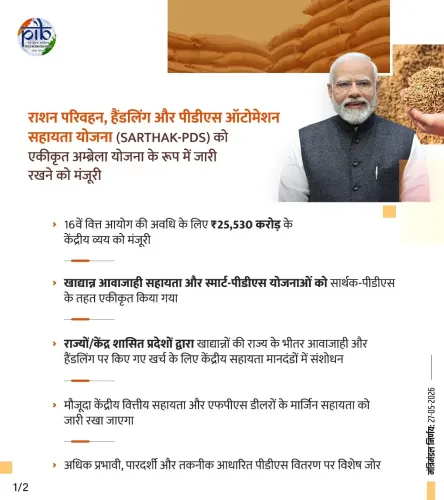
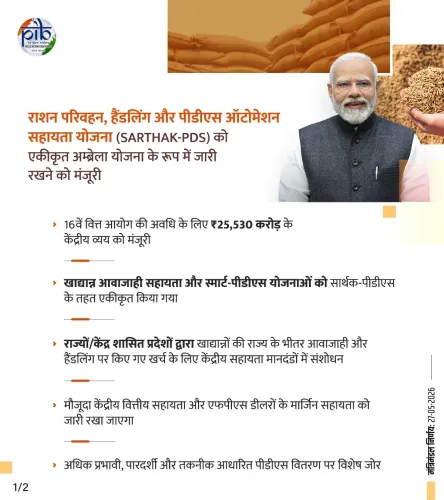
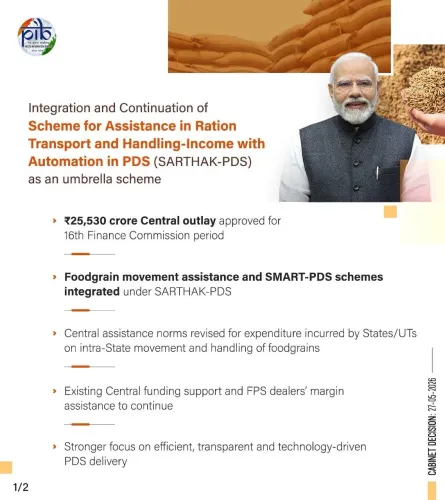
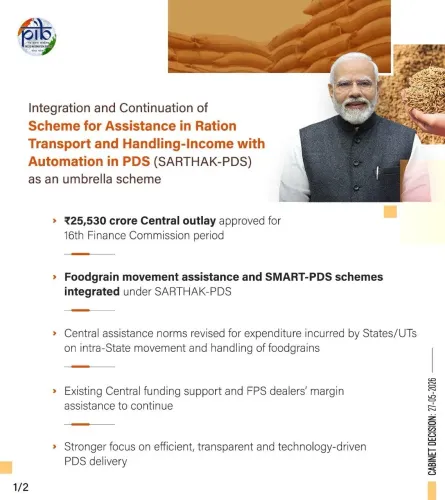
The Union Cabinet approved continuation of the 'Scheme for Assistance in Ration Transport and Handling-Income with Automation in PDS' on May 27, 2026 .
The Central share outlay is Rs.
25,530 crore , covering the 16th Finance Commission award cycle period.
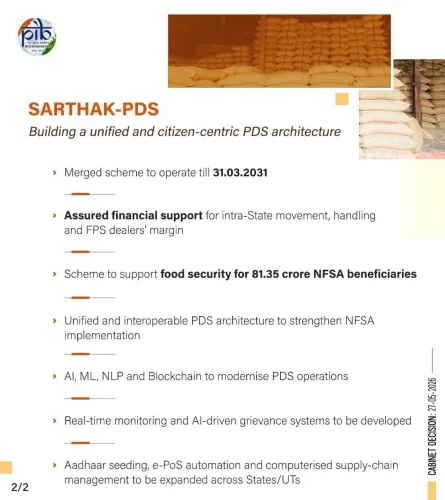
The scheme funds states for ration transport costs, godown handling charges, and IT automation including ePoS devices and Aadhaar-seeded ration cards.
The approval ensures no funding gap between Finance Commission cycles, maintaining continuity in PDS operations nationwide.
Key stakeholders include state food and civil supplies departments, the Food Corporation of India , and crores of ration card holders dependent on subsidised food grains.
Progress on automation modules and state utilisation certificates will be closely watched during the initial years of the new cycle.
Union Science and Technology Minister Dr. Jitendra Singh announced on Wednesday, May 27, 2026, that the Union Cabinet under Prime Minister Narendra Modi has approved the continuation of the 'Scheme for Assistance in Ration Transport and Handling-Income with Automation in PDS' as an umbrella scheme, with a Central share outlay of Rs. 25,530 crore for the 16th Finance Commission cycle award period.
Context
The Cabinet decision ensures uninterrupted Central funding for logistics, handling costs, and information-technology automation across India's Public Distribution System (PDS) — the nationwide programme that delivers subsidised food grains to eligible households through a network of fair price shops. The approval ties the scheme's continuation directly to the incoming 16th Finance Commission award cycle, maintaining the practice of aligning such welfare infrastructure investments with each Commission's period.
Dr. Jitendra Singh shared the Cabinet decision on X, stating that the scheme had been approved 'as an umbrella scheme, in the 16th Finance Commission cycle award period, with an outlay of Rs. 25,530 cr as Central share.'
Policy Backdrop
India's PDS draws its statutory mandate from the National Food Security Act, 2013, which expanded coverage and entitlements for subsidised food grains. End-to-end computerisation and automation of PDS operations were first launched as a centrally sponsored initiative in 2012-13, with successive extensions tied to each Finance Commission cycle — a model that has now been carried forward into the 16th cycle.
The scheme funds states and union territories for key operational costs including ration transport, godown handling charges, and the deployment of technology tools such as Aadhaar-seeded ration cards and electronic point-of-sale (ePoS) devices at fair price shops. These automation measures are central to the government's long-running effort to reduce leakages, eliminate ghost beneficiaries, and improve last-mile delivery of food entitlements.
The umbrella scheme structure allows the Centre to consolidate related sub-components under a single administrative and financial framework, streamlining fund flow to state food and civil supplies departments.
Stakeholders and Impact
The primary beneficiaries are the crores of ration card holders across India who depend on the PDS for subsidised food grains. State food and civil supplies departments, which manage day-to-day distribution operations, will receive Central funds to meet transport and handling costs that would otherwise strain state budgets.
The Food Corporation of India (FCI), the nodal agency for procurement and storage of food grains, is also a key stakeholder, as improved logistics and automation at the retail end complement FCI's upstream operations. Progress on automation — including real-time transaction tracking and biometric authentication — directly affects the efficiency and transparency of the entire supply chain.
For state governments, the continuation of Central assistance removes financial uncertainty at the start of a new Finance Commission cycle, allowing them to plan PDS operations without a funding gap.
What's Next
Attention will now turn to the Department of Food and Public Distribution, which is expected to issue operational guidelines and state-wise allocation details for the 16th Finance Commission period. State governments will need to submit utilisation certificates and progress reports on automation modules to unlock funds under the scheme.
The pace of technology adoption — particularly the rollout of ePoS devices in remaining fair price shops and the integration of Aadhaar-based authentication — will be a key performance indicator as the new cycle begins. Any supplementary guidelines on automation benchmarks or revised transport cost norms could shape how effectively the Rs. 25,530 crore outlay translates into on-ground improvements for beneficiaries.
Point of View
530 crore outlay for PDS automation and logistics signals that technology-enabled welfare delivery remains a durable policy priority across government cycles, not a one-term initiative. By structuring the continuation as an umbrella scheme aligned with the 16th Finance Commission period, the Centre reinforces a model of predictable, cycle-linked Central assistance that insulates food security infrastructure from year-to-year budgetary uncertainty. The scale of the outlay also reflects the political salience of the PDS — a programme that touches hundreds of millions of households — as the government heads into the latter years of its current term. The real test, however, lies in whether automation targets set in previous cycles have been met, and whether the new funding accelerates or merely sustains the status quo on leakage reduction.
NationPress
10 Oct 2026
Frequently Asked Questions
What is the PDS automation scheme approved by the Cabinet?
The Cabinet approved the continuation of the 'Scheme for Assistance in Ration Transport and Handling-Income with Automation in PDS,' an umbrella scheme that provides Central funds to states for ration transport costs, godown handling charges, and IT automation such as ePoS devices and Aadhaar-linked ration cards at fair price shops.
How much money has been approved for the PDS scheme?
The Cabinet approved a Central share outlay of Rs. 25,530 crore for the scheme, covering the 16th Finance Commission cycle award period.
What is the 16th Finance Commission and why does it matter for this scheme?
The 16th Finance Commission is a constitutional body that recommends tax devolution and grants-in-aid between the Centre and states for a fixed award period beginning 2026. Central welfare schemes like the PDS assistance scheme are routinely extended and funded in alignment with each Finance Commission cycle to ensure continuity.
Who benefits from the PDS ration transport and automation scheme?
The primary beneficiaries are crores of ration card holders who receive subsidised food grains through fair price shops. State food and civil supplies departments and the Food Corporation of India also benefit through Central funding support for logistics and technology upgrades.
What is the role of automation in the Public Distribution System?
Automation in the PDS includes Aadhaar-seeded ration cards and electronic point-of-sale devices at fair price shops, enabling biometric authentication of beneficiaries and real-time transaction tracking. These measures aim to reduce leakages, eliminate ghost beneficiaries, and improve last-mile delivery of food entitlements.