Shivraj Singh Chouhan: Cabinet Clears SARTHAK-PDS Scheme
Synopsis
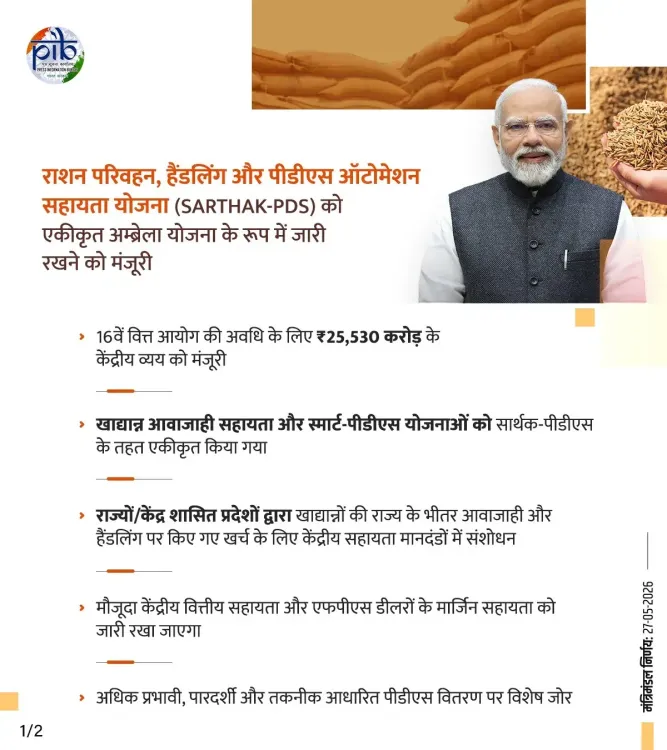
The Union Cabinet has approved SARTHAK-PDS, an integrated umbrella scheme worth ₹25,530 crore over five years, to strengthen and automate India's Public Distribution System. Union Agriculture Minister Shivraj Singh Chouhan announced the decision, calling it a step toward a technology-driven, transparent food distribution network.
Key Takeaways
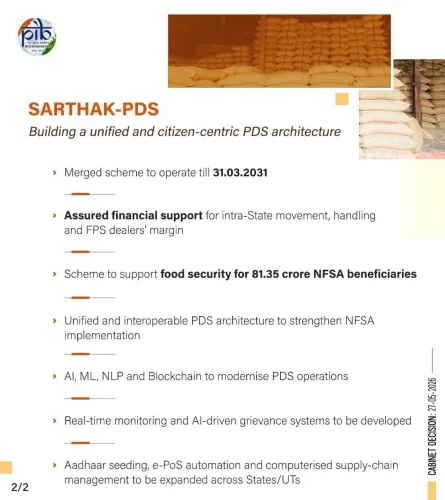
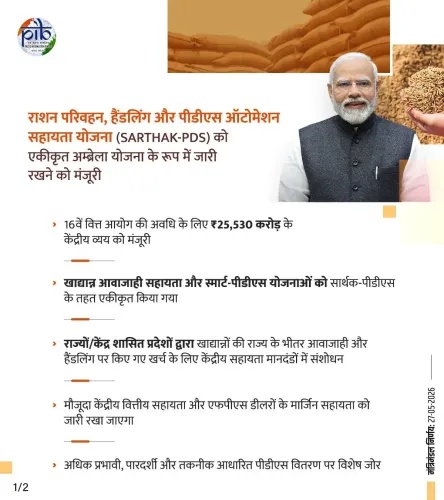
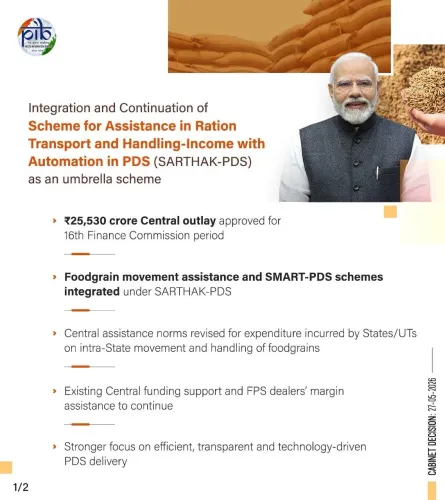
The Union Cabinet approved SARTHAK-PDS — Ration Transportation, Handling and PDS Automation Support Scheme — as an integrated umbrella scheme on 27 May 2026 .
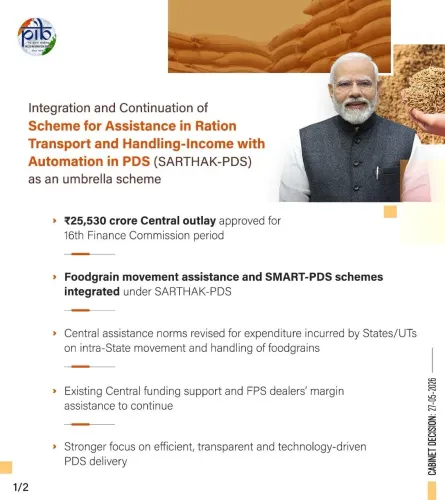
The scheme carries a total outlay of ₹25,530 crore spread over the next five years .
It consolidates support for ration transport, handling and digital automation of the Public Distribution System under a single funding window.
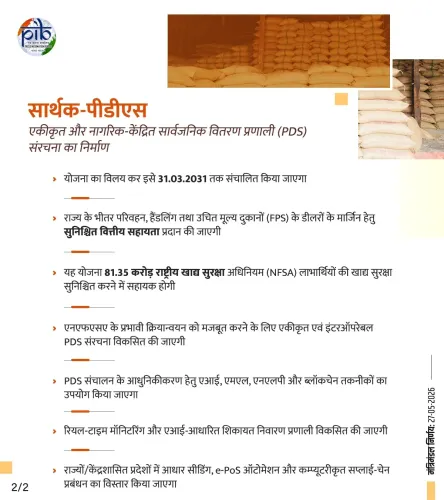
The scheme aims to build a technology-driven, transparent and modern PDS, extending reforms begun with End-to-End Computerisation in 2012 and Aadhaar-linked e-PoS rollout from 2014.
State governments and Union Territories are the implementing agencies; fair price shops and roughly 80 crore NFSA beneficiaries are the primary stakeholders.
Union Agriculture Minister Shivraj Singh Chouhan announced on Wednesday, 27 May 2026 that the Union Cabinet, under the leadership of Prime Minister Narendra Modi, has approved the continuation of the Ration Transportation, Handling and PDS Automation Support Scheme (SARTHAK-PDS) as an integrated umbrella scheme — committing ₹25,530 crore over the next five years to modernise India's food distribution network.
Context
Chouhan shared the Cabinet decision on X, writing that the scheme would 'देशभर में खाद्यान्न वितरण व्यवस्था को और सुदृढ़ करेगी' ('further strengthen the foodgrain distribution system across the country') and reinforce a technology-driven, transparent and modern Public Distribution System (PDS). The approval positions SARTHAK-PDS as a single consolidated umbrella replacing earlier fragmented support lines for ration transport, handling and digital infrastructure.
The Public Distribution System is India's largest food-security mechanism, operating under the National Food Security Act, 2013, which entitles up to 75 per cent of the rural population and 50 per cent of the urban population to subsidised foodgrains through a network of fair price shops.
Policy Backdrop
The approval builds on more than a decade of incremental reform. The End-to-End Computerisation of the Targeted Public Distribution System (TPDS), first approved in 2012, digitised ration cards, supply-chain records and fair price shop operations. From 2014 onward, Aadhaar seeding and biometric authentication at electronic Points of Sale (e-PoS) were scaled nationally to curb diversion of subsidised grain.
SARTHAK-PDS, as described by the minister, extends this trajectory by embedding automation support directly into transportation and handling logistics — the segments most vulnerable to leakage between godowns and the last-mile beneficiary. The scheme's umbrella structure is designed to give states a single, coherent funding window rather than multiple overlapping central grants.
Stakeholders and Impact
The scheme's primary beneficiaries are the estimated 80 crore individuals covered under the National Food Security Act who depend on the PDS for subsidised rice, wheat and coarse cereals. State governments and Union Territories will be the implementing agencies, responsible for deploying automation hardware and upgrading supply-chain software within their jurisdictions.
Fair price shop dealers — the final link in the distribution chain — stand to benefit from upgraded e-PoS infrastructure and streamlined logistics, potentially reducing delays and pilferages. The five-year horizon also gives state food departments a predictable funding envelope for multi-year capital expenditure on warehousing and IT systems.
What's Next
Attention will now shift to how quickly individual states publish rollout timelines for the automation hardware and whether the Centre sets measurable leakage-reduction benchmarks tied to fund disbursement. Parliamentary committees overseeing food and consumer affairs are likely to track mid-term performance metrics as the scheme moves from approval to implementation.
With ₹25,530 crore earmarked through 2031, SARTHAK-PDS represents one of the larger single-scheme outlays in food-security infrastructure in recent years — and its success will hinge on state-level execution capacity and the pace of last-mile technology adoption across India's diverse geography.
Point of View
Accountable funding architecture — a structural shift as much as a financial one. By anchoring the announcement to PM Modi's leadership, Agriculture Minister Chouhan reinforces the BJP's political messaging around welfare delivery efficiency ahead of state election cycles. The five-year, ₹25,530 crore commitment also insulates the programme from annual budget uncertainty, giving states room for multi-year capital planning. The real test, however, lies in whether automation targets translate into verifiable leakage reduction — a metric that has historically lagged behind scheme announcements.
NationPress
10 Oct 2026
Frequently Asked Questions
What is the SARTHAK-PDS scheme approved by the Cabinet?
SARTHAK-PDS stands for Ration Transportation, Handling and PDS Automation Support Scheme. The Union Cabinet approved it on 27 May 2026 as an integrated umbrella scheme with an outlay of ₹25,530 crore over five years to modernise and automate India's Public Distribution System.
How much money has been allocated for SARTHAK-PDS?
The Cabinet has approved a total outlay of ₹25,530 crore for the SARTHAK-PDS scheme, to be spent over the next five years.
Who will benefit from the SARTHAK-PDS scheme?
The primary beneficiaries are the approximately 80 crore individuals covered under the National Food Security Act who receive subsidised foodgrains through the PDS. State governments, Union Territories and fair price shop dealers are the key implementing stakeholders.
What does the PDS automation under SARTHAK-PDS involve?
The scheme focuses on technology-based upgrades to ration transportation, handling logistics and digital infrastructure at fair price shops, building on earlier reforms such as Aadhaar-linked biometric authentication and electronic Points of Sale (e-PoS) machines.
Who announced the SARTHAK-PDS Cabinet approval?
Union Agriculture Minister Shivraj Singh Chouhan announced the Cabinet decision on X, attributing the approval to Prime Minister Narendra Modi's leadership.