CM Fadnavis Welcomes Cabinet Nod for SARTHAK PDS Next Phase
Synopsis
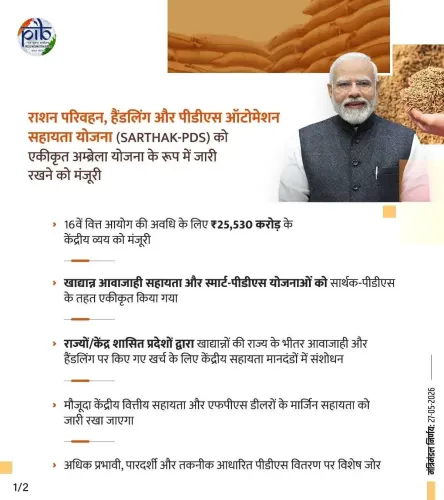
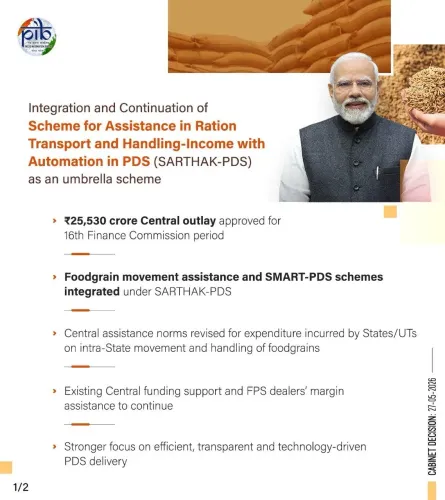
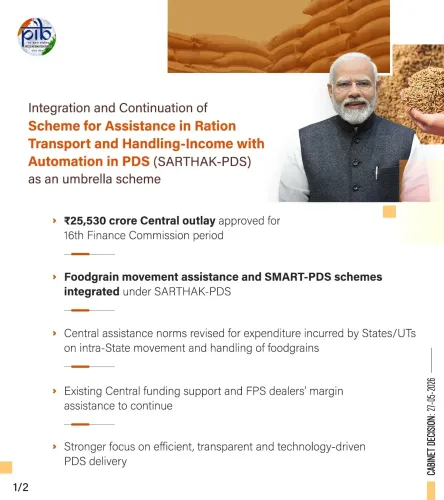
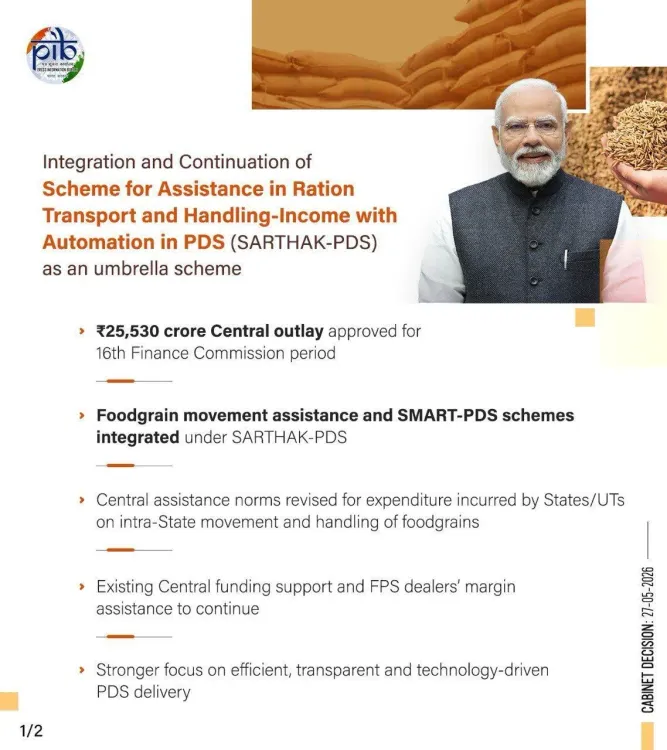
Maharashtra CM Devendra Fadnavis welcomed the Union Cabinet's approval of the next phase of SARTHAK PDS on 27 May 2026. Backed by ₹25,530 crore, the scheme will deploy AI, ML, NLP and blockchain to modernise India's Public Distribution System and improve food security for 81.35 crore citizens.
Key Takeaways
The Union Cabinet approved the next phase of SARTHAK PDS , welcomed by Maharashtra CM Devendra Fadnavis on 27 May 2026 .
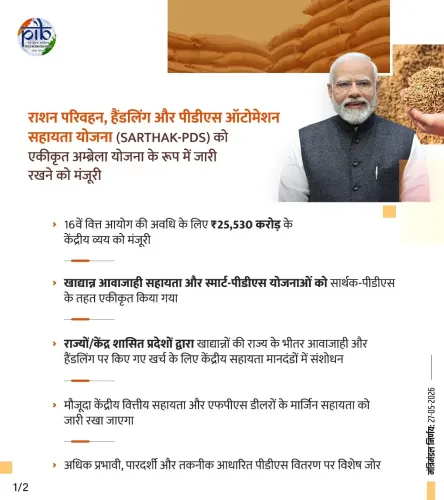
The scheme carries a central financial outlay of ₹25,530 crore .
It will cover 81.35 crore citizens under India's Public Distribution System .
Technologies deployed include Artificial Intelligence (AI) , Machine Learning (ML) , Natural Language Processing (NLP) , and blockchain .
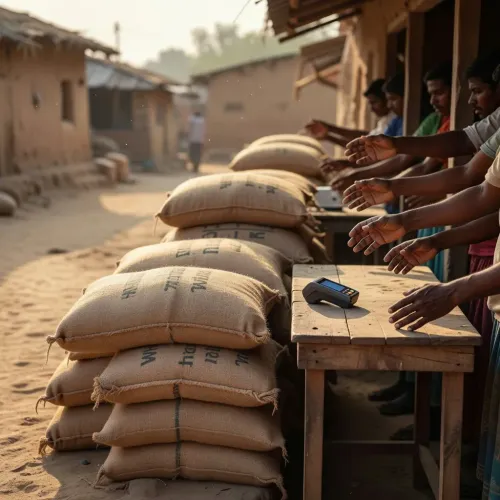
Key goals are strengthening intra-state food grain transport, empowering fair price shops , and modernising the overall PDS architecture.
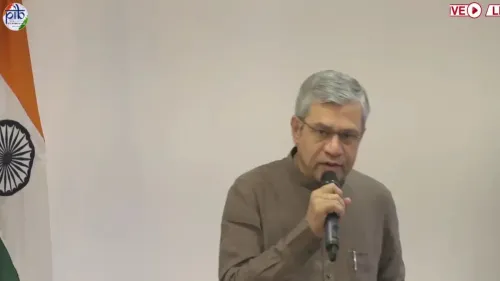
PM Narendra Modi and Union Minister Ashwini Vaishnaw were specifically thanked for facilitating the cabinet clearance.
Maharashtra Chief Minister Devendra Fadnavis on Wednesday, 27 May 2026 welcomed the Union Cabinet's approval of the next phase of the SARTHAK PDS scheme, thanking Prime Minister Narendra Modi and Union Minister Ashwini Vaishnaw for facilitating the clearance. The scheme, backed by a central outlay of ₹25,530 crore, aims to modernise India's Public Distribution System (PDS) and strengthen food security for 81.35 crore citizens.
Context
Posting in Marathi on X, CM Fadnavis expressed his gratitude — 'मनःपूर्वक आभार' (heartfelt thanks) — to the Prime Minister and the Union Minister for securing cabinet clearance. He highlighted that the scheme would enable more effective intra-state food grain transportation, empowerment of fair price shops, and a modernised public distribution architecture. The approval signals the federal government's continued commitment to technology-driven welfare delivery.
Policy Backdrop
India's PDS is the world's largest food security network, operating under the National Food Security Act, 2013, which provides statutory entitlement to subsidised food grains for approximately 67 per cent of the population. Progressive digitisation of PDS — including Aadhaar seeding of ration cards and computerisation of supply chains — has been underway since 2012 to curb leakages and improve targeting. SARTHAK PDS represents the next frontier in this trajectory, deploying Artificial Intelligence (AI), Machine Learning (ML), Natural Language Processing (NLP), and blockchain technology to make the system smarter and more transparent.
The scheme fits within the broader Digital India and e-governance push that has progressively integrated frontier technologies into entitlement-based social sector programmes. Central funding support to states for such technology upgrades has been a recurring feature of this policy pattern, and the ₹25,530 crore central provision continues that approach at scale.
Stakeholders and Impact
The primary beneficiaries are the 81.35 crore citizens currently covered under the PDS, who stand to receive better-quality food grains more efficiently. Fair price shop dealers and state food and civil supplies departments across the country will be empowered through upgraded infrastructure and real-time monitoring tools enabled by the new technologies. Reduced leakages and improved last-mile delivery are the two most direct gains anticipated for end beneficiaries.
For Maharashtra specifically, the scheme's focus on intra-state food grain transportation and fair price shop strengthening addresses longstanding logistical challenges in the state's vast and geographically diverse distribution network. The technology stack — particularly blockchain for supply-chain traceability — is expected to improve accountability at every node of the distribution chain.
What's Next
Attention will now shift to state-level rollout timelines, with Maharashtra among the key states whose implementation pace will be closely watched. Integration with the One Nation One Ration Card portability framework is a natural next step, given that both initiatives target the same beneficiary base and distribution infrastructure. Performance audits and utilisation certificates presented in state assemblies will be the first formal accountability checkpoints for the ₹25,530 crore outlay.
The SARTHAK PDS approval reinforces a clear policy direction: India's welfare delivery architecture is moving decisively toward technology-mediated, data-driven systems — and the pace of that shift is accelerating with each successive cabinet cycle.
Point of View
And it signals to the state's large PDS beneficiary base that food security infrastructure is being actively upgraded. The ₹25,530 crore outlay is substantial, but the real test will be in implementation fidelity at the fair price shop level, where systemic weaknesses have historically persisted. Politically, the cabinet nod gives the ruling coalition a concrete welfare deliverable to communicate ahead of any upcoming electoral cycle.
NationPress
11 Oct 2026
Frequently Asked Questions
What is SARTHAK PDS?
SARTHAK PDS is a central government scheme to modernise India's Public Distribution System using technologies such as AI, ML, NLP and blockchain, aimed at improving food grain delivery to 81.35 crore citizens more efficiently and transparently.
How much money has the government allocated for SARTHAK PDS?
The Union Cabinet has approved a central outlay of ₹25,530 crore for the next phase of the SARTHAK PDS scheme.
Why did CM Devendra Fadnavis thank PM Modi and Ashwini Vaishnaw?
CM Fadnavis thanked Prime Minister Narendra Modi and Union Minister Ashwini Vaishnaw for facilitating the Union Cabinet's approval of the next phase of the SARTHAK PDS scheme, which will benefit Maharashtra's PDS beneficiaries alongside the rest of the country.
How will SARTHAK PDS benefit common people?
The scheme aims to ensure that 81.35 crore PDS beneficiaries receive better-quality food grains more reliably, by using AI, blockchain and other technologies to reduce leakages, improve supply-chain transparency, and strengthen fair price shops.
What is the connection between SARTHAK PDS and One Nation One Ration Card?
Both SARTHAK PDS and the One Nation One Ration Card scheme target the same PDS beneficiary base and distribution infrastructure, making integration between the two a likely next step as rollout progresses across states.