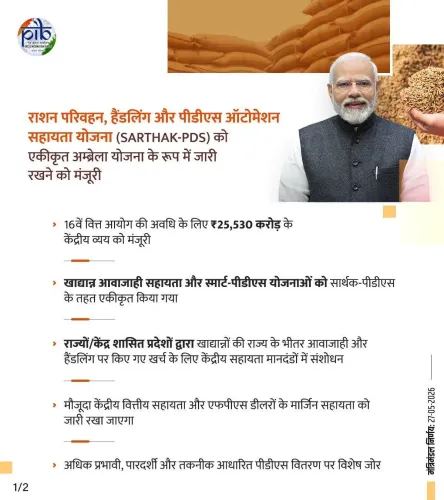
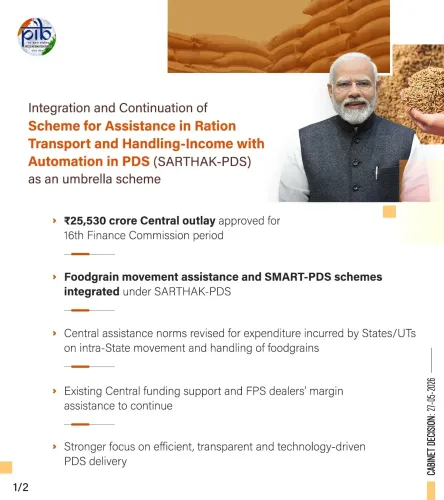
Amit Shah: Cabinet Clears ₹25,530 Cr for SARTHAK-PDS Phase-2
Synopsis
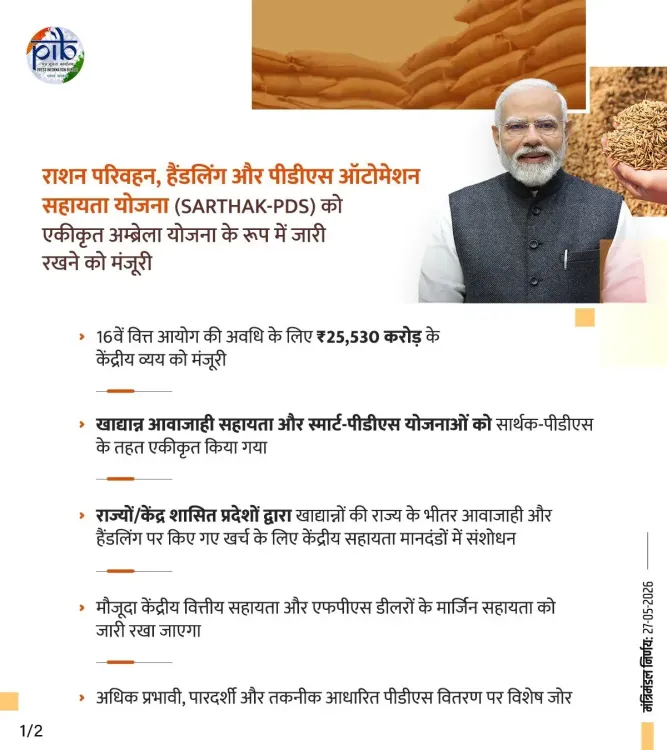
The Union Cabinet has cleared ₹25,530 crore for SARTHAK-PDS Phase-2, deploying AI-enabled beneficiary registries, GPS tracking and QR code tagging to eliminate leakages in India's subsidised food distribution network while boosting logistics support to states and raising fair price shop remuneration.
Key Takeaways
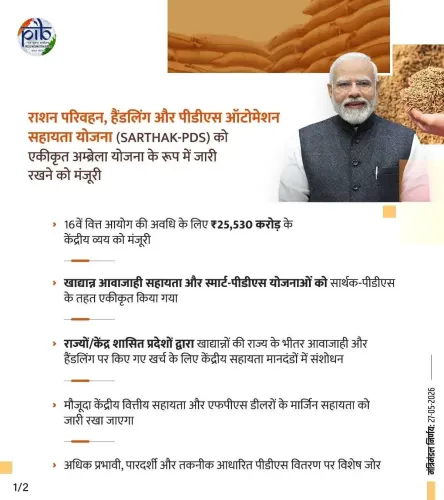
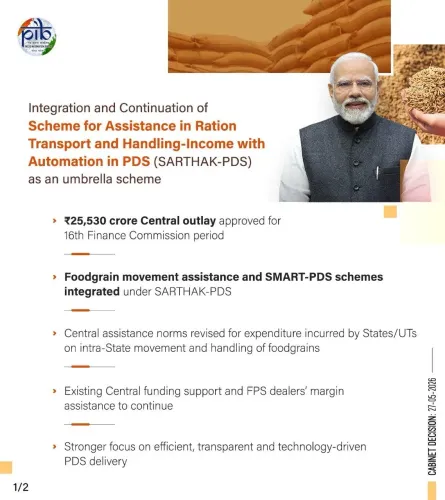
The Union Cabinet approved ₹25,530 crore for SARTHAK-PDS Phase-2 on 27 May 2026 .
AI-enabled beneficiary registries will be built to validate and update the list of eligible PDS recipients.
GPS tracking and QR code tagging will be deployed across the supply chain to prevent diversion of subsidised grain.
States will receive financial support to offset rising logistics costs in PDS operations.
Remuneration for fair price shop owners will be increased under the scheme.
The initiative builds on earlier reforms including Aadhaar seeding and One Nation One Ration Card portability launched since 2012.
Union Home Minister Amit Shah on Wednesday, 27 May 2026, announced that the Union Cabinet has approved ₹25,530 crore for SARTHAK-PDS Phase-2, a technology-driven overhaul of India's public food distribution network aimed at ensuring hundred-per-cent delivery of subsidised grain and welfare benefits to the poor.
Context
Posting on X, Shah stated that the Modi government is making pro-poor welfare schemes more transparent and accessible by equipping them with technology. He wrote: 'मोदी सरकार गरीब कल्याणकारी योजनाओं को टेक्नोलॉजी से लैस कर अधिक पारदर्शी और सुविधा संपन्न बना रही है' ('The Modi government is making welfare schemes for the poor more transparent and facility-rich by equipping them with technology').
The approved package introduces AI-enabled beneficiary registries, GPS tracking, and QR code tagging to ensure grain reaches eligible households without diversion. The announcement also includes financial support to states for rising logistics costs and an increase in the remuneration paid to fair price shop owners.
Policy Backdrop
India's Public Distribution System (PDS) operates under the National Food Security Act, 2013, which legally entitles up to 75 per cent of the rural population and 50 per cent of the urban population to highly subsidised wheat and rice. The system is executed through a nationwide network of licensed fair price shops that serve as the last-mile delivery point.
Efforts to plug leakages in the PDS date to the 2012 computerisation drive, followed by Aadhaar seeding of ration cards from the mid-2010s and the launch of One Nation One Ration Card portability in 2019, which allowed migrant workers to access their entitlements across state borders using biometric authentication. SARTHAK-PDS Phase-2 represents the next step in this two-decade-long digitisation arc, layering artificial intelligence and real-time logistics tracking onto the existing infrastructure.
Stakeholders and Impact
The three primary groups affected by the approval are eligible poor households, fair price shop dealers, and state food and civil supplies departments. For beneficiaries, the AI-enabled registry is designed to reduce exclusion errors — where genuine recipients are left out — while GPS and QR systems are meant to deter diversion of grain stocks before they reach the intended household.
Fair price shop owners, who have long flagged inadequate commissions as a viability concern, stand to benefit from the remuneration revision built into the package. State governments, which bear a significant share of PDS logistics expenses, will receive direct financial support to offset rising transport and storage costs — a provision that addresses a long-standing demand from several state administrations.
What's Next
Attention will now shift to state-wise rollout timelines and the operational framework for integrating AI-enabled registries with existing Aadhaar-linked ration card databases. The logistics support component will be closely watched to assess how funds are disbursed and whether they translate into measurable reductions in supply-chain losses.
Any revision to fair price shop commission rates in forthcoming state budget notifications will indicate how effectively the central outlay filters down to the dealer level. If implemented as announced, SARTHAK-PDS Phase-2 could set a template for technology-mediated welfare delivery that other large-scale central schemes may seek to replicate.
Point of View
GPS and QR systems onto the existing Aadhaar-linked PDS architecture, the Centre is doubling down on a technology-first approach to reducing leakages rather than structural reforms to procurement or dealer margins. The inclusion of logistics funding for states and a remuneration hike for fair price shop owners signals an attempt to build state-level buy-in, which has historically been the weakest link in central welfare rollouts. Whether the scheme delivers on its transparency promise will depend almost entirely on state capacity for implementation and the robustness of grievance mechanisms for excluded beneficiaries.
NationPress
10 Oct 2026
Frequently Asked Questions
What is SARTHAK-PDS Phase-2?
SARTHAK-PDS Phase-2 is a technology-driven upgrade to India's Public Distribution System, approved by the Union Cabinet with an outlay of ₹25,530 crore. It introduces AI-enabled beneficiary registries, GPS tracking of grain shipments, and QR code tagging at fair price shops to ensure subsidised food reaches eligible households without diversion.
How much money has been approved for SARTHAK-PDS Phase-2?
The Union Cabinet approved ₹25,530 crore for SARTHAK-PDS Phase-2 on 27 May 2026, as announced by Union Home Minister Amit Shah.
How will AI and GPS improve the ration system in India?
Under SARTHAK-PDS Phase-2, AI will be used to build and maintain accurate beneficiary registries, reducing both ghost entries and exclusion of genuine recipients. GPS tracking will monitor grain movement through the supply chain, while QR code tagging at fair price shops will create an auditable record of each transaction.
Will fair price shop owners get higher pay under the new PDS scheme?
Yes. The SARTHAK-PDS Phase-2 package includes a provision to increase the remuneration paid to fair price shop dealers, addressing a long-standing concern about the viability of running ration outlets on existing commission rates.
What is the One Nation One Ration Card scheme and how does it relate to this?
One Nation One Ration Card, launched in 2019, allows PDS beneficiaries — especially migrant workers — to access their subsidised grain entitlement at any fair price shop across India using biometric authentication. SARTHAK-PDS Phase-2 builds on this foundation by adding AI-based registry management and real-time logistics tracking to further reduce leakages.