CM Yogi Hails Rs 25,530 Cr SARTHAK-PDS Phase-2 Approval
Synopsis
The Union Cabinet chaired by PM Modi approved Rs 25,530 crore for SARTHAK-PDS Phase-2 on 27 May 2026. UP Chief Minister Yogi Adityanath hailed the decision as historic, saying AI-driven reforms will make food grain distribution more transparent and ensure dignified delivery to over 81 crore beneficiaries.
Key Takeaways
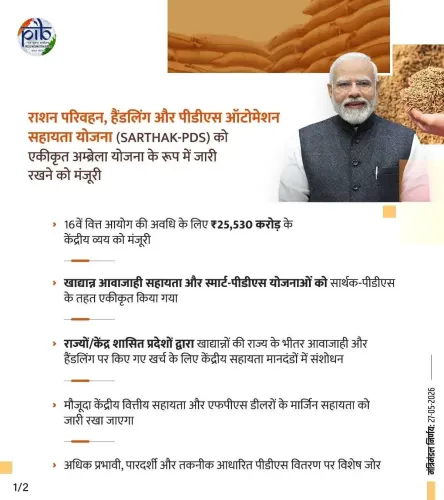
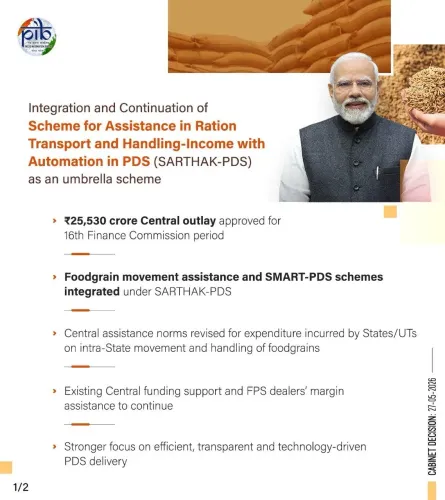
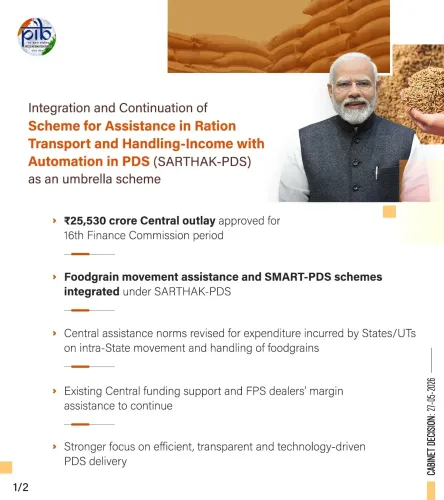
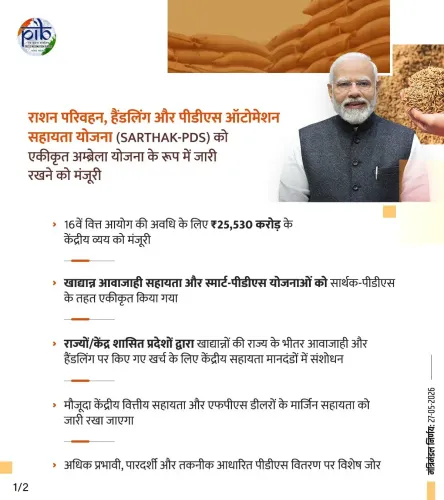
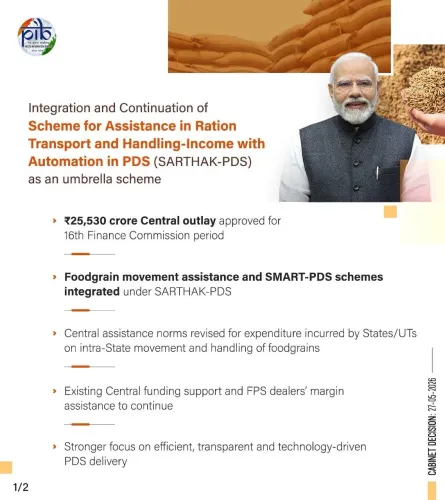
The Union Cabinet , chaired by PM Narendra Modi , approved ₹25,530 crore for SARTHAK-PDS Phase-2 on 27 May 2026 .
CM Yogi Adityanath described the decision as 'historic' and thanked PM Modi for the initiative.
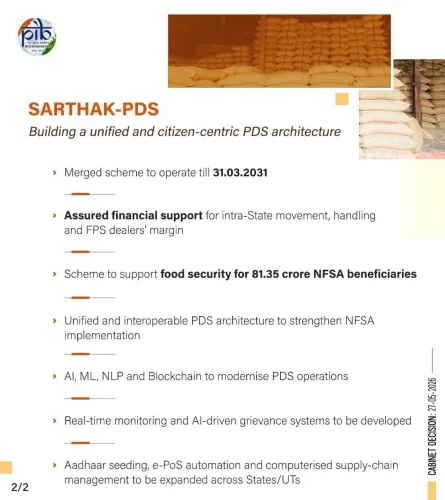
The scheme will integrate artificial intelligence and modern technologies into the Public Distribution System .
More than 81 crore citizens are expected to benefit from strengthened food security under the plan.
The move continues a policy trajectory of Aadhaar linkage , PDS computerisation , and Direct Benefit Transfer expansion since 2013–14 .
State-level rollout timelines and measurable reductions in PDS leakages will be key indicators of success.
Uttar Pradesh Chief Minister Yogi Adityanath on Wednesday, 27 May 2026 welcomed the Union Cabinet's approval of ₹25,530 crore for SARTHAK-PDS Phase-2, calling it a historic decision that will strengthen food security for more than 81 crore needy citizens across India. The cabinet meeting was chaired by Prime Minister Narendra Modi.
Context
Posting in Hindi on X, CM Yogi described the cabinet decision as 'ऐतिहासिक निर्णय' (a historic decision) that will further consolidate the food security of over 81 crore deserving citizens. He expressed gratitude to Prime Minister Modi, stating the move gives 'new energy to the resolve of delivering food with dignity to the person standing in the last row' — a phrase invoking the principle of last-mile welfare delivery.
The approved scheme, SARTHAK-PDS Phase-2, is designed to integrate artificial intelligence and modern technologies into the Public Distribution System (PDS), making it more transparent, accountable, and citizen-centric, according to the post.
Policy Backdrop
India's Public Distribution System is the world's largest food subsidy network, operating under the framework of the National Food Security Act (NFSA) enacted in 2013, which legally entitles over 80 crore people to subsidised food grains. The NFSA represented a landmark shift from welfare as discretionary policy to welfare as a legal right.
Since 2012, successive initiatives have sought to computerise PDS operations and link ration cards with Aadhaar biometric data to reduce leakages and improve targeting. The broader Direct Benefit Transfer (DBT) architecture, expanded significantly after 2014, forms the technological spine on which schemes like SARTHAK-PDS are built. Phase-2 represents a deepening of this trajectory by incorporating AI-driven tools for monitoring and accountability.
Stakeholders and Impact
The primary beneficiaries are the more than 81 crore individuals enrolled under the PDS — a population that spans urban and rural households across every state, with a significant share residing in Uttar Pradesh, India's most populous state. For these households, subsidised grains under the NFSA constitute a critical nutritional safety net.
State governments, including Uttar Pradesh, will be key implementation partners, responsible for integrating the new technology layer with existing ration card databases and fair-price shop networks. Improved AI-based monitoring is expected to reduce diversion of food grains and ensure allocations reach intended recipients more reliably.
What's Next
Attention will now shift to state-level rollout timelines and the pace at which SARTHAK-PDS Phase-2 infrastructure is integrated with existing beneficiary databases. Independent assessments of leakage reduction and last-mile delivery improvements will be closely watched as benchmarks for the scheme's effectiveness.
The ₹25,530 crore outlay signals sustained central commitment to technology-led welfare reform. Whether AI integration translates into measurable gains in PDS efficiency — particularly for the most marginalised beneficiaries — will determine the programme's long-term legacy.
Point of View
530 crore commitment to SARTHAK-PDS Phase-2 represents the most significant infusion into PDS modernisation in recent years, extending a decade-long arc of technology-led welfare reform. CM Yogi's public endorsement — framed in the language of dignity and last-mile delivery — aligns Uttar Pradesh's political messaging with the Centre's welfare-tech narrative ahead of what remains a politically sensitive electoral cycle. The AI integration angle is notable: it shifts the accountability debate from administrative discretion to algorithmic auditability, raising both the promise of reduced leakage and questions about digital exclusion among the most marginalised beneficiaries. Whether the scheme delivers on its transparency mandate will depend heavily on state-level execution, making Uttar Pradesh — with the largest PDS caseload — a critical test case.
NationPress
11 Oct 2026
Frequently Asked Questions
What is SARTHAK-PDS Phase-2?
SARTHAK-PDS Phase-2 is a centrally approved scheme that integrates artificial intelligence and modern technology into India's Public Distribution System to make food grain distribution more transparent, accountable, and efficient for over 81 crore beneficiaries.
How much money has been approved for SARTHAK-PDS Phase-2?
The Union Cabinet approved ₹25,530 crore for SARTHAK-PDS Phase-2 at a cabinet meeting chaired by Prime Minister Narendra Modi on 27 May 2026.
Who benefits from SARTHAK-PDS Phase-2?
More than 81 crore needy citizens enrolled under India's Public Distribution System — spanning urban and rural households across all states — are the primary beneficiaries of this scheme.
Why did CM Yogi Adityanath comment on SARTHAK-PDS Phase-2?
As Chief Minister of Uttar Pradesh — India's most populous state and one with a large PDS caseload — Yogi Adityanath welcomed the cabinet decision as a historic step toward ensuring dignified food delivery to every deserving citizen.
How does AI improve the Public Distribution System?
AI-based tools can monitor supply chains, flag irregularities, and verify beneficiary identification in real time, reducing diversion of food grains and improving last-mile delivery to entitled households.