Cabinet Approves SARTHAK-PDS Scheme, ₹25,530 Cr Outlay
Synopsis
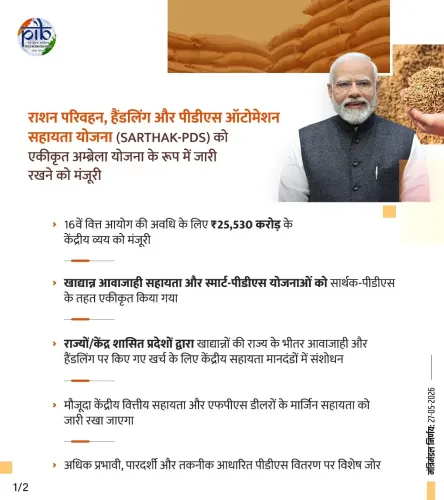
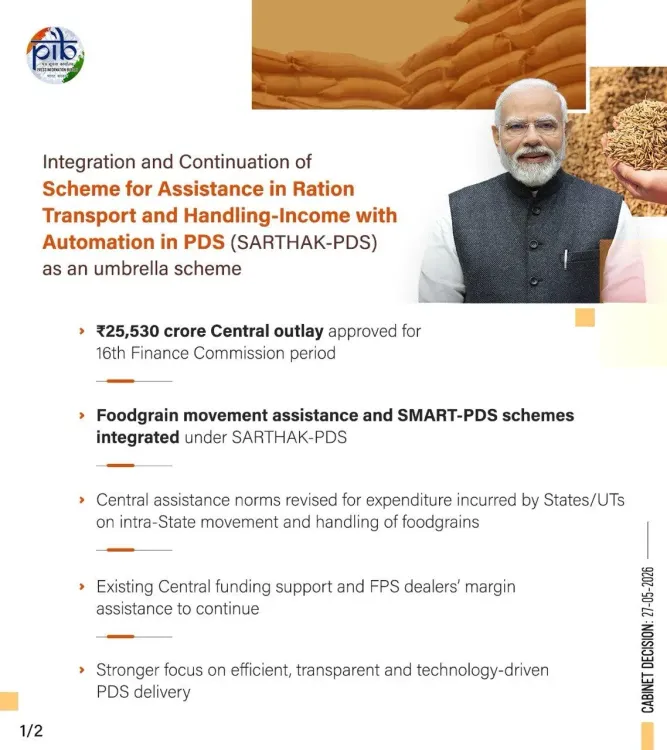
The Union Cabinet has approved SARTHAK-PDS as an umbrella scheme with a ₹25,530 crore outlay through 2031, integrating AI, Blockchain and Aadhaar-based tools to modernise food distribution for 81.35 crore NFSA beneficiaries across India.
Key Takeaways
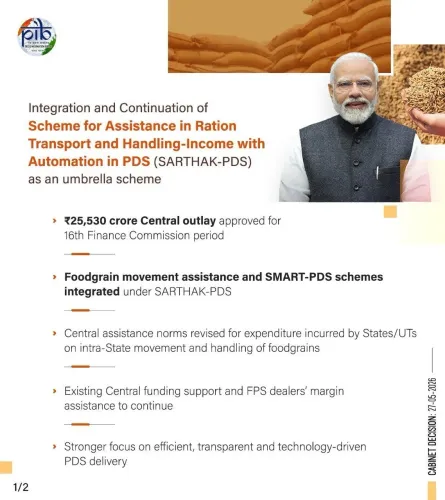
The Union Cabinet has approved SARTHAK-PDS as an umbrella scheme to unify and modernise India's Public Distribution System.
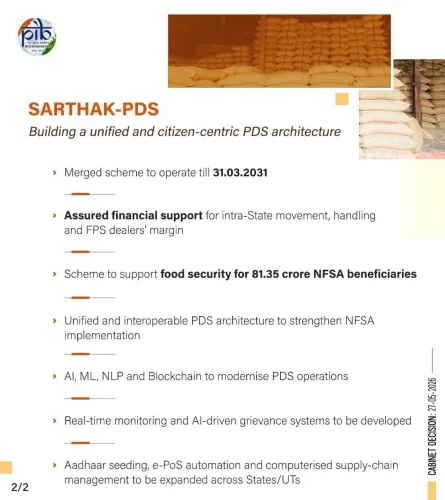
A central outlay of ₹25,530 crore has been sanctioned for the 16th Finance Commission period , with the scheme running until 31 March 2031 .
81.35 crore beneficiaries under the National Food Security Act will be covered by the scheme.
The scheme integrates SMART-PDS, Aadhaar seeding, e-PoS automation and AI, ML and Blockchain -based monitoring into a single framework.
State and UT governments and Fair Price Shop dealers will receive enhanced central support under the new structure.
Implementation timelines and first-tranche fund releases are expected in 2026-27 , with Parliament likely to receive mid-term leakage-reduction reports.
Union Education Minister Dharmendra Pradhan on Wednesday, 27 May 2026, announced that the Union Cabinet has approved the integration and continuation of SARTHAK-PDS as an umbrella scheme, marking what he described as a significant step toward building a unified, transparent and citizen-centric Public Distribution System under Prime Minister Narendra Modi.
Context
The Cabinet decision allocates a central outlay of ₹25,530 crore spanning the 16th Finance Commission period, with the scheme set to continue until 31 March 2031. The approval consolidates multiple PDS modernisation efforts under a single umbrella, aiming to serve 81.35 crore beneficiaries entitled to subsidised foodgrains under the National Food Security Act (NFSA).
Pradhan stated the scheme will 'strengthen food security for 81.35 crore NFSA beneficiaries through improved foodgrain movement, modernised supply-chain management and enhanced support for States/UTs and FPS dealers.'
Policy Backdrop
The National Food Security Act, enacted in 2013, converted existing welfare food programmes into legal entitlements covering up to 75 percent of the rural population and 50 percent of the urban population. End-to-end computerisation of the PDS was approved in 2012 and scaled up from 2015 onward, with the installation of electronic Point-of-Sale (e-PoS) devices and digitisation of beneficiary databases.
Aadhaar seeding and Direct Benefit Transfer pilots for foodgrains were launched in 2017-18 across multiple states to curb leakages and eliminate ghost beneficiaries. SARTHAK-PDS now absorbs the earlier SMART-PDS initiative, bringing Aadhaar authentication, e-PoS automation and grievance redressal under one policy framework aligned with the Finance Commission cycle.
This decision extends a decade-long shift — beginning under the Modi government in 2014 — from manual PDS operations toward fully digitised, Aadhaar-authenticated supply chains, mirroring technology adoptions already deployed in programmes such as MGNREGA and PM-KISAN.
Stakeholders and Impact
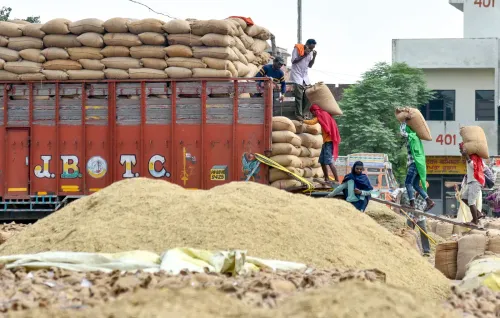
The scheme directly affects 81.35 crore NFSA beneficiaries, Fair Price Shop (FPS) dealers across the country, and State and Union Territory governments that operate last-mile distribution. The integration of Artificial Intelligence, Machine Learning and Blockchain technologies into monitoring and grievance systems is intended to reduce diversion of foodgrains and improve delivery efficiency.
FPS dealers stand to benefit from streamlined e-PoS processes and cleaner beneficiary data, while State governments are expected to receive enhanced central support for warehousing and logistics. The AI-driven monitoring layer is designed to flag supply-chain anomalies in near-real time, reducing the scope for systemic leakage that has historically afflicted PDS operations.
What's Next
Implementation will hinge on State-level agreements and the release of first-tranche funds in 2026-27. Parliament may see mid-term review reports on leakage-reduction metrics as the scheme matures. The linkage to the 16th Finance Commission cycle signals that food-security delivery will remain a structured fiscal commitment through 2031, embedding these digital reforms into long-term intergovernmental finance architecture.
With the technology stack — spanning Aadhaar seeding, AI, ML and Blockchain — now formally mandated under a Cabinet-approved umbrella, the government's ability to demonstrate measurable efficiency gains will be closely watched by States negotiating implementation timelines and by civil-society groups tracking hunger and nutrition outcomes.
Point of View
Folding a decade of piecemeal digital pilots into a single Finance Commission-linked mandate. Tying the outlay to the 16th Finance Commission cycle is a deliberate fiscal signal — it makes PDS modernisation a non-negotiable intergovernmental commitment rather than a scheme subject to annual budget discretion. The inclusion of Blockchain and AI-driven monitoring reflects the government's broader intent to shift welfare accountability from administrative audits to algorithmic oversight. Whether State governments, many of which have uneven digital infrastructure, can absorb and execute these mandates at scale will determine whether the efficiency gains remain on paper or translate into measurable reductions in leakage and hunger.
NationPress
16 Sept 2026
Frequently Asked Questions
What is SARTHAK-PDS?
SARTHAK-PDS is a Cabinet-approved umbrella scheme that consolidates India's Public Distribution System modernisation initiatives — including SMART-PDS, Aadhaar seeding and e-PoS automation — into a single, technology-driven framework aimed at improving transparency and last-mile food delivery.
How much money has been allocated for SARTHAK-PDS?
The Union Cabinet has approved a central outlay of ₹25,530 crore for the scheme, covering the 16th Finance Commission period with continuation until 31 March 2031.
How many people will benefit from the SARTHAK-PDS scheme?
The scheme is designed to serve 81.35 crore beneficiaries who are entitled to subsidised foodgrains under the National Food Security Act (NFSA).
What technologies will be used in the new PDS scheme?
SARTHAK-PDS will deploy Artificial Intelligence, Machine Learning and Blockchain for supply-chain monitoring and grievance redressal, alongside existing Aadhaar seeding and e-PoS authentication at Fair Price Shops.
What is the difference between SARTHAK-PDS and SMART-PDS?
SMART-PDS was an earlier central initiative focused on Aadhaar linkage and automation of Fair Price Shops; SARTHAK-PDS absorbs SMART-PDS and other modernisation programmes into a broader umbrella scheme with a larger outlay and a mandate extending to 2031.